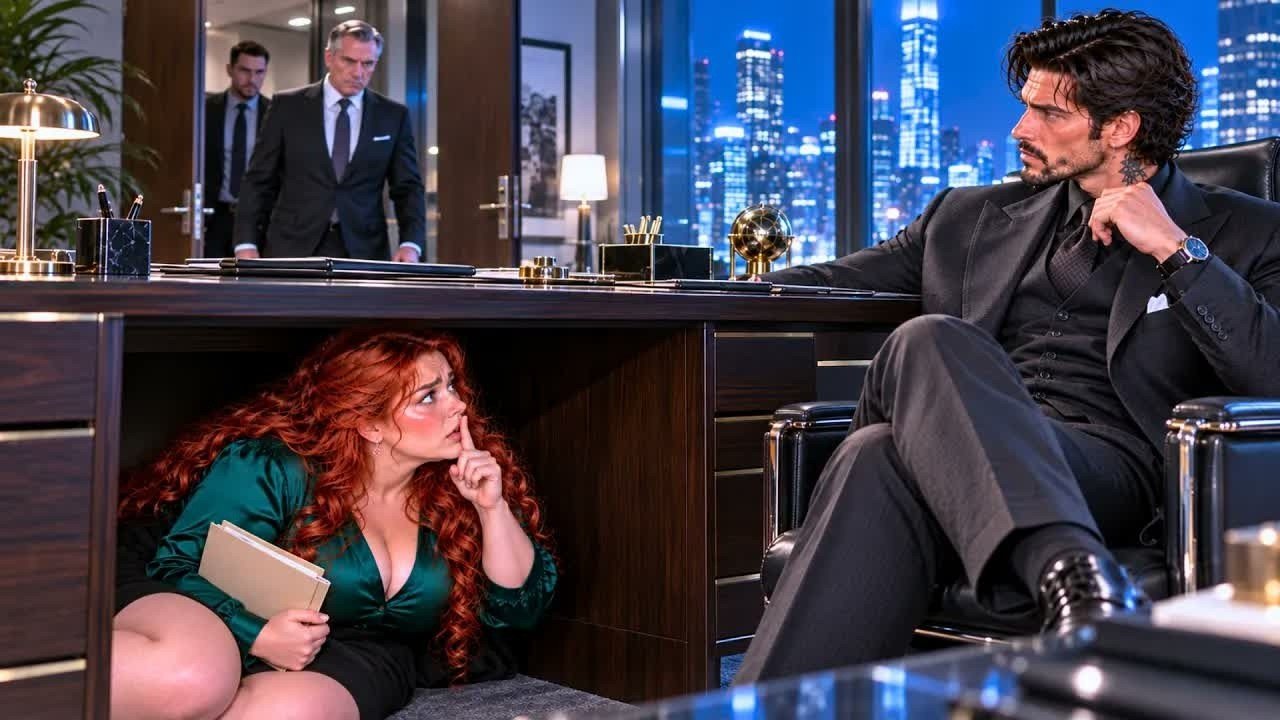
At 11:40 at night, on the thirty-first floor of a building she was not supposed to be in, Thea Bright folded herself into the dark beneath a stranger's desk and whispered the four words that would rearrange the rest of her life.
"Please, don't say I'm here."
To understand how a paralegal ends up hiding in the dark office of the most dangerous man in the city, you have to go back about nine minutes — to the fourteenth floor, and a photocopier, and a file that was never supposed to be opened by someone who could read.
Thea Bright was the best paralegal at Keyes and Adsley, which was a thing everyone knew and no one said.
Because saying it would have meant admitting that the firm ran on a woman whose name was on none of the doors.
She did the real work. The partners did the lunches.
For six years she had arrived first and left last, had built the files the partners took credit for, had found the cases and checked the citations and caught the errors that would have cost clients millions — and had been told at her last review by a managing partner who did not look up from his phone that she was "not really partner track material" and that she "should be grateful for the stability."
She had learned to be grateful.
She had learned to be quiet.
She had learned, most of all, to be invisible — because the one time in her life Thea Bright had not been quiet, it had cost her everything.
That was a different firm, four years ago, and a different file, and she had done the right thing. The loud thing. The thing you are supposed to do.
And she had been rewarded for it by being labeled difficult, and unstable, and a liability.
And she had spent eight months unemployed and blacklisted while the men she'd reported got promoted.
So when Thea Bright found the second file, she already knew exactly what doing the right thing cost.
She had not gone looking for it. That was the part she'd tell herself later, in the dark.
She'd been pulling an archived box for the Harwell matter — routine, a discovery request — and the box had a folder in it that didn't match the index. And she was a person constitutionally incapable of leaving a misfiled folder alone. And she'd opened it.
Inside was a safety memo from Harwell Industries.
Thea knew the Harwell file the way she knew all of them — completely.
Harwell made space heaters. One of them had a defect, a thermal cutoff that failed, and one of them had caught fire eighteen months ago in a small apartment, and a child had died — a little boy named Sammy Ferreira. And his mother had sued. And Keyes and Adsley, representing Harwell, had produced a safety memo proving that Harwell had not known about the defect until after the fire. And the case had collapsed — because you cannot win a wrongful death suit against a company that didn't know.
The memo in Thea's hand was that memo.
Except it was dated fourteen months before the fire.
And the one in the court file — the one that had crushed Rosa Ferreira and sent her home without her son and without a dollar — was dated two months after.
Same memo. Same words. Same signatures. Two different dates.
Thea stood in the file room at 11:30 at night and understood, with the cold, specific clarity of a woman who reads documents for a living, that someone at her firm had taken a memo proving Harwell knew their heaters could kill a child and changed the date, and buried the real one in a misindexed box, and used the fake to win.
She also understood, half a second later, that she was the only person alive outside the conspiracy who knew it.
And that was the exact moment Roland Keyes walked past the file room door.
Roland Keyes was the managing partner — a smooth silver man who had told her she was not partner material — and he stopped in the doorway, and he looked at the box, and he looked at the folder open in her hands, and he looked at her face. And Thea watched him do the arithmetic that she had just done in reverse.
"Thea," Keyes said, warm and terrible. "You're here late."
"Just finishing the Harwell discovery," Thea said — and her voice came out almost steady, which was a skill, a survival skill, the one she'd built four years ago. "I'll lock up."
"What's in the folder?" Keyes said.
"Misfile," Thea said. "I was about to re-index it."
Keyes held out his hand. "Let me see," he said.
And it was not a request.
And Thea Bright, who had learned exactly what happened to women who did the loud thing, did the only thing her body knew how to do when a powerful man reached for the truth in her hands.
She ran.
She did not plan it. She would never be able to explain it.
She simply put the folder against her chest and walked fast past him into the hall. And when he said her name, sharper, she walked faster. And when she heard him moving behind her, she took the fire stairs, and then she was in the elevator lobby, and an elevator was open, and she got in it and pressed a floor — any floor, a high one, because up felt safer than down — and the doors closed on Roland Keyes's face as he came around the corner with a second man, a broad, quiet man she'd seen in the building before and never liked, moving toward her fast.
The elevator went up.
It opened on thirty-one — a floor she had never been to, a floor that did not belong to the firm, a dim hush of dark wood and city lights.
And Thea stepped out into it because the doors had opened and she had nowhere else to be.
She moved through it on instinct, looking for a door, a closet, a dark corner — anywhere a woman could disappear, which was the one thing she was truly excellent at.
She found an office. The door was ajar. It was dark inside.
She slipped in and stood very still just inside the door and tried to make her breathing silent.
And only then, as her eyes adjusted, did she realize that the office was not empty.
There was a man sitting at the desk.
He was not working. There was no lamp on, no screen glowing.
He was simply sitting in the dark, in a charcoal suit, perfectly still. A large man with dark hair and a short beard, watching her with the mild, complete attention of a predator who has all the time in the world and no particular hunger at the moment.
Thea's heart stopped.
And then, out in the hall, she could hear the elevator again. Could hear the doors. Could hear Roland Keyes's voice saying her name in the tone of a man who has decided something.
The man at the desk read the whole situation in a single heartbeat and tipped his head a fraction toward the deep knee well beneath his desk.
And Thea Bright did the thing that would change everything.
She crossed the dark office on silent feet and folded herself into the space beneath his desk, still clutching her folder, and looked up at the dangerous stranger, and pressed one finger to her lips, and whispered the four words:
"Please don't say I'm here."
Dominic Volpe had been sitting in the dark of his own office because the dark was where he did his thinking.
And he had a great deal to think about — most of it concerning the fourteen floors below him, which he rented to a law firm he had spent a year learning to hate.
A woman had just run into his office and asked him to hide her.
He should have been annoyed.
He was not a man people hid behind. He was the thing people hid from.
In thirty years, no one had ever come to Dominic Volpe for cover. They came for power, or for mercy, or for permission. And every one of them was afraid.
And the fear was so constant that he had stopped noticing it, the way you stop noticing your own pulse.
This woman was afraid — but not of him.
She was afraid of whatever was in the hall. And she had looked at him, the most dangerous man in the city, and seen not a threat, but a shelter. And asked him to keep a secret for her, for nothing, with nothing to offer, trusting him on no evidence at all except that he was large and quiet and there.
It was the strangest thing that had happened to him in years.
He put one finger to his own lips, mirroring her, and pushed his chair back a few inches to give her more room, and turned unhurried to face the door, and waited.
Roland Keyes appeared in the doorway thirty seconds later.
He did not come in. One did not simply come into this office — a fact Keyes knew in his body, even if he could not have said why.
He stood in the doorway, and he was breathing a little hard, and he peered into the dark and found the large, still shape of the man at the desk.
"Mr. Volpe," Keyes said — and his voice had changed completely, had gone smooth and careful and deferential, the voice of a tenant addressing a landlord he is afraid of. "I'm so sorry. I didn't realize you were— I'm looking for one of my people. A paralegal. Dark red hair. She ran up here. I think she's confused. She's been under a lot of— She's not well. Have you seen her?"
Under the desk, Thea went very still.
Dominic Volpe looked at Roland Keyes for a long, unhurried moment.
"No," he said.
That was all. One word.
He did not elaborate, and he did not invite follow-up, and the single syllable landed in the room with the weight of a closed vault.
Keyes hovered. "She may have come up here. She's— It's important I find her. She has some firm property that I—"
"No," Dominic said.
And he still had not raised his voice, and he never would.
And Roland Keyes felt the temperature of the room drop and remembered, abruptly, that there were floors in this building you did not linger on.
And he apologized again. Twice. And withdrew.
And Thea heard his footsteps retreat into the elevator, and then nothing.
For a full minute, neither of them moved.
Then Dominic Volpe looked down into the knee well of his own desk at the curvy woman folded beneath it, clutching a folder to her chest, and said the first thing he had said to her.
"You can come out now. He's gone."
Thea did not come out.
"I'm good," she whispered. "I'm comfortable. This is a very nice desk. I'll just— I think I'll live here now."
She came out eventually.
She unfolded herself from beneath the desk with as much dignity as the situation allowed, which was none, and she stood in the back office holding her folder, and she looked at the large man who had just lied to Roland Keyes for her, for no reason she could identify, and she tried to assemble a sentence.
"Thank you," she managed. "I don't— Thank you. I'm not unwell. He said I was unwell. I'm not. I'm extremely well. I just found something I wasn't supposed to find, and I made the catastrophic mistake of letting him see my face while I was still thinking about it, which, as a professional who handles sensitive information, I want you to know is not a mistake I usually make."
"Sit down," Dominic said. "You're shaking."
"I'm fine."
"You're shaking, and you're going to keep talking until you fall down," Dominic said. "I've seen it before. Sit. I'll get you water."
And Thea Bright, who had not sat down in front of a powerful man in six years without being told exactly where and how, sat down and watched the stranger pour her a glass of water from a crystal decanter and hand it to her.
And she drank it, and her hand shook less.
"Who are you?" she said.
"I own the building," Dominic said.
"That's not what I asked."
"No," he agreed, "it isn't."
And Thea Bright, paralegal — who read documents for a living and people for survival — looked around the dark office in the thin city light at the absence of a computer, at the single phone on the desk, at the way two men were visible now in the hall outside, standing, waiting, not chatting — at the quality of the stillness in the room. And she did the thing she was best at, which was assemble small facts into a true and unwelcome picture.
"Volpe," she said slowly. "The building's the Volpe Building. The lease is held by Volpe Holdings. I've seen the entity in a hundred documents and never once thought about the human it's named after."
She looked at him. "You're him. You're the Volpe. The one the senior partners lower their voices about. The one Keyes just apologized to twice."
She set the water down. "I hid from a man who forges court documents by running into the office of a man that the men who forge court documents are afraid of."
"I'd have phrased it with more flattery," Dominic said, "but yes."
Thea closed her eyes. "Of course," she said. "Of course that's where I ran. That's so exactly my luck that I can't even be surprised. I spent four years learning to hide in the quietest, smallest, safest corner of any room, and the one time it actually matters, I hid in the single most dangerous square foot in the city."
"You seem calm, for someone who's just worked that out," Dominic observed.
Thea let out a breath that was almost a laugh. "Here's a thing you learn," she said. "When you've already lost everything once for seeing something you shouldn't have — after that, the dangerous men stop being the scariest thing in the room. The scariest thing in the room is the document. You can hide from a man. You can't hide from what you know."
She looked at the folder in her lap. "I'm not afraid of you, Mr. Volpe. I don't have the capacity left over. I used it all up being afraid of this."
And Dominic Volpe, who had spent his entire life being the most frightening thing in every room he entered, looked at a woman who had just told him, honestly, that she was too busy being afraid of a piece of paper to be afraid of him — and felt something he had no name for, because no one had ever, in his memory, found something more dangerous than him and meant it as a compliment to the paper.
"What's in the folder?" he said.
And this time it was not Roland Keyes's question. This time it was quiet, and it was real.
And Thea Bright looked at the man who had hidden her, and made a decision that was either the best or the worst of her life — and which, like most of her decisions that night, turned out to be both.
She told him.
She told him about Harwell and the space heater and the thermal cutoff that failed.
She told him about a fire eighteen months ago and a child named Sammy Ferreira and a mother who sued.
She told him about the safety memo — the one that proved Harwell didn't know, the one that won the case and sent Rosa Ferreira home with nothing.
And then she took the folder, and she opened it, and she showed him the same memo, word for word, signature for signature, dated fourteen months earlier.
"They knew," Thea said. "Harwell knew their heaters could do this fourteen months before Sammy Ferreira died. Keyes and Adsley had the memo that proved it, and instead of handing it over in discovery, somebody changed the date on a copy, buried the real one in a mis-indexed box, and produced the fake. They didn't just lose that little boy's case, Mr. Volpe. They forged the evidence that lost it on purpose. To protect a client who makes things that kill children."
Dominic Volpe did not move for a long moment.
When he spoke, his voice had changed — had gone quiet in a new way. A way that would have frightened Roland Keyes very much.
"Say the name again," he said. "The mother."
"Rosa," Thea said. "Rosa Ferreira."
And Dominic Volpe stood up and walked to the window and looked out at the city.
And Thea watched the stillest man she'd ever met go very, very still in a different register.
And she understood that she had just said a name that meant something to him.
"You know her," Thea said.
"She cleans this building," Dominic said to the window. "Six nights a week. She's cleaned this floor for eleven years. She cleaned it the week after her son died because she couldn't afford not to. And I know that because I was sitting in this chair in the dark like I am most nights. And she came in with her cart, not knowing I was here. And she got halfway across the floor before she sat down on the ground and cried in a way I have never heard a human being cry. And then she got up and finished the floor. Because that's what people like Rosa do."
He turned around. "I tried to help her quietly, the way I help people. And when I looked into what happened to her boy, every document said the same thing. Harwell didn't know. The case was clean. The company was tragically blameless. And I couldn't prove otherwise, because the proof had been destroyed by professionals. And in a year of looking, I never found it."
He looked at the folder in her hands. "You found it in a mis-indexed box in nine minutes."
"I'm very good at my job," Thea said quietly. "It's the only thing about me that's ever been true."
It took three days for the trap to close.
And it closed the way these things actually close — which is not with a gun, but with metadata, and a chain of custody, and a woman who knew exactly where the bodies were filed.
Because here is what Thea Bright understood that Dominic Volpe, for all his power, did not.
He could make men afraid. He could move money and move people and make problems disappear. But he could not make a forged document unforge itself. And he could not make a court believe a crime boss over a white-shoe law firm. And if he simply took the folder — the folder and the folder alone — to the authorities, Keyes would say it was a fabrication. A plant. A disgruntled employee. A misdated draft. And it would become one man's word against a firm's. And firms win those.
"Paper beats power," Thea said in his office the next night, spreading documents across his desk in a way that made Toby, Dominic's right hand, visibly anxious about the sanctity of the furniture. "That's the thing nobody with power ever believes until it's too late. You can't just hand a judge the real memo. Keyes will say I made it. I'm a paralegal with a grievance who ran through the building like a crazy person. He's already building that story. He called me unwell to your face. We don't need the memo, Mr. Volpe. We need to prove the memo in the court file is the fake. And forgery leaves a trail. It always leaves a trail. People who change documents never understand that the document remembers."
"Explain," Dominic said.
He was, Thea was learning, a man who said explain the way other men said more. Who had an appetite for competence that she found, against every instinct, deeply disarming — because no one at Keyes and Adsley had ever once asked her to explain. They'd asked her to finish.
"The real memo is dated fourteen months before the fire," Thea said. "The court copy is dated two months after. But a date on a page is just ink. What matters is the metadata. The court copy was produced from a digital file. That file has properties. Created date. Modified date. Author. Every time someone opens a document and changes it and saves it, the file writes down that they did — in a place most people don't know how to look."
She tapped a printout. "I pulled the properties on the court-filed PDF before I ran. The document was created the morning before it was produced in discovery. Eight months after Harwell swears it was written. You can forge a date you type. You can't forge the date the file was born. And the file was born the day they made the fake."
"And the real one," Dominic said.
"Is on paper, in that box, with a real contemporaneous date stamp from Harwell's own mailroom — which they stamped fourteen months before the fire and never thought about again," Thea said. "Two documents. One says it was written before. The other was born the morning they needed it. Put them side by side in front of a judge with the metadata, and there's no story Keyes can tell. The paper tells it for him."
Dominic looked at the array of documents on his desk, and then at the woman arranging them, who had stopped shaking entirely. Who had, in fact, come completely alive. The way a person does when they are finally allowed to be the thing they actually are.
"You're not afraid anymore," he said.
"Not of this part," Thea said. "This part I'm good at. It's the next part I'm afraid of."
"What's the next part?"
"The part where I come forward," Thea said, and her hands went still on the paper. "Because that's how this works, Mr. Volpe. The documents don't walk into court by themselves. Someone has to produce them. Someone has to sign the affidavit and sit in the deposition and say under oath, 'I found this. Here's where. Here's how.' And the someone is me. A paralegal against the firm that employs me, and a client with unlimited money, and a managing partner who's already told one powerful man I'm unwell."
She looked up. "I did this once before. Four years ago. Different file, different crime, same choice. I came forward. I did the loud, right, brave thing. And they didn't go to prison, Mr. Volpe. I did. Not literally. But I lost my job, my references, my savings, eight months of my life, my belief that doing the right thing protects you. They called me difficult and unstable, and they were believed — because they had suits, and I had a box of files and the truth. And it turns out the truth is the weakest thing in the room if you're the only one holding it."
She let out a breath. "So forgive me if the metadata is the easy part. I know exactly what comes next. I've paid for it before."
And Dominic Volpe understood then the real shape of the woman in front of him.
She was not a coward. She had run from Keyes not because she was weak, but because she was experienced. Because she had learned, at enormous cost, the precise price of being seen doing the right thing — and had rationally, reasonably decided that invisibility was the only armor a person like her could afford.
"Don't say I'm here."
It was not a plea from that one night. It was the organizing principle of her entire life.
"Come here," Dominic said. "I want to show you something."
He took her to the window — the wide, dark window that looked down over the city — and he pointed, not at anything grand, but down at the street, at the small figures moving under the lights.
"Rosa Ferreira is down there somewhere," he said, "walking to a bus. She buried her son on the strength of a document a man invented in a morning. You spent four years learning that doing the right thing costs everything. You learned it correctly. It does. I'm not going to lie to you and tell you it's safe."
He turned to her. "But I want to tell you the one thing those men four years ago didn't have, and Rosa didn't have, and you've never had. You were always holding the truth alone. That's why you lost. The truth isn't weak. The truth is just heavy. And they made sure you were the only one carrying it — because one person carrying the truth can be called unstable and crushed."
He looked at her. "You're not alone this time. I'm not a suit. I can't give you a better affidavit than Keyes's lawyers. But I can make very sure that the right people are in the room. That the deposition happens somewhere he can't make it quietly disappear. That no one touches you. And that for once in your life, the person holding the truth has the most dangerous man in the city standing behind her while she holds it."
He paused. "You don't have to disappear anymore. You have to do the opposite. And you won't do it alone."
Thea Bright looked at him for a long moment.
"Why?" she said. "Why do you care? Really? Not the Rosa part. I believe the Rosa part. The me part. Why are you standing a thing like you behind a thing like me?"
Dominic was quiet for a moment.
"Because in thirty years," he said, "no one has ever done what you did three nights ago. You found something that could cost you everything, and your first instinct wasn't to sell it, or trade it, or use it. It was to protect it. To get it somewhere safe. Even if that somewhere was under a stranger's desk. I have spent my entire life around people who see a valuable thing and calculate what it's worth to them. You saw a dead child's justice, and your whole body tried to carry it to safety."
He looked at her. "I didn't know people like that were real. I thought integrity was a story powerful people told to keep the powerless in line. And then one walked into my office in the dark and asked me to hide her. And I've spent three days discovering that the most dangerous thing I've ever been near is not a weapon, or a rival, or a threat. It's a woman who does the right thing even when it's already broken her once. I don't have that. I've never had it. I'd like to stand next to it just once, and see what it costs, and help pay."
Roland Keyes, of course, did not wait quietly to be exposed.
Men like Keyes never do.
They move first, and they move the only way they know how — which is to make the person holding the truth into the problem.
By the next morning, Thea Bright was locked out of the firm's systems, her key card dead, and an email had gone to every partner informing them that a paralegal had been terminated for cause after being discovered removing privileged client files from the premises, and that any contact from her should be reported, as the matter was under investigation and possible criminal referral.
She found out standing in the lobby, her card refusing the turnstile, the security guard who'd nodded at her for six years now unable to meet her eyes.
"It's the same play," she told Dominic in his office, and she was shaking again — the old shake, the four-years-ago shake. "Beat for beat. They make me the thief. They make me the unstable one who stole files. By the time I say forgery, I'm a disgruntled criminal ex-employee with a motive to fabricate, and the real memo becomes something I planted. I've seen this movie. I know how it ends. It ends with me."
"Not this time," Dominic said.
"You don't understand. It always—"
"Thea," Dominic said, "look at me. The last time you ran this play alone. And they beat you, because a single person with the truth is a story anyone can rewrite. You are not a single person anymore. Let me show you the difference power actually makes when it's used correctly — which is almost never."
He did not threaten anyone.
That was the thing Thea would remember — the thing that rearranged her understanding of what the man was.
He made a few calls.
He made certain the removed privileged files in question were, in fact, already in the hands of the State Bar's Disciplinary Council — logged and dated — so that the firm's own email became a documented admission that the evidence existed, and that the firm was trying to suppress it.
He made certain that a copy of everything lived in three places Keyes could not reach.
And he put Thea somewhere Roland Keyes and his associates could not get to her. Which turned out to be a very quiet apartment four floors below his office, with a view, and a lock, and a man named Toby stationed in the hall who took the assignment with the grim dedication of a soldier guarding a vault.
Toby did not know what to make of Thea.
"Can I get you anything, Ms. Bright?" Toby asked on the first evening, standing in the doorway like a wardrobe that had learned to speak.
"I'm okay," Thea said. "Thank you, Toby. You don't have to stand out there. I'm just going to work. I work when I'm scared. It's a whole thing."
Toby considered this.
"The boss works when he's scared, too. Not that he gets scared."
He paused, recalibrating a loyalty.
"He hasn't worked this much in years is the thing. Since you. He used to sit in the dark. Now there's—" he gestured vaguely at the papers she'd spread across every surface. "This. Files. He asked me yesterday what a chain of custody was. Nine years I've known him. He never once asked me what anything was. He tells. He doesn't ask."
Toby frowned at the floor. "I don't have a protocol for you, Ms. Bright. I want that on the record."
"That's okay," Thea said gently. "Nobody does. I've looked. There isn't one."
Dominic came down most nights, and they worked — because the deposition was coming, and the case had to be airtight.
And Thea discovered that the most dangerous man in the city was, in the specific matter of document review, almost unbearable to work with — because he could not sit still, and he could not wait, and he treated every form as a negotiation he intended to win.
"You can't argue with the metadata, Dominic," she told him for the third time, at one in the morning, both of them surrounded by paper. "It isn't a person. You can't outstare it. It says what it says."
"I'm not arguing with it," he said. "I'm reviewing it."
"You're glaring at it. You've been glaring at the same timestamp for ten minutes like it owes you money."
"It's inconsistent with the mailroom stamp by four hours," he said. "I want to know why before Keyes does."
And Thea looked up, surprised, because he was right.
There was a four-hour gap. A small one. The kind of thing only two kinds of people notice — the kind who forge documents and the kind who catch them. And she'd missed it. And he hadn't.
"Huh," she said. "The time zone. The mailroom stamp's Eastern. The file's on a server set to Central. That's the four hours. It's not a problem. It's a fingerprint. It actually helps us."
She stared at him. "You found that. You've been doing this for three days, and you found a thing I missed."
"I had a good teacher," Dominic said. "She's very strict. She confiscated my pen for annotating in the margins."
"You were annotating evidence in pen," Thea said. "I'd confiscate it again."
"I'd confiscate it from a judge."
And Dominic Volpe, the most feared man in the city, looked faintly, genuinely wounded about the pen.
And Thea Bright laughed — a real one — at one in the morning, in a safe apartment, with the truth spread out around them. And realized, with a small interior lurch, that she had not laughed in approximately four years.
And that the man who'd caused it was watching her do it like a person watching something they'd only ever read about.
"Why are you really doing this?" she said, when the laugh had faded. "The hours. The teaching. The pen. You could have just handed the folder to your bar council contact and been done. You didn't need to learn chain of custody. Why did you?"
Dominic was quiet for a moment.
"Because you were going to do this alone again," he said. "You'd made up your mind. I could see it. You were going to walk into that deposition and hold the truth by yourself, the way you did four years ago — because you don't know how to do it any other way, because no one has ever once stood with you. And I couldn't make the fear go away for you. But I thought if I learned it — all of it, the metadata and the custody and the time zones — then at least when you stood up in that room, you'd know that somebody else in the world understood exactly what you were holding. That you weren't the only one who could see it anymore."
He looked at her. "The thing that crushed you last time wasn't the men. It was the aloneness. I can't take the danger away. But I can take the alone. That's the only thing I've ever actually been good at giving people. And I've spent thirty years giving them the opposite."
Thea Bright looked at him across a table covered in a dead boy's justice and did not say anything for a long moment, because the true thing had gotten much too big for her mouth.
It ended in a deposition room — which is the least dramatic room in the world, and that week the most.
Dominic Volpe could not make a court believe a crime boss. But he could make certain things true that had not been true four years ago, when Thea stood alone.
He made certain the matter reached a lawyer who could not be bought — a sharp, humorless woman from the State Bar's Disciplinary Council who had been quietly looking at Keyes and Adsley for other reasons, and who received, through channels that were never explained to her, a very good anonymous tip about a mis-indexed box.
He made certain that when Thea produced the documents, she did it in a room with a court reporter, a disciplinary investigator, and opposing counsel all present at once — so that nothing could vanish between the finding and the filing.
And he made certain, in ways that involved no violence and a great deal of quiet money and the simple, immovable fact of men standing in hallways, that Roland Keyes understood he was not going to be able to make this one go away the way he made things go away.
And then he stepped back and let her do it.
Thea Bright sat at the deposition table — a paralegal with no name on any door — across from Roland Keyes and two of his lawyers, and she laid the two memos side by side.
"This is the safety memo Harwell Industries produced in the Ferreira matter," she said, and her voice did not shake, which still surprised her, because the old reflex kept reaching for the fear and finding, for the first time in four years, that someone had already carried it for her. "Dated two months after the fire. This is the same memo, retrieved from archive box 114C, dated fourteen months before the fire, with a contemporaneous Harwell mailroom stamp. And this is the metadata report on the court-filed copy, showing the digital file was created at 9:40 on the morning of March 9th — the day before it was produced, eight months after it claims to have been written."
She looked up at Keyes. "The memo didn't exist in that form until someone needed it to. Harwell knew about the defect fourteen months before Sammy Ferreira died. Your firm had the proof. And someone changed the date and buried the original to win."
"You're a disgruntled employee," Keyes said — but his voice had the wrong texture. The texture of a man reading a line he no longer believes. "This is a fabrication. You have a history of instability."
"I have a history of being right and being called unstable for it," Thea said. "I'm aware of how that story goes. I've lived it. But here's the difference between four years ago and tonight, Mr. Keyes."
She did not look at the back of the room, where Dominic Volpe stood against the wall. But she felt him there — the way you feel a load lift from a thing you've carried so long you'd forgotten it had weight.
"Four years ago, I was the only one holding the truth, so you could call me crazy and make it true. Tonight, there's a court reporter, and disciplinary counsel, and a box with an index that doesn't match, and a file that remembers the exact morning you made it. I'm not holding it alone anymore. So you can't make me the crazy one. You can only be the forger. Those are the two jobs left in this room, and you've already got yours."
One of Keyes's lawyers tried — because that is what they are paid to do.
"Ms. Bright," he said smoothly, "isn't it true you were terminated for cause for removing these very files? A terminated employee with a grievance has every reason to—"
"To do what?" Thea said. "To correctly report the creation date of a PDF, Counselor? I didn't make the metadata. Microsoft did. I didn't stamp the mailroom date fourteen months before the fire. Harwell's own mailroom did — and then forgot about it, which is the only reason it survived. You can fire me for cause. You can fire me for spite. You can put it in an email to every partner in the building — which, by the way, you did, and which disciplinary counsel now has, and which reads a great deal like a firm trying to suppress evidence it has just admitted exists."
She slid the email across the table. "You're trying to make this about me, because I'm the only part of it you can smear. But I'm not the evidence. I'm just the person who found it. Smear me all you like. The box doesn't have a grievance. The file doesn't have a motive. The dates don't care whether you fired me. That's the thing about paper, Mr. Keyes. It's the one witness you can't discredit, because it was never trying to help anyone. It just remembers."
The lawyer did not have a second question.
The deposition room was very quiet.
Roland Keyes looked at the two memos side by side, and the metadata report, and he looked at the disciplinary investigator writing steadily. And he looked, finally, at the woman he had called not partner material — who had run from him three nights ago, and had come back with the one thing power can't forge.
And the smooth silver confidence drained out of his face, the way it always drains, at the end, out of men who were certain the invisible people weren't really paying attention.
He did not get to make the case go away.
He got to watch it become, in the space of an afternoon, a thing with his name on it instead of hers.
It unwound quickly after that — the way these things do, once the paper is in the right hands.
Keyes and Adsley did not survive the discovery that it had forged evidence in a dead child's case. Firms can survive many things, but not that. Not once a disciplinary investigator and a court reporter have it in writing.
Roland Keyes was disbarred, and in time, charged.
Harwell settled the reopened Ferreira matter for a number that did not bring Sammy back, but meant his mother would never again finish a floor at midnight because she couldn't afford not to.
Dominic Volpe kept the folder the way careful men keep folders, and never needed to use the half of it that had nothing to do with the memo.
And Rosa Ferreira, who cleaned the thirty-first floor six nights a week, came in one evening to find an envelope on the desk with her name on it, and no name on the sender. And inside it, the only thing she had wanted for eighteen months. Which was not money. Which was a court document, officially filed, that said in the flat language of the law that they knew. And that it was not an accident. And that her son had mattered enough for someone to prove it.
She never found out who put it there.
She had a guess.
She cleaned the floor around the man in the chair very gently after that. And he let her. And neither of them ever said a word about it, which is how people like Rosa and Dominic say the largest things.
Then Thea tried to leave.
Of course she did.
She came to his office to return a thing she'd borrowed, and to say goodbye in the same breath. The way you pull off a bandage.
And she stood in the doorway she'd once hidden behind, and said she was grateful — truly. And that she'd been offered a job at a firm across town. A fresh start. Where no one knew her. Where she could be quiet and useful and invisible again. Which was, she said, what she was good at.
"Stay," Dominic said.
"I can't," Thea said. "You don't understand what this looks like from where I'm standing. You're Dominic Volpe. You own half the city's foundations, literally — the buildings sit on them. And I'm a paralegal who hid under your desk. That's not a love story. That's a story where a powerful man keeps the clever invisible woman around until she's less interesting. And I've been the interesting-until-I'm-not before, and I'm too tired to be it again. So I'm going to go be quiet somewhere new."
Dominic was quiet for a moment.
"You said something to me that first night," he said. "You said being invisible was the only armor a person like you could afford. Don't say I'm here. You told me it was the organizing principle of your whole life. You've spent four years making yourself small enough that no one could ever crush you again. And it worked. And it's the loneliest armor I've ever seen. And I would know. Because I've been wearing the other half of it my whole life."
"The other half?" Thea said.
"You hide so no one sees you," Dominic said. "I'm so visible, no one sees me. You made yourself invisible so you couldn't be hurt. I made myself frightening so I couldn't be reached. Opposite walls. Same empty room behind them."
He came around the desk. "And then you walked into my dark office and asked me — a stranger — to keep you safe. And I did. And three days later, you stood up in a room full of people who could end you, and you did the loud, right, dangerous thing, and you did not disappear, and the ceiling did not fall, and a mother got her son's name back. You don't need the armor anymore, Thea. You proved it in a deposition. I watched you take it off in real time. Don't put it back on and move it across town."
"That's a very good speech," Thea said, and her voice was not steady at all. "You've had practice being persuasive."
"I've never made this speech," Dominic said. "I've never had anything to make it about. I've persuaded a great many people of a great many things. I've never once tried to persuade someone to let me stand next to them in the light. I don't know how it's done. I'm doing it badly."
He stopped in front of her.
"You did the bravest thing I've ever seen a person do. Twice. And the first time it cost you everything, and you did it anyway the second time. I don't want to keep you until you're less interesting. I want to be the thing that stands behind you every single time you decide to stop hiding, for the rest of your life, so that it never costs you everything again. Stay. Not under the desk. Beside it. Where I can see you."
Thea Bright, who had spent four years learning to be the quietest, smallest, safest thing in every room, looked at the most dangerous man in the city asking to stand behind her in the light — and felt the armor she'd been wearing so long she'd forgotten it was armor finally, quietly, come loose.
"You know the maddening part?" she said, wet-eyed. "I almost didn't run into your office. There was a supply closet on thirty-one. I saw it first. Smaller, darker, safer. Exactly my kind of hiding place. And some part of me that I'd given up for dead decided, at the last second, to run toward the open door instead of the closet. The one reckless choice I've made in four years."
She let out a breath. "I spent my whole life choosing the closet. And the one time I chose the open door, it turned out to be the first safe place I'd found since I learned that safe places weren't real."
"So stop choosing the closet," Dominic said.
"I run a very good deposition, Thea said. I should tell you that now. If I stay, I'm not going to be quiet. I was quiet because it was the only way to survive. I'm done surviving. I'd like to try the other thing."
"What's the other thing?" Dominic said.
"Being seen," Thea said. "On purpose. By someone who was looking."
There's a last picture, and it belongs to a small frosted-glass door on the ground floor of a building a dangerous man happens to own — where the rent mysteriously is one dollar a year.
It's some months on, in the way the end of a story lets time move. And there's a name on the door now, painted in clean gold letters. A thing that has never once in her life been true before. And the name is hers.
Bright Legal Document Review and Investigation.
She takes the cases other people can't afford and no one else will touch. The mis-indexed boxes. The memos with two dates. The quiet people who got crushed by paper, and need someone who knows exactly how paper lies.
She is extraordinarily good at it.
She has, it turns out, a gift for finding the thing that was buried — which is a useful gift, in a person who spent so long being buried herself.
There's a large man who comes by most evenings and sits in the waiting room and is terrible at small talk and reads her case files over her shoulder and has opinions about chain of custody that are usually, annoyingly, correct.
Toby comes by on Fridays. He has developed, to his own ongoing horror, a real interest in forensic document analysis.
And on the wall behind her desk, framed, is not a diploma — because she never got to finish the degree. That was one of the things the first firm cost her. It's a court document, officially filed. It says, in the flat language of the law, that a company knew. And that a boy named Sammy Ferreira mattered enough for someone to prove it.
Because that's the thing about the truth, in the end.
It isn't weak.
It's just heavy.
And the only thing that ever makes it too heavy to carry is being made to carry it alone.
A curvy paralegal hid in the wrong office, not knowing he was a mafia boss.
But that was never really the story. That was just the four words that started it.
The real story was quieter.
And it happened under a desk, in the dark, when a woman who had spent her whole life learning to disappear asked the most dangerous man in the city to help her hide one more time.
And he did.
And then he spent the rest of his life making sure she never had to hide again.
She'd been taught that being seen was the thing that got you crushed.
He'd been taught that being feared was the only way to stay safe.
And it turned out the bravest thing either of them ever did was let one other person see them in the dark — and not look away.
She just had to run toward the open door instead of the closet once to find out that someone had been sitting in the dark the whole time, waiting to keep her safe.