At thirty-three, I lived alone in a rented room of less than two hundred square feet on the edge of Providence. The one window faced north, so the room got almost no sun. My left eye could only make out large shapes. My right needed thick lenses to tell colors apart. My doctor said I should rest, but a woman with no family, no reputation, and no savings doesn't get to rest.
That night, a livestream was playing on my old television. The opening of an international exhibition in New York called *Mountains Remember*. The headline artist was Julian Voss.
I stared at the name for a few seconds. Ten years is long enough for a man who once split a sandwich in half to make it last two days to become a famous contemporary artist. He stood under the lights in a black suit tailored to the millimeter, and beside him stood Vivian Mercer. She wore a white silk dress and a polite smile, and nothing of the fragile little sister who used to follow me around calling me *Claire, Claire*. The host introduced her as the curator who had walked beside Julian for years and understood his artistic world better than anyone.
The camera moved to the centerpiece. On the left of the canvas was a range of mountains sinking into blue-gray haze. The outlines were deliberately blurred, and between the second and third layers of color ran a hair-thin band of mineral green, so the peaks seemed to sink behind their own bones.
I knew that technique. I had tried it forty-odd times to find the ratio. It came from a damaged passage in *Twelve Views of the Catskills*, the nineteenth-century panorama my family's archive had guarded for generations. At twenty-three, I'd stayed up three nights in a row reconstructing the missing eastern ridge. Julian sat beside me bringing me coffee, rubbing my shoulders, saying he just wanted to learn.
I believed him. I showed him my pigment ratio charts. I fixed the composition of his thesis show. I dug up architectural references, checked the dates on ornamental patterns, and spent my own savings on mineral samples for his experiments. When I suggested listing him as a co-researcher on my notes, he laughed and hugged me.
"Claire, what's the difference between yours and mine?"
It had sounded so sweet then. Now I understood that the scariest thing isn't the thief who takes what's yours. It's the one who gets you to hand it over with your own hands and feel happy about it.
I laughed. Ten years of wear had made my feelings numb. On the live feed, Julian dropped to one knee and proposed to Vivian.
Memories from age twenty-two crashed over me. I had loved Julian Voss to the point of dying and coming back. My father forbade him access to the archive, and I decided Dad looked down on Julian's background. My mother told me to hold on to my principles, and I thought she was old-fashioned. Vivian stood beside me, crying on his behalf. "Claire, Julian just needs one chance. Help him this once, and he'll never let you down."
I stole the key. I meant to take out the pigment notebooks, the tracings, and some of my own reconstructions. Afterward the files were copied and two original sheets were burned. When it all came out, Julian said he had no idea where the materials came from. Vivian testified that I had done everything willingly.
Dad stood in front of me, his hand shaking. "Claire, do you understand that what you took wasn't only the Hartwell family's property? It was the responsibility of everyone who does this work."
I argued back then. Later there was no chance to argue. He cut off all my access to the archive. I left home out of pride, and by the time I wanted to return, he wouldn't see me. A few years later he died. Mom moved overseas to live with my sister. Vivian became the representative for art projects I could once have joined, and I disappeared into private restoration shops, taking jobs that carried no name.
The broadcast ended with applause. I looked at the last sketch I still kept in my desk drawer. The credit line beneath it had faded, but my handwriting was still there.
That night a sharp pain split my chest. My pills scattered across the floor. Right before I lost consciousness, I had one thought. *If I get to do it again, I won't save the love. I'll save myself.*
---
When I opened my eyes, I heard my mother outside the door. "Claire, still asleep? It's your birthday."
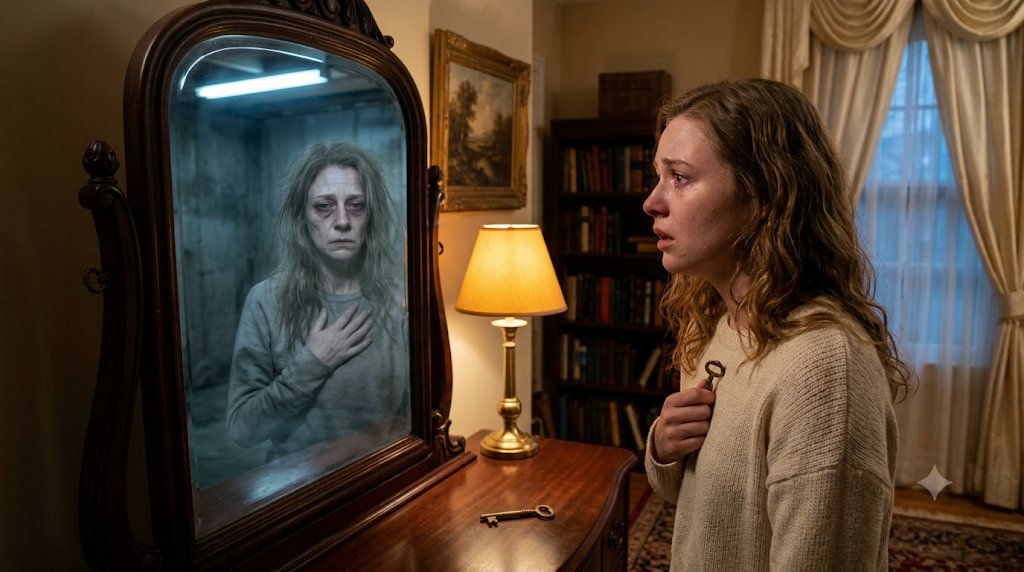
I didn't move. The room smelled faintly of cedar. Cream curtains, a mahogany bookshelf, the pale blue dress hanging on the closet door. Everything was so familiar that my heart pounded. I got out of bed and nearly ran to the mirror. A twenty-two-year-old face looked back at me, with bright eyes and thick hair, no shadows from years of all-nighters.
My phone buzzed on the desk. The date on the screen turned my palms cold. My twenty-second birthday. The day I stole the key to the archive.
A new message lit up. *Julian: I'm at the back gate. Don't forget the pigment notebooks and the tracings.*
I looked at the brass key in my hand. In my first life I walked toward that back gate. This time I turned around, went down the stairs, and walked straight into my father's study.
Dad heard the door and frowned. "I thought you said you were busy tonight."
I set the key on his desk. "Dad."
He looked up.
"Tonight someone wants to take the materials for *Twelve Views of the Catskills*."
He looked at the key, then at me. There was no surprise in his face, only wariness. "A few days ago you were arguing with me about letting Julian Voss see the archive. Tonight you've changed your mind. Why?"
I pulled out a chair and sat. "Just listen to one phone call first."
Mom had come in behind me and stopped in the doorway. Behind her was Vivian. Looking at her now, I finally saw how good her acting really was. Her long hair was tied low, her dress was white, and she carried a birthday gift she'd wrapped for me. Anyone looking at that face would think the word *sweet*.
"Claire, what's going on?"
I didn't answer. I put my phone in the middle of the desk and called Julian. He picked up fast.
"Claire, why aren't you out yet?"
His voice was so much younger than the one I remembered from the end of my life. For one second my chest tightened. Not love. Just the reflex of someone who'd been a fool for far too long.
"I've got the key," I said calmly.
Julian's voice dropped. "Are the pigment notebooks all there?"
"All there. The tracings are in the same drawer, right?"
I looked over at Vivian. Her face had gone pale.
"And the reconstruction of the eastern ridge?"
"Yes."
He exhaled. "Then bring everything out. I'll only borrow it for a night."
I deliberately paused. "My father says those materials can't leave the house."
The line went quiet for a few seconds. Then his voice softened. "Claire, did your father get into your head again?"
I said nothing. He went on. "I just need a chance. You know what I can do. After I'm established, the Hartwells will benefit too. Do you want to spend your whole life watching me get looked down on?"
Dad tightened his grip on his pen. I looked straight at him. In my first life those words had made me feel I was protecting the man I loved. Now they just sounded ridiculous.
"What if my father finds out?" I asked.
A very soft woman's voice came through the phone. "Don't worry, Claire. The whole study will be quiet."
The voice was unmistakable. Vivian flinched back half a step. Her own words kept coming through the speaker. "Mr. Hartwell is just old-fashioned. What's the harm in letting Julian see them for one night?"
I turned slowly to Vivian. She shook her head fast. "Claire, I..."
I held up a hand. Julian, still on the line, seemed to sense something was wrong. "Claire, where are you?"
I hung up. I didn't need to hear any more.
Dad slammed his pen onto the desk. "Vivian."
Her eyes filled instantly. "Mr. Hartwell, I only wanted to help Claire. Julian really is talented, and I was afraid that you and she would fall out over this."
"If you only wanted to help me," I cut in, "how did you know which room the tracings are kept in?"
She froze.
Mom frowned. "The archive is divided into several rooms. Even family doesn't know exactly where each kind of material is stored unless they've been inside."
Vivian's lips moved. "Claire told me once."
"I never did."
"Maybe you forgot."
"I remember very clearly." I didn't give her room to steer the conversation. "Dad, check the access logs for the archive wing over the last three months."
He looked at me for a long time. Then he called our housekeeper and the man who managed the security system. Within twenty minutes the results came back. A secondary keycard belonging to one of the household staff had opened the archive corridor several times when nobody was supposed to be there.
When the staff member was called in, she began shaking the moment she saw Vivian. "Miss Mercer said she wanted to find some of her late mother's old things. I thought..."
Nothing more needed explaining. Vivian's face went white. "Mr. Hartwell, it's not what you think."
"Then what were you doing in there?" I asked.
She started to cry. "I only wanted to look."
"Look at what?"
She had no answer.
In my first life I hated how calm my father stayed whenever he questioned someone. Now I understood. When you have the evidence, raising your voice is unnecessary.
---
About half an hour later, a car pulled into the driveway. Julian had come on his own. He strode into the living room looking worried, saw me, and came straight toward me. "Claire, what are you doing?"
I stepped away from his hand. The movement was small, but enough to stop him.
"You called me here so your parents could humiliate me?"
"Nobody called you."
His expression shifted. "Then why didn't you come out?"
"Because I don't want to steal the materials anymore."
He looked at me as though I'd said something absurd. "I told you I'd just borrow them."
"If they can't leave the house, borrowing them is still taking them."
"Claire, do you have to put it like that?"
I took the bracelet he'd given me off my wrist and set it on the table. Then the music box. Then the key to the apartment he'd once rented. I'd been carrying a few small gifts in my bag since morning, meaning to bring them out with me.
"What's this? What do you mean?"
"From now on, your work is yours and my research is mine."
Julian went stiff. In his memory I was always the one running after him. If he went cold, I'd soften. If he said people looked down on him, I'd find a way to prove how good he was. Today it didn't work.
"Over a few documents, you want to break up?"
"I'm breaking up because you think taking my materials is a given."
He laughed coldly. "Fine, Claire Hartwell. Don't regret this."
"I already did."
He didn't understand the last part, and he didn't need to. Dad wanted Vivian out of the Hartwell house that night, but I stopped him. It wasn't pity. In my first life I'd only seen the end of many things. I didn't know how much she'd copied or when she'd started working with Julian. Pushing them out too early would only give them time to erase their tracks. I wanted them close enough to stay in the light.
After everyone left, only the three of us remained in the study. Mom sat beside me, her eyes red but silent. Dad's face was still cold.
"Did you come back because you realized Julian is a bad man, or because you truly understand what you did wrong?"
I looked at the key on the desk. "What I did wrong wasn't loving the wrong person."
He said nothing.
"It was taking something that belonged to this family and using it to prove another person's love."
His expression changed, just slightly. He didn't forgive me. That was right. A mistake that nearly destroyed the archive couldn't be erased with a few apologies. I had the rest of my life to make up for it.
Just then, the housekeeper knocked. "Sir, there's a guest."
Dad frowned. "Who?"
"Nathan Kessler."
My hand stopped. Nathan Kessler had come back to Providence. In my first life, he was the one man I'd said to both our families, flat out, I would never like as long as I lived.
---
Nathan walked into the living room at nine o'clock that night. Gray shirt, dark trousers, no sign of someone who'd just stepped off a plane. His face was younger than I remembered, the lines still cool, but the eyes didn't feel distant.
Our families had known each other since our grandfathers' time. In my first life my father had said Nathan was a good match for me. At the time, I thought the word *match* insulted love. Now I knew that love isn't about matching. Sometimes it's just an accident that lasts too long.
"Nathan," I greeted him first.
He looked at me a second longer than expected. He didn't ask why my attitude had changed or bring up the past. He'd come to discuss with Dad a restoration project for a late Federal-period meetinghouse outside the city.
While they talked, I sat nearby reviewing my reconstruction. Nathan passed behind me and his eyes stopped on my page. "This is wrong."
I looked up. "Which part?"
He pointed to the roofline at the right corner. "The pitch."
"It follows the original painting."
"The painting only preserves part of it. You can infer the rest from the structure."
"I inferred it from architecture of the period."
"A later period." His voice was so even it annoyed me. "I checked the sources."
"Which sources?"
I pulled a book off the shelf. He didn't look at it. "The 1987 survey only records the structure after the first restoration. You're reconstructing a landscape at least a century earlier."
I stopped.
"The bracketing here is fine, but the proportions are off." He took a pencil and drew a quick line. "With this span, if the roof is as steep as you've drawn it, the framing underneath has to change. The painting doesn't show that."
I started to argue. After a few seconds of recalculating, the words stuck in my throat. He was right. Not by guessing. By expertise.
He set the pencil down on the part I'd colored. "The color work is good."
I looked at him. "You just said it's wrong."
"The architecture is wrong. That doesn't mean the color is."
It was a simple sentence, and it reminded me of Julian. He had never once told me I was wrong, and I'd mistaken that for respect. In truth, he didn't need me to be right. He only needed my ideas to be usable. If I built something wrong, he wasn't the one who'd bear the consequences.
Dad watched us argue without interrupting. When the project was nearly settled, he asked me, "Do you want to be part of it?"
I paused. "The mural project?"
"Yes. The early phase needs a condition survey and materials testing."
My father had meant to recommend another team. In my first life, at this very moment, I'd turned the offer down because Julian was planning his first small show and needed my help. I gave up a real professional chance to sit in his rented apartment mixing paint.
"I'll take it."
He didn't look pleased. "Don't accept just because you want to prove something tonight."
"I know."
He looked at me a few seconds and nodded.
---
The lead architect was Nathan Kessler. On the first day on site, he handed my entire survey back.
"Redo it?" I frowned.
"It's missing hourly humidity data. You've only got daily averages. The mural is flaking in the northeast corner, and averages won't catch that."
I was irritated. "It's the preliminary phase."
"If you're careless at the preliminary phase, everything after is just repairing mistakes." He went to check the roof.
I stood still for a few seconds. In the past I'd have decided he was deliberately making things hard for me. This time I went back to measure.
Three days later, the results proved Nathan right. Humidity in the northeast corner spiked at one hour of the day, because air was moving through a gap in the wall left by an old repair. Going by daily averages would have missed the cause entirely.
I stared at the chart for a long time. The feeling was half annoyance, half exhilaration. This was what real work felt like. No one was coaxing me. No one was flattering me because they wanted something. If you were right, it stood. If you were wrong, you fixed it.
Two months in, the project posted its official staff list. I passed the conference room and saw the sign on the door. *Architecture: Nathan Kessler. Mural Conservation: Claire Hartwell.* I stopped. It was only a temporary sign for a project that wasn't finished, and still my eyes burned.
In my first life, I would have been grateful just to see my name in a tiny credit line under one of Julian's pieces. He'd said it wasn't time yet. After that, my name never appeared again.
"What are you looking at?" Nathan's voice came from behind me.
"Nothing."
He followed my gaze, understood, and didn't ask. "There are new scans in the data room. Have you seen them?"
"Not yet."
I followed him in. The computer was already showing a series of detailed images from a partner archive. When I scrolled to the seventeenth, my fingers went stiff. A pattern of rolling clouds filled the screen.
In my first life I had given Julian my analysis of this ornament a few months after my birthday. In this life he had never received it. Yet this morning, the poster for his new exhibition had just been released, and it contained a variation almost identical to it.
I zoomed in on the file's creation date. It was older than the day I was reborn. My chest went cold. The day I planned to carry the key out the back gate wasn't the first time he'd taken from me. It was only the first time I'd found out.
---
For three days I checked all my old data. The result was worse than I expected. My personal sketches, my pigment ratio tests, scans of unpublished sections, my notes on mountain structure, even errors I had marked, all of it appeared in Julian Voss's work in altered form. One detail could be coincidence. A dozen in a row was theft.
I remembered something. A few months before my birthday, Vivian had borrowed my laptop. She said her own was broken and she had to fix a presentation fast. I hadn't just lent it to her. I'd given her my password too. I'd been foolish in a truly systematic way.
I didn't go to the police right away. I didn't post an accusation online. The evidence I had proved the materials were mine, but not how they'd been taken. If I was going to fight, it had to be done cleanly, once.
I started rebuilding my records. Every file got backed up in three places. My research notebooks were converted into digital versions with timestamps. Every pigment sample was coded. Emails, edit histories, access logs, and scans were all stored separately. Things I'd once assumed people in the field would simply understand, I now turned into evidence.
Nathan found me in the research room close to one in the morning. He put a glass of water on the desk. "Are you planning to sleep here?"
"A few more files. I'll do the rest tomorrow."
"You're not sleepy?"
"No."
He looked at the screen, at the data windows stacked on top of each other. "What's going on?"
I was quiet for a moment. Lying to someone that observant only wastes your own time. "Someone is using my research."
He didn't ask who. He didn't say *let me handle it*. "What do you want to do?"
I looked up. "Let him keep going."
He understood almost at once. "You want him to leave more traces."
"Yes."
"You're sure he'll keep going?"
"Someone who's eaten for free rarely stops on his own."
The corner of Nathan's mouth lifted. "Then protect the new data."
"Already done."
"Do you need a technical specialist?"
"No."
"I'll introduce you to Sam Okoye tomorrow. He specializes in provenance data for historic artifacts."
He didn't say much, and he didn't try to take control of the decision. I liked that.
---
While I was gathering evidence, Vivian wasn't idle. The first rumor surfaced in a small academic group chat. *I heard the Hartwell heiress got into the preservation project through family connections.* Then it became *Claire Hartwell is getting special treatment from the lead architect, Nathan Kessler.* In the end it turned into *rich girl playing at restoration.* Some people I had never met began commenting that conservation takes ten years of experience, not a hobby for trust-fund kids.
I didn't answer. It wasn't nobility. If my ability had to be defended with my status, I'd already lost.
The mid-project review came a month later. The mural I was responsible for had severe pigment loss, and beneath the surface were signs of a bad repair from decades earlier. The committee questioned me for nearly an hour. I answered every point. I presented a plan to preserve the original layer, remove the incorrect additions, and limit the area of intervention.
An older specialist asked, "If we follow your plan, this section will still have losses after conservation. Visitors may find it unattractive."
"Our goal is to preserve the work, not to redecorate it to please the eye."
The room was silent for a few seconds. He nodded. The plan was approved.
That afternoon, the official minutes listed my name under technical lead. I didn't have to argue online. One professional signature carries more weight than a thousand rumors.
Julian began telling his version of the story too. In an interview, the host asked about the hardest period of his life. He mentioned me without naming me, saying he'd once dated a woman from a privileged family and that they broke up over differences between their worlds. The story quickly made him the struggling artist abandoned by a wealthy girl. I watched the clip during a break, then shut off the screen.
Nathan sat across from me. "Does it bother you?"
"It's annoying. But being annoyed doesn't mean I have to react the way they want."
He nodded.
That night we ate noodles at a small place near the site. No private room, no expensive wine, just two bowls of beef pho and the noise of other people talking. Out of nowhere Nathan asked, "Are you afraid people will say you're relying on me?"
I bit down on my chopsticks. "No."
"Why not?"
"If I really had no ability, that would be the scary part."
He laughed. It was the first time I'd seen Nathan laugh so freely. It turned out he wasn't always cold.
When I got home, my phone showed a notification. A major gallery in New York had announced a solo exhibition for Julian Voss, titled *Memory of Mountains*. The main poster used a variation from my research. This time it wasn't a few details scattered inside paintings. He had taken the entire visual language.
I stared at the screen. Sam texted right after. *If the exhibition goes public, the whole catalog becomes evidence that's easier to establish.*
I answered with one word. *Good.*
---
A week before the show, I received an anonymous message with twelve photos attached. Julian and me hugging outside a dorm. The two of us sitting in a car. The two of us leaving a hotel together. The last was shot from a clever angle, so it looked as if I were kissing him in a hallway.
The text read: *If these show up in front of the industry, do you think Nathan Kessler will still stand next to you in public?*
I looked at it for a few seconds. In my first life, Vivian had used something similar. Back then I panicked. I explained, begged, deleted posts, tried to bury the story. The more I reacted, the more control she had over me. This time I didn't need to. I forwarded everything to Nathan. Three minutes later he called.
"I got them."
"Aren't you going to ask?"
"Ask what?"
"Julian and I used to be together. You can see there are hotel photos."
He was silent a moment. "Do you want me to trace the sender?"
"Yes, but only the source. Don't handle it for me."
"Okay."
He didn't question my past. He didn't ask me to prove I was clean. He didn't deliver a noble speech about believing me unconditionally. Somehow I found that kind of trust more real.
"And if the photos are real?"
The line was quiet for a couple of seconds. "Your past is yours." Then he added, "I only need to know where you stand now."
My hand tightened on the phone. It was the first time since I'd been reborn that I realized I could feel something. Not because I'd been rescued, but because I was being treated like an adult who has the right to own her own past.
Two days later, Nathan took me to a project he'd just finished. An old house converted into a research space. On the west wall, cracks still ran across the plaster.
"Why didn't you smooth them over?"
"They don't affect the structure. It looks old because it is old." He reached out and lightly touched the wall. "Not everything damaged needs to be hidden."
I looked at his profile. I couldn't tell whether he'd meant it that way. "I'm talking about the wall. Take it however you like."
I smiled. After a while I asked, "What if one day you find out I once did something really stupid? Like steal the key to a family archive for a man."
He turned toward me. He didn't look away. "That's bound to come out sooner or later."
"Did you actually take anything out?"
"No. I held the key, but I didn't take any materials out."
"Would you do it again?"
"No."
He nodded. "Then that's fine."
That was all.
"You only care whether I'd do it again?"
I looked at the cracked wall in front of us. Maybe people are like old buildings. History that has already happened can't be plastered over with a new coat and pretended away. What matters is what you keep from the damage.
That afternoon, Sam sent the investigation results. The anonymous number had been activated with false information, but it kept logging in near the media office Vivian worked out of. A linked cloud account had also logged in to the team's internal email. It wasn't enough for a legal conclusion, but it pointed the way. I saved it without publishing. If Vivian wanted to use my past as a bomb, let her keep holding it.
---
The night before the exhibition, I received a thick envelope with the gallery's logo embossed on it. A VIP invitation. The sender was Julian Voss. On the back, in his handwriting: *Come see what you once said I couldn't do.*
I set it down on the table. In my first life I'd never said he couldn't do anything. I'd only told him to build his foundations first. Maybe to someone who always wanted to be called a genius, advice to keep learning is just another insult.
Nathan glanced at the card. "Do you want me to go with you?"
I shook my head. "You come as yourself. You'll understand."
It wasn't a date, and it wasn't a place where I needed someone standing behind me. This stage was mine. I put the invitation in my bag. I would definitely go.
The gallery was blindingly bright. Guests included critics, representatives from arts foundations, curators, collectors, and several specialists in historical American art. Julian stood in the middle of the crowd with Vivian beside him, handling the press with such polish that it left almost no gaps.
When I arrived with the experts from the preservation project, a few heads turned. Some recognized me. Some whispered. I wore a white shirt and black trousers and didn't try to stand out. Nathan arrived later. He greeted me from across the room and stayed with the group of architects. He didn't come closer, and I knew he was doing it on purpose.
The presentation began. Vivian stood on stage talking about how Julian Voss had restructured traditional aesthetics in a contemporary language. It was beautifully delivered. The only pity was that the core inside it belonged to someone else.
Julian took the microphone. "This series is the result of years of personal research on mineral pigments, historic architecture, and landscape structure."
Applause rose. I looked at the central painting. Eleven details I could match directly against my own records. He really was that greedy.
In the Q&A, several critics asked general questions. Julian answered them well, having rehearsed. I raised my hand. The eyes of both people on stage shifted at the same moment. Vivian smiled. "Does Claire have a question?"
"For Mr. Voss," I said. The microphone was passed over to me. I looked straight at him. "In piece number seven, you used azurite in the third layer at a lower ratio than the first two. What was your reasoning?"
Julian hesitated a beat. "It was an intuitive choice."
"Intuition based on what? The quality of the light? Why the third layer specifically?"
The mood in the room started to change. He laughed. "Art doesn't always need a formula."
"True." I nodded. "Let's move on. What period did you date the roof form in piece three?"
"Late Federal, based on contemporary architectural sources."
"Which sources?"
His smile stiffened. I didn't let him off. "The missing mountain section in piece one. What principle did you use to infer the contour?"
"Composition. Overall structure. Specifics."
"Claire," he said, lowering his voice, "you came here to make trouble."
I looked at the folder in my hand. "I came to ask the man who claims to have researched this for years about his own research."
A few faces in the audience changed color. I continued. "You can't explain the pigment ratios. You can't name the architectural sources. You can't describe your method for inferring the missing sections. So let me ask something simpler." I pointed at the screen. "Where does this pattern come from?"
Julian looked at it and said nothing.
"You don't know?"
I held the microphone closer. "Because the thing you're calling personal research wasn't researched by you."
The hall stirred. Vivian stepped forward. "Claire, this is a public exhibition. If you have a personal grievance, authorship is not a lovers' quarrel."
I signaled the technician. The big screen switched to a series of files. First came my drafts from four or five years earlier, then my pigment test swatches, scan logs, and sample photographs. Every document carried a timestamped chain. I placed each one beside the matching work. I didn't need to say much. The overlaps spoke for themselves.
An expert in the front row stood up. "Mr. Voss, you developed this palette yourself?"
"We exchanged ideas," Julian answered.
I turned. "We. Claire, have you forgotten? We were together. You voluntarily shared a lot of your materials."
I nodded. "Yes."
The hall went quiet.
"I helped you," I said. "I fixed your compositions. I mixed the pigments. I gave you references and feedback. But helping isn't the same as transferring authorship."
A critic asked immediately, "Does the catalog credit a research collaboration?"
"No."
"Does it cite sources?"
"No."
"Is there a co-author?"
"No."
Julian began to lose his composure. "This is my artwork. I transformed the materials."
"I'm not disputing ownership of the paintings." I looked at him. "I'm asking what gives you the right to claim that the research system behind them was built by you alone."
No answer.
Right then, Vivian raised her hand. "Fine." Her voice had turned much colder. "If you want to talk about professional ethics, everyone should know what you once did."
The screen went black. Then a video played. Grainy footage from an old camera. At twenty-two, I walked into the archive corridor and took the key from a side drawer.
The hall erupted. Vivian turned to me. "This is her. The woman who once tried to steal her own family's archive is now standing here lecturing us about authorship."
Cameras swung toward me. I looked at the video. In my first life, if proof like this had been exposed, I would have panicked. Today I only felt relief. She had finally played the card I'd been expecting.
I raised the microphone. The noise died down. People hadn't expected me to speak at all, and neither had Vivian. She stared at me, waiting for an excuse. I didn't give her one.
"The person in that video is me." I said it evenly. "At twenty-two, I did intend to take my family's materials to Julian Voss."
Murmurs spread through the audience.
"I believed helping the person I loved at any cost was natural. I thought principles could give way to feeling." I looked straight into the lens. "That was wrong. I won't blame my youth, and I won't say I was manipulated. I did it, so I own it." I switched the screen. "But my mistake does not turn the theft of someone else's research into something right."
The recording began. My twenty-two-year-old voice. *But my father says these materials can't leave the house.* Then Julian: *Just one night. After I'm famous, the Hartwells will benefit too.* His face drained of color. Next came another segment, from the same night, captured by the archive's automatic audio logging.
*If people ask where it came from?*
Julian laughed. *Once I'm famous, who's going to care where it started?*
Nobody spoke. Then Vivian's voice. *Don't worry, Claire. Mr. Hartwell is just old-fashioned.*
I stopped the audio. "That was part one."
The screen switched to the archive access logs. The times the secondary keycard had opened the archive corridor. The housekeeper's account. The written confirmation. The laptop login history. The device used for copying data. Sam had helped match all of it.
I didn't need to say she was the thief. The chain of data was clearer than any accusation.
Vivian shook her head. "You can't prove the person using that card was me."
"Correct." I nodded. "That's why I'm not saying it was you."
She choked.
"But the cloud account that received the data after those entries belongs to a secondary email managed by your team." I let the next slide appear. "And this is the source of the threatening messages I received last week."
Several reporters looked up at once. I put the screenshot of the message on screen. *If these show up in front of the industry, do you think Nathan Kessler will still stand next to you in public?*
Vivian's face turned bone white. I didn't look at Nathan. I didn't need to. He wasn't the main character tonight.
Julian turned to Vivian. "You did this."
She laughed, her voice shaking. "Now you're asking me? You told me to handle the media, and suddenly I did it all myself?"
The crowd fell silent in a different way. The two of them no longer stood on the same side.
"The data was your idea," Julian snarled. "You said there was a way to get it."
"You used it. I only copied it."
I stood watching and felt no triumph, only familiarity. In my first life, when they needed to get rid of me, they'd worked together flawlessly. When the interests collapsed on them, an alliance like that couldn't survive a single push.
Vivian suddenly turned on me. "You think you've won?"
I didn't answer.
"You were born with everything." Her voice rose. "The Hartwells gave you the archive, the teachers, the chances. I had to work ten times harder and people still said I was just the girl the Hartwells took in."
My mother, in the back row, closed her eyes. My father didn't move.
"Why does your name always come before mine?"
I looked at her for a long time. At last I'd heard the truth. "You didn't lose because you weren't born a Hartwell."
She stiffened.
"You lost the moment you decided to claim your name by erasing someone else's."
Her lips trembled. She had nothing left to say.
Julian suddenly stepped off the stage and lunged for the folder in my hand. Someone stepped in front of me. Nathan. He only caught Julian's wrist. No punch, no threat.
"That's enough."
Julian ground his teeth. "This has nothing to do with you."
"True." Nathan let go of his wrist. "The rest is for the lawyers and the review board."
It was a plain sentence, and it left Julian nowhere to perform.
The gallery announced that the exhibition was suspended that night. A review committee formed to investigate the sources of the research. An international arts program announced it was suspending Julian Voss's standing pending the results. Vivian Mercer was suspended from her curatorial work. No one went bankrupt. No one knelt. But the people who lived on reputation began to lose the one thing they valued most.
The guests drifted out. I stayed in the gallery. Staff were taking down the placard with the artist's name, *Julian Voss*. I watched it come off the wall for a long time. Nathan sat down beside me.
"His name finally came off something that belongs to you."
He shook his head. "It's not finished."
I turned.
"Your name hasn't gone back up yet."
---
After that night in New York, many people sought me out. Interviews, talk shows, podcasts, even a brand that wanted me as its ambassador for a story about a woman conservator robbed of credit. I turned down almost all of it. I hadn't come back to turn from nobody into somebody through a scandal. The work was still in the conservation lab.
Two months later, my father set the file for *Twelve Views of the Catskills* in front of me. "Do you want to do it?"
I didn't answer at once. "Are you asking as my father, or as the director?"
"As the director."
"Then I need to see the whole file first."
He studied me for a second. The corner of his eye moved. "All right."
It was the first time we'd ever truly worked together. Not father teaching daughter, not daughter fighting her father. Two people in the same trade. We argued more than before. Once we debated for almost two hours over whether to reconstruct a lost passage of the landscape. Dad thought the data was sufficient. I said it wasn't.
"You're being too cautious," he said coldly.
"You're trusting secondary sources too much. Of the three you're counting, two copied each other." I pushed the dating notes across to him. "They share the same transcription error."
He looked at it for ten minutes. Then he said, "Leave that section blank."
Nobody was angry. Nobody needed to save face.
That evening at home, my mother looked at the two of us and laughed. "It used to be that every fight ended with one of you skipping dinner and the other slamming a door."
Dad grunted. "I'm still eating." He didn't say anything else, but he put a piece of fish on my plate.
The next two years of research weren't easy. The deeper I went, the more I found that some parts could never be reconstructed. In my first life I'd wanted to complete everything, to prove I was good enough to fill every gap. Now I understood that a conservator has no right to replace history with imagination.
At the final committee meeting, a member pointed to the empty stretch. "If you completed this, it would look better."
"But there isn't enough evidence."
"Visitors wouldn't know."
"I would."
He fell silent. "Conservation isn't rewriting history," I said. The final plan passed. The gap was kept. An honest absence is better than a fabricated wholeness.
Around the same time, the results of the investigation into Julian Voss were published. Several of his works were found to have serious problems with the sources of their research. The gallery ended its partnership with him and the exhibition contract was canceled. Vivian was held responsible for unauthorized access to and use of data, and lost her place in several projects. I read the news once and didn't look into how they lived afterward. Their disappearance from my life was enough.
Nathan was busy too. He had a project in Newport, and for a long stretch we saw each other once a week. The relationship didn't thin because of it. He'd send me a photo of a structural member he suspected was misdated, and I'd send back a pigment analysis. Sometimes we argued until midnight. Sometimes we didn't text for two days. Neither of us checked up on the other. We didn't need to cling to prove we cared.
On the day the project we'd worked on together was finished, the two of us stood in the courtyard after everyone else had left. "When did you start liking me?" I asked.
Nathan looked at me. "You're asking late."
"I didn't want to know before. Now I do."
He leaned against the railing. "When I was eighteen."
I was surprised. "That early?"
"Your family once brought a torn fragment of a painting into the workshop where I was an apprentice. I remember it wasn't worth much on the market, just part of a family collection. You sat for seven hours saving one small corner. Everyone else thought it wasn't worth it."
I said nothing.
He looked out over the courtyard. "I liked someone who had the patience to save something everyone else thought had no value left."
Not because I was pretty. Not because of the Hartwell name. Not because in this life I was stronger. He liked something in me that had existed for a very long time, something I had simply forgotten.
My phone buzzed. A text from my father. *The committee has officially approved the plan for Twelve Views of the Catskills.* At the bottom, *Lead conservator: Claire Hartwell.*
I looked at the screen for a long time.
"What is it?" Nathan asked.
"It's done." I nodded. "This time my name is really back."
---
The day *Twelve Views of the Catskills* opened to the public, a light rain fell over Providence. The exhibition space Nathan designed had no showy lighting and no extra decoration. Pale gray walls, a simple path, and a distance between viewer and painting calculated just right. "The star here is the painting," he'd said.
"For once you know how to step aside."
"I always did. You just weren't looking."
We bickered for two more sentences, then went off to work.
In the morning, professional guests entered first. I walked through each section. Now and then, memories of my first life surfaced. A cold rented room, a dying lamp, hands trembling from failing sight. Julian's exhibition playing on my computer. My father turning his back. The Hartwell door closing. My name gone from every document. Those scenes had once made me believe my whole life was ruined. Now, standing in front of the real painting, I understood that a life can be ruined for many reasons. But a second life doesn't have to be lived just to negate the first.
I walked up to the placard. The text wasn't large. *Lead Conservator: Claire Hartwell.* Just five words. I looked at it longer than at any painting in the room.
In my first life, I once begged Julian to add my name to a section of the research. He told me to wait until he had a position, and that he'd make it up to me later. I waited until nothing was left. In this life no one needed to make it up to me. My work carried my name by itself.
My parents stood behind me. Mom held out a tissue. I didn't take it. "I'm not crying."
She smiled. "Of course not. Your eyes are red from the lights."
My father stood beside me for a long time. At last he only said, "Well done."
I turned. He was far older than the day I was reborn, with gray at his temples, but he was still standing here.
"Thank you, Dad. You don't need to apologize again. We don't have to go back over the old things."
Some relationships aren't healed by one big conversation. They're mended by hundreds of ordinary days.
That afternoon, a colleague mentioned the news about Julian Voss. After several works were investigated, he'd left the mainstream exhibition circuit. A few places still invited him to sell commercial paintings, but the title of artist-researcher of historic aesthetics was gone. Vivian had lost her curator title in the proceedings. Their testimonies contradicted each other in many places, and in the end they became evidence against each other.
I didn't ask more. Their disappearance from my life was enough.
That evening, after all the visitors had gone, I went back to the main gallery for a last check of the temperature. Nathan was standing by the door. "Finished?"
"Almost."
"There's something I want to show you."
He led me to stand in front of *Twelve Views of the Catskills*. Nobody else was there. Only the soft conservation lighting on the painting's surface.
Nathan took out a small box.
I looked at it and laughed. "You really picked your day."
"Too much?"
"Open it."
He opened the box. The ring was very simple. On its face ran a thin line of pattern. I recognized it immediately. It was taken from a motif in the corner of *Twelve Views of the Catskills*.
"It's an old motif," he said, "but a new design."
I picked it up and looked at it. The past I had repaired was finished.
His voice carried in the quiet room. "Let's not restore the rest. Let's build something new."
I looked up. No flowers, no witnesses, no big screen. I thought it was the most fitting proposal I could imagine.
I held out my hand. "Yes."
---
Two years later, I opened my own studio. The name was simple: Northlight Conservation. It didn't only take restoration jobs. It also researched traditional materials, digitized archives, and trained young conservators. My father once asked why I didn't use the Hartwell name to make the brand easier to build. I told him I didn't need to. He didn't push.
Nathan kept working in preservation architecture. Some projects we did together, and some we did on our own. Neither of us was ever the other's assistant. Once, on a new site, I saw the nameplate hanging outside the preservation coordination office. *Nathan Kessler, Architecture. Claire Hartwell, Mural Conservation.* Two names side by side, neither bigger, neither covering the other.
I stood looking at it for a moment. Nathan came up behind me and looked at it too.
"Still not used to it?"
"I like it."
He didn't say anything more. I followed him inside.
In my first life, I believed that loving someone meant giving them all the light. If he succeeded, I could stand behind him. If he became famous, it didn't matter whether my name appeared. If he needed my talent, I gave it. In the end, the one who disappeared was me.
In this life I finally understood that the best love doesn't require anyone to stand in the dark. Some old works deserve to be saved. Some cracks should be kept. Some gaps don't need to be filled. But my second life wasn't meant to patch up the first. I didn't have to live well just to prove Julian Voss wrong. I didn't have to succeed just to make Vivian Mercer regret. I certainly didn't have to find a better man to prove that an old love had failed.
I came back to take back the right to decide. The right to keep what belongs to me. The right to write my name under my own work. The right to be wrong and fix it. The right to love without disappearing.
Ahead of us was an old meetinghouse waiting to be surveyed. I put on my gloves, picked up my notebook, and stepped through the door. Nathan walked toward the structural bays. I went toward the mural. Two different directions in the same building, like the two names on that nameplate, side by side, each belonging to the person who carried it.
My life was the same. Not a restoration. An entirely new work.