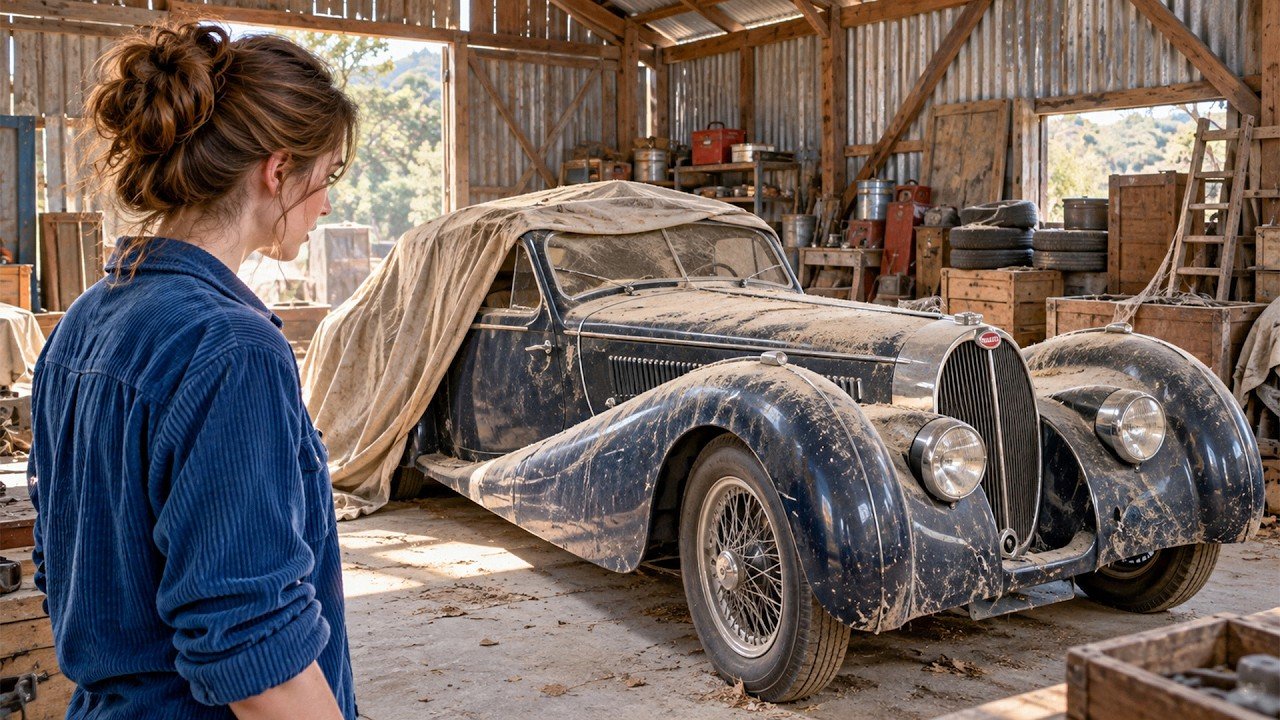
You think you know your family until the reading of a will tears it apart.
When her sister sneered and handed over the keys to their grandfather's rotting barn, she thought it was a cruel joke.
She had no idea the dusty tarp inside hid a multi-million-dollar secret.
The mahogany-paneled office of attorney David Reynolds felt suffocatingly warm, though the air conditioning was humming at full blast.
Scarlett Sullivan sat rigidly in a high-backed leather chair, her hands folded tightly in her lap.
Beside her, radiating an aura of expensive perfume and thinly veiled condescension, sat her older sister, Aurora.
Arthur Sullivan's death had not been a surprise.
Their grandfather was eighty-nine — a fiercely independent and stubbornly eccentric man who had spent the last two decades of his life sequestered on a sprawling, dilapidated property in the dry, sun-baked hills of Ojai, California.
What was a surprise, however, was the way he had chosen to divide his legacy.
David Reynolds cleared his throat, adjusting his wire-rimmed glasses as he looked down at the heavy parchment on his desk.
"To my eldest granddaughter, Aurora," he read, his voice dry and measured. "I leave the sum of my liquid assets, as well as the deed to the condominium in Santa Barbara."
Aurora let out a soft, satisfied exhale, subtly adjusting the collar of her silk blouse.
She had always been Arthur's polished pride — the one who married a wealth management executive and threw charity galas.
"And to my youngest granddaughter, Scarlett," Reynolds continued, pausing for a fraction of a second, "I leave the Ojai property, including the main house, the barn, and all physical contents remaining on the grounds. I trust her to know what to do with the pieces of my past."
The room fell dead silent.
Scarlett blinked, her mind struggling to process the words.
The Ojai property — the farm, as Arthur had laughingly called it — hadn't seen a crop since the early '80s.
It was three acres of overgrown scrub oak, rusted chain-link fencing, and a massive, sagging corrugated metal barn that Arthur had packed to the rafters with what anyone else would call absolute garbage.
He was a notorious hoarder of mechanical scraps, old appliances, and rusted tools.
Aurora turned to Scarlett, a cold, pitying smile stretching across her face.
"Well, Bee," she whispered, her tone dripping with condescension, "keep Grandpa's junk, Scarlett. It suits you. You always did like getting your hands dirty with him out in that awful shed. I suppose you can make a few hundred dollars selling the scrap metal."
Scarlett felt a flush of anger creep up her neck, but she swallowed it down.
She was a high school history teacher, scraping by on a modest salary, drowning in student debt.
She hadn't expected millions, but being handed a massive, expensive cleanup job felt less like an inheritance and more like a punishment.
Two days later, Scarlett drove her battered Subaru up the winding, pothole-riddled dirt road leading to Arthur's estate.
The California sun beat down mercilessly, baking the dry earth.
When she finally pulled up to the rusted front gate, her heart sank into her stomach.
It was worse than she remembered.
The main house — a small mid-century ranch — was peeling paint and choked by overgrown ivy.
But the real nightmare loomed in the back.
The barn.
It was a monstrous structure, at least three thousand square feet, its aluminum siding oxidized and buckling under the weight of decades of neglect.
Scarlett unlocked the heavy padlock with a screech of rusted iron and hauled the sliding doors open.
A blast of hot, stale air hit her face, carrying the distinct, heavy odors of dry rot, mouse droppings, and ancient motor oil.
She coughed, waving the dust away from her face as the sunlight cut through the gloom.
The sight was overwhelming.
Floor to ceiling, the barn was packed.
There were towers of yellowed newspapers, stacks of rotting wooden crates, dismembered washing machines, rows of oxidized lawn mowers, and endless, haphazardly stacked tires.
It was a labyrinth of forgotten trash.
There was barely a narrow goat path carved through the center of the chaos, leading into the pitch-black depths of the structure.
Tears pricked the corners of Scarlett's eyes.
It would take months to clear this out.
It would cost thousands of dollars in dumpster rental fees alone just to make the property presentable enough to sell the land.
Why would Arthur do this to her?
Why give Bee the clean, easy money and leave her with a monument to his hoarding?
"All right, Grandpa," Scarlett muttered to herself, pulling a pair of heavy leather work gloves from her back pocket. "Let's see what kind of mess you left me."
For the first four days, it was backbreaking, soul-crushing labor.
Scarlett worked from dawn until dusk, hauling out rotted wood and rusted iron, filling the massive industrial dumpster she had rented with her credit card.
Every muscle in her body ached.
Her hands were blistered, her lungs felt heavy with dust, and her patience was wearing dangerously thin.
But on the afternoon of the fifth day, as she was wrestling a heavy, rusted filing cabinet toward the door, one of the drawers slid open and spilled its contents onto the dirt floor.
Scarlett dropped the cabinet with a frustrated groan and knelt down to gather the mess.
It was a collection of old, yellowed paperwork.
But as she brushed the dirt off a heavy, leather-bound ledger, something slipped out from between the pages.
It was a faded black-and-white photograph.
Scarlett wiped her brow, leaving a streak of grease across her forehead, and studied the image.
It was Arthur, looking perhaps thirty years old, standing in front of a European-style stone archway.
He was grinning wildly, wearing a greasy mechanic's jumpsuit.
Next to him was a car — or rather, a massive object covered by a heavy tarpaulin, with only the bottom edge of wire-spoked wheels visible.
She turned the photo over.
Scrawled on the back in Arthur's messy handwriting was a single line:
"Paris, 1968. The Sleeping Beauty Comes Home."
Scarlett frowned, looking up into the dark, uncleared rear half of the barn.
Behind the walls of broken refrigerators and towers of tires, the shadows seemed thicker.
For the first time since she had arrived, a flicker of genuine curiosity pierced through her exhaustion.
What exactly had her grandfather brought back from Paris?
The discovery of the photograph shifted something in Scarlett's mindset.
The mindless, agonizing chore of tossing garbage suddenly felt like an archaeological dig.
She began paying closer attention to the items she was moving.
She found a bundle of letters from a shipping company in Le Havre, France, dated 1969, detailing the transport of "agricultural machinery" to Long Beach, California.
The stated weight, however, was suspiciously precise — 1,550 kilograms.
By the end of her first week at the Ojai property, Scarlett had managed to clear a path halfway to the back wall of the barn.
She was covered in soot and sweat, taking a brief respite on an overturned bucket, drinking from a warm bottle of water, when the sound of crunching gravel outside shattered the quiet of the rural afternoon.
Scarlett walked out of the barn, squinting against the harsh glare of the sun.
A sleek, midnight-blue Audi A8 was parked next to her dusty Subaru.
The contrast was almost comical.
A man stepped out of the driver's side.
He looked to be in his late forties, wearing a tailored charcoal suit that had no business being anywhere near a dirt farm in Ojai, complete with Italian leather loafers that immediately collected a layer of dust.
He wore expensive aviator sunglasses and carried a slim leather portfolio.
"Scarlett Sullivan?" the man asked, his voice smooth, projecting an easy, practiced authority.
"Who's asking?" Scarlett replied, crossing her arms defensively.
The man smiled, revealing bright, perfectly capped teeth.
He walked toward her, extending a manicured hand.
"Richard Hayes. I represent a boutique real estate development firm down in Los Angeles. First, let me offer my condolences regarding your grandfather, Arthur. He was a staple of this community."
Scarlett didn't take his hand. "Thank you. But the property isn't on the market yet. I'm still clearing it out."
Hayes let his hand drop smoothly, unbothered by the rejection.
He took off his sunglasses, revealing sharp, calculating blue eyes that swept over the peeling paint of the house and the yawning, trash-filled mouth of the barn.
"I can see that," he said, chuckling softly. "It looks like a monumental task, Ms. Sullivan. Frankly, my firm is looking to acquire a portfolio of land in this specific corridor of Ojai. We aren't interested in the structures. In fact, the cleanup is usually the biggest hurdle for an inheritor."
He unzipped his portfolio and pulled out a single sheet of paper.
"I'm authorized to make you a cash offer today. We take the land entirely as-is. You don't have to lift another piece of scrap metal. You don't have to pay for another dumpster. You just hand over the keys and walk away."
He held out the paper.
Scarlett hesitated, then took it.
Her eyes widened.
The number printed at the bottom of the page was $400,000 — for a stretch of undeveloped scrub brush land with a hoarder's house on it.
It was an astronomical sum.
It was enough to wipe out her student loans, buy a decent house in a good neighborhood, and never worry about money again.
Aurora had been wrong.
The land was worth something.
"It's a very generous offer," Hayes pressed, his eyes locking onto hers. "But it is time-sensitive. We'd like to close by the end of the week."
Scarlett looked from the paper to Hayes.
Something didn't sit right with her.
As a history teacher, she was trained to look for context and underlying motives.
Why was a slick LA developer standing in her driveway on a Tuesday afternoon, offering well over market value for a toxic dump of a farm?
And why was he insisting on taking the contents of the barn without even looking inside?
"Why as-is?" Scarlett asked slowly. "Usually developers want a clean title and a clean lot."
Hayes offered a dismissive wave. "Economies of scale, Ms. Sullivan. We have our own demolition crews. It's cheaper for us to bulldoze the lot in a day than for you to spend six months sorting through— well, whatever Arthur left behind."
As he spoke, Scarlett noticed his gaze drift.
He wasn't looking at the land.
He wasn't looking at the main house.
His sharp blue eyes were locked firmly on the dark, cavernous opening of the barn.
There was a hunger in his expression that made the hairs on the back of Scarlett's neck stand up.
He knows what's in there, she thought. Or he suspects.
Scarlett folded the paper carefully and handed it back to him.
"I appreciate the offer, Mr. Hayes, but my grandfather left this to me for a reason. I'm going to finish going through his things before I make any decisions about selling."
Hayes's polite smile slipped for a fraction of a second, revealing a flash of genuine irritation.
"Ms. Sullivan, I assure you, whatever sentimental junk you think is in there is not worth throwing away nearly half a million dollars. I strongly advise you to reconsider."
"I'll keep your card," Scarlett said firmly, stepping back toward the barn doors. "Have a safe drive back to LA."
Hayes stared at her for a long, tense moment.
The charming veneer was entirely gone.
He put his sunglasses back on, turned on his heel, and got back into his Audi.
He threw the car into reverse, tires spitting gravel as he sped aggressively back down the dirt road.
Scarlett stood in the dust cloud, her heart hammering against her ribs.
She turned slowly and looked at the barn.
She marched inside, bypassing the dumpsters and the brooms.
She grabbed a heavy crowbar and a high-powered LED flashlight.
For the next three hours, she worked like a woman possessed.
She didn't bother sorting or organizing.
She just violently dismantled the walls of junk blocking the rear corner of the structure.
She shoved aside rotting mattresses, kicked over stacks of paint cans, and hauled heavy rusted engine blocks out of the way.
By late afternoon, the sun was dipping low, casting long golden shadows through the cracks in the aluminum siding.
Scarlett wiped the sweat from her eyes, panting heavily.
She had reached the very back corner of the barn.
The space was walled off by a makeshift barricade of heavy wooden pallets.
With a grunt of effort, Scarlett jammed the crowbar behind the wood and wrenched it free, tossing the pallets aside one by one.
Behind the barricade, occupying a large, cleared-out square of concrete, sat a massive, hulking shape.
It was covered by a thick, heavy canvas tarp that was completely gray with half a century of dust.
The shape was unmistakable.
It was long, incredibly low to the ground, with distinct, sweeping curves that suggested speed even while sitting perfectly still.
Scarlett's breath hitched in her throat.
She stepped forward, her boots kicking up little clouds of dust in the stifling air.
She reached out with trembling, blistered hands, grabbing the heavy fabric at the front of the shape.
She pulled.
The canvas was stiff and brittle, resisting at first, then tearing slightly as she dragged it back over the mass.
A thick cloud of dust billowed into the air, making her cough, but she didn't look away.
Underneath the canvas there were layers of old, moth-eaten moving blankets.
She grabbed those and threw them to the floor.
Scarlett aimed her flashlight at the front of the machine.
There, sitting on four flat, rotting tires, was an automobile.
It was coated in an incredibly thick layer of grime and bird guano, the paint dull and chalky.
But the shape — the shape was unlike anything she had ever seen in her life.
It featured massive, teardrop-shaped pontoon fenders that swooped gracefully backward.
The hood was impossibly long, featuring two rows of delicate louvers punched into the metal.
But it was the grille that made Scarlett's heart stop.
It was shaped like a massive horseshoe, wrought from what looked like tarnished nickel, standing proud at the front of the vehicle.
Pinned to the very top of the grille, beneath decades of filth, was a tiny, oxidized emblem.
Scarlett leaned in close, rubbing a gloved thumb over the metal badge.
An oval. Red enamel, barely visible through the dirt.
White letters spelling out a single word that meant absolutely nothing to a high school history teacher — but meant everything to the man in the Audi.
Bugatti.
Scarlett stood frozen in the stifling heat of the barn, her thumb resting on the red enamel of the Bugatti badge.
She didn't know much about vintage automobiles, but even she knew that name.
It was synonymous with European royalty, pre-war racing dominance, and unfathomable wealth.
With shaking hands, she pulled her smartphone from her pocket and snapped a dozen photos of the car, capturing the swooping fenders, the split windshield, and the dust-caked dashboard featuring large, intricate dials.
She rushed back to the main house, locked the deadbolt behind her, and opened her laptop at the kitchen table.
As she cross-referenced her photos with historical archives, the reality of what sat in her grandfather's barn began to crystallize, sending a cold shockwave down her spine.
The vehicle was a 1937 Bugatti Type 57S Atalante.
Designed by Jean Bugatti himself, it was one of only seventeen ever manufactured.
To the global automotive community, a Type 57S wasn't just a car — it was the holy grail.
The last time one had been uncovered in a similar barn-find condition, belonging to a reclusive British doctor named Harold Carr, it had sent the auction world into a frenzy.
Arthur's ledger, which she had tossed onto the table hours earlier, suddenly made perfect sense.
In 1968, he hadn't imported agricultural machinery from Le Havre.
He had smuggled a masterpiece out of Europe, hiding it away in the dusty foothills of Ojai to protect it from thieves, taxes, and the prying eyes of the elite.
But the elite had found out anyway.
Richard Hayes hadn't been a real estate developer.
The as-is offer for the land was a smokescreen.
He was a high-stakes broker for black-market automotive collectors — car hunters who scoured probate records and death certificates for rumors of lost chassis numbers.
Somehow, Hayes had tracked the Bugatti to Arthur's estate, and he had nearly walked away with a ten-million-dollar masterpiece for the price of a dirt lot.
Scarlett immediately drafted an email to Simon Crawford, a renowned senior specialist at Gooding & Company, a premier classic car auction house.
She attached three photos and a single line of text: "I believe I have found a Type 57S Atalante. Please advise."
Less than ten minutes later, her phone rang.
"Miss Sullivan," a frantic, heavily accented British voice blurted out the second she answered. "My name is Simon Crawford. Tell me you have not touched the paint. Tell me you have not tried to wash it or start the engine or inflate the tires."
"I haven't touched anything except the tarp," Scarlett replied, her heart hammering.
"Thank God," Simon exhaled loudly. "Do not let anyone near that barn. I am booking the next flight out of London Heathrow. I will be in Ojai in fourteen hours."
But Scarlett's relief was short-lived.
The next morning, before Simon could arrive, the roar of an engine shattered the quiet of the farm.
Scarlett looked out the kitchen window to see Aurora's pristine white Range Rover pulling through the rusted gates, followed closely by the sleek midnight-blue Audi A8 belonging to Richard Hayes.
Scarlett stepped out onto the porch, crossing her arms as Aurora marched up the dirt path.
Her sister wasn't wearing her usual condescending smile.
Her face was tight with fury and greed.
"You lied to me," Aurora snapped, pointing a manicured finger at Scarlett. "You sat in David Reynolds' office and let me believe this place was full of trash."
"It is full of trash, Bee," Scarlett said coldly, her eyes shifting to Hayes, who was leaning against his Audi with a smug expression. "You're the one who told me to keep Grandpa's junk. You didn't even want to step foot on the property."
"A Bugatti is not junk, Scarlett!" Aurora screamed, dropping all pretense of composure. "And it is certainly not a 'physical content of the grounds.' It is a high-value automotive asset. And as the primary beneficiary of the liquid estate, it belongs to me. Richard here was kind enough to inform me of what you were trying to hide."
The betrayal stung, but it also fueled a fiery indignation in Scarlett's chest.
Hayes had realized Scarlett wouldn't sell the land, so he had bypassed her entirely, going straight to the greedy, easily manipulated older sister to force a legal dispute.
"I have already filed an emergency injunction in probate court," Aurora threatened, pulling a folded legal document from her designer handbag and shoving it toward Scarlett. "You cannot move, sell, or touch that car. It will be tied up in litigation for the next ten years. You don't have the money to fight my lawyers, Scarlett. You're a high school teacher drowning in debt."
Hayes stepped forward, adjusting his expensive cuffs.
"There is an easier way, Ms. Sullivan," he said smoothly. "I'm still prepared to offer a private buyout. Two million dollars, cash, split evenly between you and your sister. No court fees, no auction house commissions, no public spectacle. You both walk away rich."
It was an extortion attempt.
They were trying to starve her out, knowing she couldn't afford a protracted legal battle over the inheritance.
Scarlett looked at her sister, seeing the desperate, calculating glint in Aurora's eyes, and then looked at Hayes.
She took the injunction paper, folded it neatly in half, and handed it back to Aurora.
"Get off my property," Scarlett said, her voice eerily calm. "Both of you. Before I call the sheriff for trespassing."
"You are making a massive mistake!" Aurora shrieked as Scarlett turned her back and walked inside, locking the door behind her.
Scarlett knew she was in a perilous position.
Aurora had the financial firepower to freeze the estate indefinitely.
But Scarlett had something Aurora didn't: Arthur's leather-bound ledger.
When Simon Crawford arrived that afternoon, flanked by two armed private security guards he had hired straight from the airport, he confirmed what Scarlett already knew.
"It— it is chassis number 57502," Simon whispered reverently, shining his penlight over the engine block as they stood in the gloomy barn. "Originally delivered to Earl Howe, the British racing driver, in 1937. It changed hands a few times before vanishing completely off the map in Paris in the late '60s. Miss Sullivan, this is one of the most significant automotive discoveries of the century. In its original, unrestored condition, we are looking at an estimate of twelve to fifteen million dollars."
Scarlett felt the blood drain from her face.
Fifteen million dollars.
"My sister is contesting the will," Scarlett told him, her voice trembling slightly. "She claims the car isn't covered under 'physical contents.'"
Simon frowned, but Scarlett held up the dusty ledger.
She had spent the last two hours reading through Arthur's frantic, scribbled notes.
She turned to the very last page, dated just three months before his death.
She read it aloud to Simon:
"To my dearest Scarlett, Aurora only sees the polish, never the engine. I know she will take the easy money, but the farm and everything hidden in its shadows is yours. The sleeping beauty under the tarp is not an asset. It is a piece of art, a piece of my heart, and it is a physical part of the dust and dirt of this barn. Protect her from the vultures, sell her to the world, free yourself."
When Scarlett brought the ledger to attorney David Reynolds the next morning, the lawyer's eyes widened.
"This is a holographic codicil," Reynolds explained, a rare smile breaking across his stern face. "In California, a handwritten addition to a will by the testator is legally binding if the handwriting is verified. Arthur specifically referenced the car, its location, and his explicit intent for you to inherit it and sell it. Your sister's injunction is completely baseless."
Two weeks later, Aurora's lawsuit was thrown out of court by a judge who sternly reprimanded her legal team for attempting to override a clearly stated holographic will.
Hayes, realizing his extortion play had failed, vanished back into the Los Angeles underworld, his reputation among black-market collectors completely shattered by his failure to secure the Atalante.
The extraction of the Bugatti was a spectacle.
Gooding & Company sent a specialized, climate-controlled transport truck.
Under the watchful eyes of armed guards and a stunned local Ojai crowd, the barn doors were removed entirely, and the dusty, magnificent beast was slowly winched out into the California sunlight for the first time in over fifty years.
Scarlett stood by the rusted gates, watching it go.
She didn't feel sad.
She felt an overwhelming sense of gratitude toward the eccentric, brilliant grandfather who had trusted her with his greatest secret.
Six months later, Scarlett found herself sitting in the VIP section of the Gooding & Company auction tent at the Pebble Beach Concours d'Elegance in Monterey.
The room was packed with the wealthiest collectors on the planet — oil tycoons, tech billionaires, and European aristocrats.
On the rotating center stage, bathed in brilliant spotlights, sat the Bugatti Type 57S Atalante.
True to Simon Crawford's advice, they had not washed it.
They hadn't even dusted it.
It was presented exactly as Scarlett had found it — a true barn find, preservation-class vehicle, wearing its fifty years of dirt like a royal mantle.
The contrast between the filthy, oxidized car and the men in bespoke tuxedos bidding on it was purely cinematic.
"Lot 114," the auctioneer's voice boomed over the speakers, echoing through the massive tent. "The lost 1937 Bugatti Type 57S Atalante. Ladies and gentlemen, history is on the block. We shall start the bidding at eight million dollars."
Paddles shot up instantly.
"Nine million."
"Ten million from the gentleman in the front row."
"Eleven million on the telephone."
Scarlett gripped the arms of her chair, her breath catching in her throat as the numbers climbed at a dizzying pace.
She thought of the blisters on her hands, the suffocating dust of the barn, Aurora's cruel sneer, and Hayes's manipulative threats.
It had all led to this exact moment.
"Thirteen million," the auctioneer called out. "Do I hear fourteen?"
A gavel raised in the back of the room.
"Fourteen million! I have fourteen million dollars. Going once... going twice..."
The heavy wooden gavel slammed down with a sharp, definitive crack.
"Sold for fourteen million dollars!"
The room erupted into a standing ovation.
Simon Crawford, sitting next to Scarlett, let out a massive whoop of joy and pulled her into a tight hug.
Tears streamed down Scarlett's face, washing away the last remnants of the stress and debt that had weighed her down her entire adult life.
She didn't just walk away rich.
She walked away free.
In the months that followed, Scarlett used a portion of the funds to establish the Arthur Sullivan Historical Preservation Foundation, providing full-ride college scholarships to passionate, low-income history students.
She didn't sell the Ojai property to developers.
Instead, she had the dilapidated main house and the rotting barn torn down, clearing the land completely.
On the exact spot where the barn once stood — where she had swung a crowbar and uncovered a legend — Scarlett built a beautiful, modern home with a sweeping view of the Ojai Valley.
She had kept her grandfather's junk, just as her sister had mocked her to do.
And in doing so, she had found a treasure that changed her world forever.