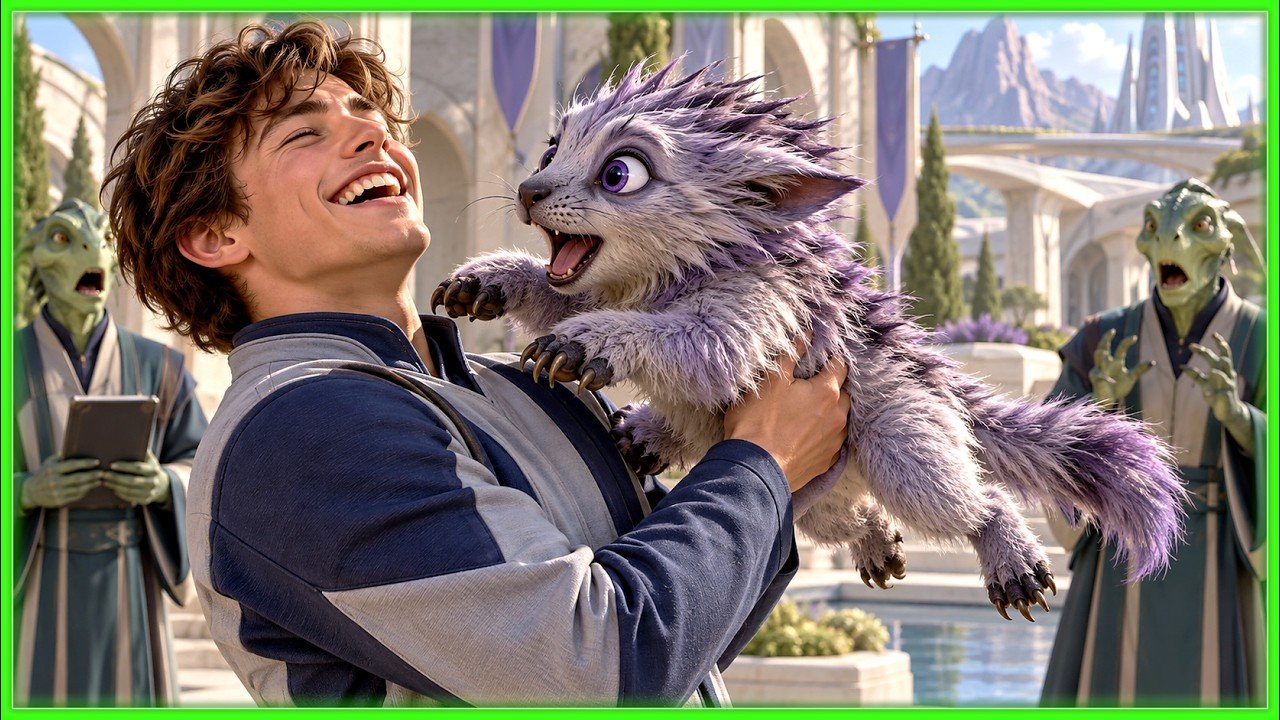
The predator cub cleared the containment field in a single leap, and every Thesari in the courtyard did exactly what ten thousand generations of instinct told us to do.
We froze.
Every one of us except the human who opened his arms, caught the snarling thing out of the air, and started laughing.
I need to explain why that moment changed my life.
And to do that, I need to tell you what a Vashra is.
My name is Oek Varamund.
I am Thesari — which means I am tall and narrow, with green scales, a long tail for balance, and a frill of skin around my neck that flares out when I am frightened.
I have taught xenopona studies at the Halamir Exchange Academy for twenty-two years.
The academy sits on the edge of our capital city, Sinari, where students from seven worlds come to study together.
And on our world, the Vashra is the oldest nightmare there is.
An adult Vashra is the size of a cargo hauler.
It has six powerful legs, a thick coat of spiky gray and violet fur, and huge glowing violet eyes that can see in total darkness.
It is fast, silent, and clever.
For most of Thesari history, our ancestors lived in fear of it.
Our oldest songs are about the Vashra.
Our children's stories are about the Vashra.
When a Thesari baby is scared of the dark, what it is scared of, deep in its bones, is a Vashra.
Today, the great beasts live only in the Thorn Wild Preserve, a vast mountain forest east of the city, surrounded by energy fences.
Our rangers watch them from a distance.
Nobody goes near them.
Nobody would ever dream of it.
Which is why, three weeks before that day in the courtyard, the whole city had been in an uproar.
A ranger patrol had found a Vashra cub alone near the edge of the preserve, half-starved and shivering.
Its mother was nowhere to be seen.
The rangers did not know what to do.
You cannot leave a cub to starve, but you also cannot exactly hand it back to a mother you cannot find.
So after a great deal of argument, they brought it to the one place in the city with secure animal enclosures and trained staff — my academy, my department, me.
For three weeks, I kept that cub behind a triple-layered containment field in the old xenopa wing.
It was about the size of a large travel case.
It had soft, spiky fur that stood straight up when it was alarmed, six short, clumsy legs, and enormous violet eyes.
I fed it through a slot with a long pole.
I observed it through a screen.
I wrote careful notes.
It hissed at me.
It threw itself at the field again and again.
It paced.
It cried at night — a high, thin, trilling sound that echoed through the whole wing.
My notes said, "Subject displays aggressive territorial behavior consistent with species profile. Recommend continued maximum containment."
On the morning of that day, I had arranged a demonstration for my second-year students.
We moved the cub, still inside its portable field, to the central courtyard of the academy.
It was a bright morning — sun on the pale stone, the fountain splashing.
Students from seven worlds gathered around on the steps.
I wanted them to see a living Vashra safely from a distance, so they would understand what our ancestors faced.
I was in the middle of my lecture when the power fluctuated.
It was a tiny thing. A flicker.
A maintenance crew three buildings away had tripped a breaker.
The portable field dimmed for less than half a second.
Half a second was all the cub needed.
It burst out of the field in one great springing leap — six legs spread wide, fur standing up in spikes, mouth open in a squealing snarl.
It sailed straight over the heads of the front row of students.
And it was heading right for a cluster of second-years sitting on the steps.
I froze.
My frill flared so wide it hurt my neck.
Beside me, my teaching assistant, Ilvan, made a strangled little sound and did not move either.
Every Thesari student on those steps went rigid as stone.
That is what our instinct says to do when a Vashra strikes.
Be still. Be very, very still. Maybe it will not see you.
But one student did not freeze.
His name was Danny Alvarez.
He was human — one of only four on our campus that year, from a place on Earth called San Antonio.
He was nineteen years old, broad-shouldered and cheerful, with dark curly hair and a laugh you could hear across the whole dining hall.
He had been sitting on the second step, eating a piece of fruit, only half listening to my lecture.
He saw the cub coming.
He dropped his fruit.
He stood up and opened his arms wide.
And he caught it right out of the air.
The cub slammed into his chest, all six legs scrabbling, and Danny staggered back a step and wrapped his arms around it and fell backward onto the steps with the cub on top of him.
I was sure I was about to watch a student die.
And then Danny started laughing.
Not a scared laugh. Not a shocked laugh.
A big, delighted, belly-deep laugh — the kind I had heard human students make when they were watching comedy programs in the common room.
He was lying on his back on the stone steps with a Vashra cub standing on his chest, and he was laughing so hard his whole body shook.
"Hey," he said. "Hey there, little guy. Whoa, okay. Okay, you got me. You got me."
The cub was growling. It was batting at his face with its front paws. Its mouth was open. Its teeth — small but sharp — were right next to his ear.
"Danny, don't move!" I finally managed to shout. "Don't move! It will—"
"It's okay, Professor," he called back, still laughing. "It's fine. Look at him. He's just playing."
"That is a Vashra. It is not playing. It is attacking."
"No, no, no. Look at his tail. Look at his ears."
I looked.
I did not know what I was supposed to see.
The cub's short, fluffy tail was whipping back and forth very fast.
Its round ears were flicking forward and back, forward and back.
And its paws — which I had been sure were slashing at Danny's face — were actually landing very softly. Patting. Patting.
Its claws, I realized slowly, were tucked away.
Danny caught one of the cub's front paws in his hand and gave it a little wiggle.
The cub squeaked, flopped over sideways onto the step, and wriggled onto its back with all six legs in the air.
Then it rolled right back up and pounced on Danny's hand again, chewing on his fingers with its mouth wide open — but so gently that his skin barely dented.
Danny laughed harder.
"See?" he said, grinning up at me. "That's a play bite. He's not even trying. He's just bored out of his little mind. When was the last time anybody played with this guy?"
I opened my mouth.
Then I closed it.
The honest answer was: never.
Nobody had ever played with that cub.
Nobody had touched it in three weeks.
I had fed it through a slot on the end of a pole.
All around the courtyard, students were slowly coming out of their frozen terror.
Thesari students with their frills still half-flared.
Mellin students, small and pale, peeking out from behind the fountain.
A pair of tall Ankor exchange students who had climbed onto a balcony.
Every one of them was staring at the human lying on the steps with a Vashra cub wrestling his hand.
Then the cub did something that made my frill go flat against my neck in shock.
It stopped wrestling.
It climbed up onto Danny's chest, turned around three times, lay down in a fluffy ball right over his heart, and began to make a sound.
A deep, rumbling, rolling vibration, like a small engine.
Danny stopped laughing.
His face went soft.
"Oh, buddy," he said quietly, and put one hand on the cub's back. "Yeah, I know. I know."
"What is that sound?" Ilvan whispered beside me. "Is it a warning?"
"I do not know," I said.
And for a teacher of xenopona studies, those were very hard words to say.
There is nothing like it in any record of Vashra behavior.
"Professor," Danny called over without lifting his head, "I think he's purring. On Earth, cats do that when they're happy, or when they feel safe."
Feel safe.
A Vashra with a human.
I was still trying to understand those words when a voice spoke behind me, cold and sharp as winter.
"Professor Varamund. What is the meaning of this?"
I turned.
Director Hessane was standing at the top of the courtyard steps, flanked by two academy security officers with stun rods.
She was the head of the whole academy — old and stern, with deep green scales gone gray at the edges.
Her frill was fully flared.
Her eyes were fixed on the cub.
"Security," she said. "Sedate the animal, then transfer it to the deep containment vault immediately. It will not see daylight again until the preserve rangers can take it away."
The officers stepped forward, raising their stun rods.
And Danny Alvarez, still lying on his back on the steps, wrapped both arms protectively around the purring cub and said very clearly:
"Ma'am, with respect — if you lock him back up in the dark alone, I think he's going to die."
The whole courtyard went silent.
Even the fountain seemed quieter.
Nobody spoke to Director Hessane that way.
Not professors. Not visiting ambassadors.
Certainly not second-year exchange students lying on the ground with a predator on their chest.
"Explain yourself, cadet."
Each word was like a small piece of ice.
Danny sat up slowly, carefully, cradling the cub in his arms.
It grumbled sleepily and tucked its face into his elbow.
"Ma'am, I grew up with five little brothers and sisters," he said. "And all through high school I worked at an animal rescue on weekends. Dogs, cats, a couple of raccoons, one very angry goat. And every summer I was a recess monitor at my little sister's elementary school."
"I do not know what a recess monitor is," the Director said.
"It's the person who watches the kids when they go outside to play," Danny said. "Between lessons. And one thing you learn real quick doing that job is that young animals and young kids are the same in a lot of ways. They need to play. It's not extra. It's not a reward. It's how they learn to be what they are. A kid who never gets to run around goes a little crazy. A puppy who's kept in a box alone gets sick. And I've seen this little guy's enclosure. He's been alone in there for three weeks."
He looked down at the cub.
"When young predators play, they're practicing. Chasing, pouncing, wrestling. But they need somebody to practice with. Normally that would be his brothers and sisters, or his mom. He doesn't have any of those. So he's been throwing himself at the walls trying to find somebody to play with, and everybody's been writing down 'aggressive.'"
My scales went hot, because I had written exactly that. Many times.
The Director was quiet for a long moment.
Then she looked at me.
"Professor Varamund. You are the expert. Is this true?"
I could have said no.
It would have been easy.
Every book on Vashra behavior said they were aggressive from birth.
Every record said they could not be handled.
Every thesis, every song, every story agreed.
But I had just watched a Vashra cub fall asleep on a human's heart.
"I do not know, Director," I said. "I believe I may have been wrong."
The Director's frill slowly folded down.
She looked at the cub. At Danny. At me.
"One week," she said at last. "The cub remains in the xenopa wing. Cadet Alvarez will be permitted supervised contact. Professor Varamund will supervise. If there is any injury — any at all — to any person, the cub goes to the vault. Is that understood?"
"Yes, ma'am," Danny said. "Thank you, ma'am."
"Do not thank me," said the Director. "Prove me wrong."
She turned and walked away.
The security officers followed, looking very relieved.
That afternoon, Danny walked into the xenopa wing carrying the cub in his arms like a sack of groceries.
I walked beside him, keeping a careful distance, with a stun rod in my hand that I very much hoped I would not need.
"First thing," Danny said, looking around the enclosure. "We gotta turn the containment field off."
"Absolutely not."
"Professor. How would you feel if you lived in a glass box?"
I had no good answer for that.
We compromised.
The outer field stayed on around the whole room, so the cub could not escape into the building.
But the inner field came down.
Danny took off his boots, sat down on the floor in the middle of the enclosure, and set the cub down in front of him.
"Okay, buddy," he said. "Let's play."
What happened over the next week, I recorded in more detail than anything I have recorded in my whole career.
I still have the notes.
I have read them perhaps a thousand times.
The cub loved to chase.
Danny would roll a ball across the floor — a ball he had made from a rolled-up exercise shirt — and the cub would explode after it in a flurry of six legs, skidding and tumbling and pouncing.
Then it would bring the ball back, drop it at Danny's feet, and stare at him with its huge violet eyes until he threw it again.
"He's fetching," Danny said, delighted. "He figured out fetch in like ten minutes. You know how long it took my uncle's dog to learn fetch?"
"Never. That dog never learned fetch."
The cub loved to wrestle.
Danny would lie on his back and let the cub climb all over him — pouncing on his hands, his feet, his hair — and Danny was always laughing, always talking to it in a soft, silly voice.
But he was also always watching.
When the cub got too excited and its play bite started to press too hard, Danny would let out a sharp, high "ow!" and go completely still and turn his face away.
The cub would freeze. Its ears would flatten. Then it would creep forward and lick his hand very gently, as if to say sorry.
"That's how they learn," Danny explained. "When puppies play and one bites too hard, the other puppy yelps and stops playing. So the biter learns to be gentle. It's called bite inhibition. He's gotta learn it from somebody. Might as well be me."
"You are teaching a Vashra manners," I said.
"I'm teaching a kid how to play nice at recess," he said. "Same thing."
By the third day, the cub had a name.
Danny called it Biscuit.
"Why Biscuit?" I asked.
"Because he's round and fluffy and golden brown on his belly," Danny said. "And because it's the least scary name I could think of. If he's going to be famous, I want people to hear his name and not be scared."
By the fourth day, Biscuit was eating from Danny's hand.
By the fifth, he was eating from mine.
I will never forget that moment.
I sat on the floor, my tail curled nervously around me, my frill half-flared despite everything I had seen.
Danny sat beside me.
I held out a strip of dried meat on my open palm, the way he had shown me.
My hand was shaking.
Biscuit looked at me for a long time with those enormous violet eyes.
Then he walked over very slowly, sniffed my fingers, and took the meat with his lips so gently that I barely felt it.
Then he climbed into my lap and lay down.
My frill went completely flat.
I had not known it could lie that flat.
I sat very still, with the oldest nightmare of my people curled up purring in my lap, and something inside me that had been afraid my entire life quietly unknotted itself.
"There you go," Danny said softly. "See? He likes you."
"Danny," I said. My voice was not steady. "Do you understand what this means? For my people, the Vashra is everything we are afraid of. We have been afraid of them since before we had words. And you just walked up and caught one and laughed."
Danny was quiet for a moment.
"Can I tell you something, Professor? On Earth, a long time ago, we had wolves. Big, smart predators that ate the same animals we did. People were scared of them. Real scared. And then somewhere back there — nobody knows exactly when — some human looked at a wolf pup and thought, 'I wonder if you want to play.' And that's where dogs came from. Every dog on Earth. Every single one."
"You befriended your predators," I said slowly.
"Not all of them," he said, laughing. "Don't try that with a bear. But we've got kind of a long history of looking at scary things and thinking, 'Maybe you're just misunderstood.'"
Word spread through the academy faster than I would have believed.
By the fifth day, there was a crowd outside the observation window of the xenopa wing every afternoon.
Mellin students pressed their small pale faces against the glass.
The two tall Ankor students brought snacks and sat cross-legged on the floor as if they were watching a sports match.
Thesari students came too — at first standing far back from the window with their frills half-raised, then a little closer, then closer still.
Every time Biscuit pounced on Danny's foot, or skidded across the floor after his ball, or flopped onto his back to have his belly scratched, the crowd outside laughed.
And I noticed that each day, the Thesari students laughed a little more, and their frills stayed down a little longer.
On the afternoon of the fifth day, I looked up from my notes and saw someone standing alone at the very back of the crowd.
Old and stern, with green scales gone gray at the edges.
Director Hessane.
She did not come in.
She did not say a word.
She watched Biscuit chase his ball three times across the floor and bring it back to Danny's feet.
Then she turned and walked away.
But before she did, I saw her frill, for just a moment, fold all the way down.
On the sixth day, I wrote my report for the Director.
It was the most important thing I had ever written.
It said that Vashra cubs were social, intelligent, playful, and capable of forming deep bonds.
It said that our records were wrong.
It said that a human cadet had taught me more about the Vashra in six days than I had learned in twenty-two years.
I sent it that evening, and I went to bed happier than I had been in a very long time.
At dawn on the seventh day, my communicator woke me with an emergency alarm.
It was the preserve rangers.
"Professor Varamund," said the chief ranger, and her voice was tight with fear. "We have a situation. Last night an adult female Vashra broke through the eastern fence of the Thorn Wild Preserve. She is moving west, toward the city. She is moving fast, and she is following the exact route the rangers took when they carried the cub to your academy."
I sat up in bed, my frill flaring.
"She is looking for him," I whispered.
"Yes, Professor," the ranger said. "And at her current speed, she will reach the edge of Sinari by tomorrow night."
By mid-morning, the whole city of Sinari knew.
News screens on every street corner showed the same images, taken by ranger drones from high above the forest.
A huge gray-and-violet shape moving through the trees.
Six legs. A coat of spikes. A head as big as a ground car.
She moved in long, flowing strides that ate up the distance.
And every few minutes she stopped, lifted her great head, and sniffed the air.
The ranger drones also caught her voice.
They played it on every channel.
It was the same high, thin, trilling cry Biscuit had made every night alone in his enclosure.
Only it was a hundred times deeper. A hundred times louder.
It rolled across the forest like a bell.
Panic spread through the city like fire through dry grass.
Families started packing.
The roads heading west were jammed with vehicles.
Schools were closed.
At the academy, students gathered in nervous clumps in the hallways, whispering.
At noon, the Director called an emergency meeting of the academy council, the city defense office, and the preserve rangers.
I was summoned.
So was Danny.
We sat at a long table in the council chamber.
On the wall, a map of the city glowed with a single red dot crawling steadily toward it from the east.
"The situation is simple," said Commander Terravasque of City Defense — a heavy-shouldered Thesari with a deep scar along his frill. "An adult Vashra is approaching a city of four million people. At this time tomorrow, she will be at our eastern districts. We will establish a stun barrier line at the city edge with heavy emitters. If she approaches, we bring her down."
"Bring her down?" Danny repeated. "You mean stun her?"
"An adult Vashra is very large and very strong," the commander said grimly. "Our stun emitters were not designed for something her size. It may take many shots at full power. I cannot promise she will survive it. But I can promise my city will."
"Or," Danny said, "we could give her back her kid."
Every head at the table turned to look at him.
"She's not attacking anybody," he went on. He pointed at the map. "Look at her path. She hasn't gone near a single farm or village. She's walking right past them. She's following one trail — his trail. She's not hunting. She's a mom looking for her baby."
"She is a Vashra," said Commander Terravasque, "looking for her prey."
"Then why is she calling for him?" Danny said. "Every few minutes she stops and calls. You heard it on the news. That's the same sound Biscuit makes at night. That's not a hunting sound. Hunters are quiet. That's a mom calling for her kid to come home."
The commander's frill flared a little.
"Professor Varamund," said the Director. "Your report. I read it last night. You believe the cub is social, that it has bonded with the cadet?"
"Yes, Director."
"Do you believe the adult would react the same way?"
That was the question. The only question that mattered.
And I did not know the answer.
"I believe," I said slowly, "that we have spent our entire history running from the Vashra. That every piece of knowledge we have about them was gathered from far away, by people who were afraid. And I believe that in seven days, a young human taught me that almost all of it was wrong."
"Almost," said the commander. "Almost?"
I admitted, "The commander leaned forward. Then here is what I know for certain. My grandfather's village in the eastern hills was destroyed by a Vashra when he was a boy. Not one person was hurt, because they all ran in time. But they lost their homes, their fields, everything. He told me that story every night of my childhood. I will not risk four million homes on 'almost.'"
There was silence in the room.
Then Danny spoke, very quietly.
"Sir, can I ask what happened right before the Vashra came to your grandfather's village?"
The commander frowned. "What do you mean?"
"I mean, did anybody take something? Did anybody go into the forest? Did a hunter maybe catch a cub?"
The commander opened his mouth.
Then he closed it.
Something changed in his face. Something old and uncomfortable.
"There was a story," he said finally, slowly. "A young man of the village. He found a cub in the hills and brought it home to show everyone. He said it was a great trophy. The Vashra came three nights later."
He stopped.
"I had forgotten that part. My grandfather always told it as the least important part of the story."
"Sir," Danny said gently, "I think it might be the most important part."
Nobody said anything for a long time.
Finally, the Director rose.
"Here is my decision, Commander. You will set up your barrier line. The city must be protected. But nobody fires unless the animal attacks. Meanwhile, Professor Varamund will prepare a plan to return the cub to the preserve safely before the adult reaches the city. Perhaps a transport, flown to the forest edge. You have until tomorrow morning."
"Yes, Director," I said.
The meeting ended.
In the hallway outside, Danny walked beside me, quiet for once, his hands shoved deep in his pockets.
"A transport won't work," he said finally.
"Why not?"
"Because she's following his scent. If we fly him somewhere, the scent trail ends at the academy. She'll still come here. She'll still walk right into the barrier line, and somebody's going to get scared and fire."
He was right. I knew he was right.
"Then what do you suggest?"
"We have to walk him out," Danny said. "On the ground, along his own trail. So she follows us away from the city instead of into it. And then when we meet her, we let him go."
"When we meet her," I said. "A full-grown Vashra. In the forest. On foot."
"Yeah," Danny said, and gave me a nervous little half-grin. "I know it sounds crazy when you say it out loud."
"It sounds crazy when you say it quietly, too."
"Professor," he said, "you were sitting on the floor with him in your lap yesterday. Did it feel crazy then?"
I did not answer.
But I did not say no.
That night, I could not sleep.
I sat in my office, staring at maps of the eastern forest, tracing routes with my claw.
Every route ended in the same place: two small, soft creatures standing in front of the oldest nightmare in Thesari history, hoping she would understand.
Sometime after midnight, I went down to the xenopa wing to check on Biscuit.
I found Danny there.
He had fallen asleep on the floor of the enclosure, his back against the wall, his jacket bunched under his head.
He had not wanted Biscuit to be alone on what might be his last night.
But Biscuit was not with him.
The far wall of the enclosure — the old one, near the ventilation shaft — had a gap in it.
A small, ragged gap, low to the ground, where a maintenance panel had been knocked loose.
On the floor below it were tufts of gray and violet fur, and small six-toed prints in the dust, leading into the dark.
Outside, through the high window, I heard it.
Far away, from the east — long and deep and lonely.
The mother's call.
And then, much closer, from somewhere outside the academy walls, heading toward the forest:
A thin, high, trilling answer.
"Danny," I said. "Danny, wake up."
He opened his eyes, saw my face, and was on his feet in a second.
"Where is he?"
I pointed at the hole in the wall.
"He heard her," I said. "He is going home. Alone. In the dark. Straight toward the barrier line."
We ran.
Danny grabbed his jacket and a light stick.
I grabbed my emergency kit and a ranger communicator from my office.
We went out through the service gate at the back of the academy and into the eastern district of Sinari, where the streets were empty and quiet because everyone had been evacuated.
Biscuit's trail was easy to follow at first.
Little six-toed prints in the dust of the street.
A tuft of fur caught on a fence.
A knocked-over trash container.
He was heading due east, toward the edge of the city. Toward the forest.
Toward the barrier line.
"Can you call the commander?" Danny asked as we ran. "Tell him not to shoot."
I tried.
The communicator crackled.
"Commander Terravasque, this is Professor Varamund. The cub has escaped. It is heading toward your line. Do not fire on any small animal. I repeat, do not fire."
A pause. Then the commander's voice, sharp:
"Understood, Professor. But I have to tell you something. My scouts report the adult has changed direction. She has picked up a new scent. She is no longer following the old trail. She is heading straight for the eastern edge of the city — toward my line. She has smelled the cub."
"I said he is going to her, and she is coming to him."
"And they are going to meet," said the commander, "right in front of my emitters."
We ran faster.
"Danny," I said between breaths as we ran down the empty streets, "if we reach her — if we truly meet her — what will you do?"
"Honestly? I don't totally know yet," he panted. "When I was a kid, the neighbor had this huge dog named Tank. My little sister Rosie was terrified of him. She'd scream every time he barked. So one day, I sat down in the yard right next to the fence and just played with a stick. Didn't look at Tank. Didn't try to pet him. Just played. And after a while, Tank came over and lay down and watched. And after a longer while, Rosie came over and sat next to me. By the end of that summer, she was riding around the yard on his back."
"A Vashra is not a dog named Tank."
"No," Danny agreed. "But a scared mom is a scared mom on any planet. I think if you show a scared mom you're not a threat, she'll at least stop and listen."
I hoped, with every scale on my body, that he was right.
The eastern edge of Sinari is where the city stops and the forest starts.
There is a wide, open field of tall silver grass between them.
And that night, it was lit up bright as day by floodlights.
All along the edge of the city stood a row of heavy stun emitters — big, humming machines on tripods, each one manned by a nervous defense officer.
Behind them, Commander Terravasque paced.
We came out between two buildings, panting, just in time to see a small, fluffy shape bounding through the tall grass in the middle of the field.
"Biscuit!" Danny shouted.
Biscuit stopped.
He turned his head.
He saw Danny, and his tail started wagging so hard that his whole back end wiggled.
But then the call came again from the forest — close now, very close.
And Biscuit turned back toward the trees and trilled as loud as his little body could manage.
"Hold fire!" the commander barked down the line. "Hold fire! That is the cub!"
And then the forest moved.
At the far edge of the field, the trees parted, and out of the darkness stepped the mother Vashra.
I had seen images. I had read descriptions.
None of it prepared me.
She was enormous — taller at the shoulder than a two-story house.
Her six legs were thick as tree trunks.
Her coat of gray and violet spikes rippled in the floodlights.
Her eyes were the same violet as Biscuit's, but each one was as big as a dinner plate, and they glowed.
Along the barrier line, I heard defense officers gasp. Some of them stumbled backward.
Every Thesari on that field had their frill flared to the limit, including me.
Every instinct in my body screamed at me to freeze. To be very, very still.
The mother lowered her great head and looked across the field.
She saw the row of humming machines.
She saw the lights.
She saw the Thesari officers in their armor, all of them staring at her.
And her spikes rose up along her back, and she let out a low, rolling growl that I felt in my teeth.
"Commander!" an officer shouted. "She's threatening! Request permission to fire!"
"Not yet!" the commander shouted back, but I heard his voice shake.
"She's scared," Danny said beside me, very quietly. "Look at her. She's seeing all these machines and lights and people, and her baby is right in the middle of it. She thinks we're going to hurt him."
"Danny, somebody has to show her we're not."
And before I could stop him, he walked out into the field.
He did not run.
He walked slowly, calmly, his hands open at his sides, through the tall silver grass toward the place where Biscuit was standing.
And the mother Vashra turned her huge head and watched him come.
"Cadet!" the commander roared. "Get back here! That is an order!"
Danny did not stop.
He reached Biscuit, who bounced up to him, wagging and trilling.
Danny knelt down in the grass, and he did something I will never, ever forget.
He laughed softly — warmly — the same laugh I had heard in the courtyard.
He ruffled Biscuit's fur and said, "Hey, buddy. Hey, look who came to get you. Look who it is."
Then he turned to face the mother.
He was maybe forty meters away from her.
She could have crossed that distance in two strides.
He lowered himself down.
He put his elbows and his chest on the ground, with his hips up in the air.
It looked ridiculous. It looked like a child playing a game.
"What is he doing?" Ilvan whispered. She had followed us out of the academy without my noticing. "Professor, what is he doing?"
And all at once, I knew.
"It is a play bow," I whispered. "It is what Biscuit does when he wants to play. Front down, back end up. Danny is telling her, in her own language: I am not a threat. I am a friend. I am just here to play."
The mother Vashra stared at him.
Her spikes were still raised. Her growl still rolled across the field.
But she had stopped moving forward.
Her huge head tilted very slightly to one side.
Biscuit looked at Danny, bowing in the grass.
He looked at his mother.
Then he bounded off toward her through the grass as fast as his six little legs could go, trilling with joy.
The mother lowered her head.
Biscuit leapt up against her enormous nose.
She sniffed him all over, from his ears to his tail, making deep huffing sounds.
Biscuit rubbed his face against her, wiggling all over.
And then the mother made a sound.
Deep, rumbling, rolling. Like a great engine.
She was purring.
All along the barrier line, I heard the Thesari officers go silent.
One by one, their frills began to fold down.
The mother lifted her head again.
She looked at Danny, still lying in the grass.
And then, very slowly, she began to walk toward him.
"Danny," I breathed. "Danny, don't move."
He did not move.
He stayed in his play bow, very still, very calm, as the oldest nightmare of my people walked up to him across the silver grass, one enormous step at a time, until her head was right above him, and her breath stirred his curly hair.
She lowered her nose until it was almost touching him, and she sniffed.
Long, deep sniffs. His hair. His hands. His jacket.
Smelling her cub on him.
Smelling all seven days of play.
And then, from the barrier line behind me, I heard a sound that turned my blood to ice.
The rising whine of a stun emitter charging to full power.
I spun around.
At the far end of the line, a young defense officer — barely older than Danny — was standing behind his machine.
His frill was flared so wide it trembled.
His eyes were wild.
His claws were on the firing trigger.
"She's going to kill him!" he screamed. "She's going to kill him! I have to stop her!"
"No!" the commander roared.
But the emitter was already pointed straight at the mother Vashra.
And standing directly beneath her — right in the line of fire — was Danny.
I do not remember deciding to move.
I only remember that I was suddenly running, and that my tail was whipping behind me for balance, and that I was faster than I had been in twenty years.
I reached the young officer just as his claw tightened on the trigger.
I did not knock him down.
I did not grab the machine.
I simply stepped in front of the emitter — right in front of its glowing barrel — and spread my arms wide.
"Stop," I said. "Look at her. Look."
The young officer stared at me. His frill was shaking.
"Professor, move. She's going to—"
"She is not going to do anything," I said. "Look at her. Really look. The way the human taught me. Look at her ears."
He looked.
All along the line, the officers looked.
The mother Vashra's great round ears were tipped forward, soft and relaxed.
Her spikes, which had been standing straight up a minute ago, were slowly lying down flat against her back.
And her tail — her huge, heavy tail — was swinging slowly back and forth across the grass.
Back and forth.
The same way Biscuit's did when Danny rolled the ball.
"She is not hunting," I said quietly. "She is saying thank you."
The young officer's claw slowly came off the trigger.
The whine of the emitter faded.
Behind me, I heard Commander Terravasque let out a long, shaking breath.
"Power down," the commander said. "All units, power down. Now."
One by one, all along the line, the great machines went quiet.
Out in the field, the mother Vashra had finished sniffing Danny.
She raised her head.
She looked down at him for a long moment with those huge, glowing eyes.
And then she did something that no Thesari in all of our history had ever seen.
She lowered her front end to the ground. Elbows down. Chest down.
Her huge back end rose up into the air, her tail swinging.
A play bow.
Danny started laughing.
That big, delighted, belly-deep laugh that I had first heard in the courtyard a week before.
He could not help it.
He rolled over on his back in the silver grass and laughed up at the stars.
And the mother Vashra watched him.
And Biscuit came bounding back across the grass and pounced on his chest.
And Danny caught him and laughed even harder.
"Okay, okay," he said finally, sitting up, wiping his eyes.
He picked Biscuit up and held him for one long moment, his face buried in the cub's spiky fur.
"Okay, buddy. Time to go home. You be good for your mom, okay? No more running away. No more chewing on people."
He set Biscuit down in the grass.
The cub looked up at him, then at his mother, then back at Danny.
"Go on," Danny said softly. "Go on. It's okay."
Biscuit trilled once — a small, soft sound — and trotted to his mother's side.
She lowered her head and nuzzled him.
Then she turned, and together, the great beast and the small one walked back across the silver field toward the dark edge of the forest.
At the tree line, the mother stopped and looked back.
She looked at Danny.
Then, for a long moment, she looked at me — standing in front of the emitter with my arms still spread wide.
Then she was gone into the trees.
And from deep inside the forest, a little while later, we heard two calls rising together.
One deep. One high.
Not lonely anymore.
Danny walked back across the field slowly.
When he reached me, his eyes were wet, but he was smiling.
"Professor," he said, "you stood in front of the cannon."
"Yes," I said. My legs had started to shake. I sat down rather suddenly in the grass. "I did. I do not quite know why."
Danny sat down beside me.
"I think you do," he said.
"Perhaps I did."
The commander came over then.
He stood above us for a long moment, looking at the dark forest.
His scarred frill was completely flat.
"My grandfather," he said finally, "spent his whole life afraid of that animal. He taught me to be afraid of it. And tonight, a boy from another world walked out and laughed at it. And it laughed back."
"She wasn't really laughing, sir," Danny said. "That's just how I describe it."
"Cadet," the commander said, "I know exactly what I saw."
Things changed after that night.
Slowly at first — the way real things change — and then all at once.
My report to the Director was read, and then read again, and then sent to the planetary council.
The ranger drone footage of that night was played on every screen in Sinari.
A human boy lying in a play bow in the silver grass.
A Vashra cub bounding to its mother.
A mother Vashra bowing back.
The image was printed in every newspaper.
Children drew it in their schools.
Somebody made it into a song.
Within a year, the Thorn Wild Preserve had a new program.
Not a fence program. An understanding program.
Rangers began to study the Vashra up close — carefully, respectfully, the way Danny had shown me.
They learned that the great beasts were social. That they lived in family groups. That they played. That they had different calls for different meanings, almost like words. That they were curious about the Thesari and had always been avoiding us, not hunting us. That most of the old stories of attacks had begun just like the commander's grandfather's village — with someone taking a cub.
I was asked to lead the program.
I said yes, on one condition: that Danny Alvarez be invited to help design it.
He came every summer, all through his time at the academy.
He taught the rangers about play bows and bite inhibition and tail wags.
He taught them how to sit on the ground and be patient.
And most of all, he taught them how to laugh.
"Not at the Vashra," he told a group of new rangers once, while I watched from the edge of the field. "With them. You can't fake it. Animals can always tell. If you're scared, they know. If you're pretending, they know. You have to really, actually believe that they're just a kid who wants to play at recess. And then they'll believe it, too."
"But how do you believe it?" one young ranger asked. "When everything you've ever learned says to be afraid?"
Danny thought about that for a while.
"Humans have been doing this for a really long time," he said. "Wolves, horses, elephants, even some big cats a little bit. Every time, somebody was scared first, and then somebody got curious. And curious won. I think curiosity is the bravest thing there is. Braver than strength. Braver than fighting. You just have to let it win."
One time, on the last day of Danny's final summer before he went home to Earth to become a wildlife scientist, we walked together to the edge of the Thorn Wild Preserve, where a new observation post stood among the trees.
We sat on the ground at the edge of a quiet clearing.
Danny took a ball out of his bag — one made from a rolled-up exercise shirt, old and faded now — and set it in the grass.
We waited.
After a while, the trees moved.
And out into the clearing stepped a young Vashra.
Not a cub anymore. Bigger than a cargo hauler, with a thick coat of gray and violet spikes and huge glowing violet eyes, and a belly that was still just a little golden brown.
Biscuit looked at us.
His ears went forward.
His enormous tail began to sweep the grass back and forth. Back and forth.
Then he lowered his front end to the ground. Elbows down. Back end in the air.
Danny laughed and threw the ball.
And I, Oek Varamund, Thesari, teacher of xenopona studies, descendant of ten thousand generations who had frozen in terror at the sight of a Vashra, sat in the grass beside my friend and laughed too, as the oldest nightmare of my people bounded across the clearing like a child let out for recess.