The bank gave her thirty days to clear out the rot.
That was the legacy of Arthur Hayes — ninety acres of dead dirt, a collapsed barn, and a farmhouse smelling of cheap whiskey and regret.
Nora didn't come to grieve.
She came to salvage whatever scrap metal would cover the funeral costs.
She thought she was burying the last of her family's failures.
She didn't know she was standing on top of their salvation.
The tires of Nora's ten-year-old sedan chewed through the gravel of County Road 9, spitting dust into the dry Texas wind.
The air conditioning had died three hours ago somewhere outside of Amarillo, leaving her to bake in the afternoon heat.
She rolled the window down. It didn't help.
The air moving through the cabin felt like the exhaust from an industrial furnace.
She kept one eye on the temperature gauge and the other on the horizon.
Out here, the horizon was a flat, unforgiving line of scrub brush and cracked earth, broken only by the skeletal remains of forgotten oil derricks and leaning utility poles.
Then she saw it.
The mailbox hung from a rusted chain, the painted letters reading HAYES flaking away to reveal the gray, sun-bleached wood beneath.
Nora pulled off the road, the engine sputtering and dying before she even turned the key.
She sat in the silence for a long moment, listening to the ticking of the overheated metal.
This was Oak Haven.
The name was a bitter joke. There wasn't an oak tree within fifty miles.
There was only mesquite, brittle yellow grass, and the house.
It sat at the end of a long dirt driveway — a two-story farmhouse that looked as though it were slowly being pulled down into the earth.
The paint, which might have been white a decade ago, was now a sickly, peeling gray.
The porch sagged heavily to the left, groaning under the weight of its own rotting timber.
Nora opened the car door and stepped out.
The heat hit her like a physical blow.
She wiped a line of sweat from her forehead, her fingers coming away stained with road dust.
She reached into the passenger seat and grabbed the manila envelope she'd been carrying for three days.
Inside was a letter from a man named Gregory Finch, an estate attorney who charged by the hour and spoke in flat, transactional sentences.
Nora remembered sitting in his air-conditioned office in Dallas, feeling the sweat dry cold on her skin as he slid the paperwork across his polished oak desk.
"Your grandfather passed away unexpectedly, Miss Hayes. As his only living relative, the estate defaults to you."
Nora had stared at the papers.
She hadn't seen Arthur Hayes in fifteen years.
The last memory she had of him was the back of his faded denim jacket as he walked out of the hospital after her father's funeral, refusing to pay for a headstone.
Arthur was a hard, paranoid man who believed banks were criminal enterprises and the government was a parasite.
He lived off the grid before it was a lifestyle trend, driven by a deep, calcified bitterness that had alienated everyone who ever tried to love him.
"I don't want it," Nora had told the lawyer. "I don't want anything of his."
Finch had adjusted his glasses, looking at her not with sympathy but with the weary patience of a man explaining math to a child.
"It's not quite that simple. The property has back taxes attached — a little over forty thousand dollars. If you refuse the estate, it goes to county auction. But the county auction won't cover the demolition costs and the environmental cleanup required for the old oil drums on the north acreage. The remaining debt will likely be passed to the next of kin. That is you."
Nora had closed her eyes.
She was thirty-two years old.
She managed a diner in a Dallas suburb, working sixty hours a week just to keep her head above the drowning pool of her own student loans and the medical debt her mother had left behind.
She had eighty-four dollars in her checking account.
"What are my options?" she had asked.
"You have thirty days to clear the property and list it for a private cash sale," Finch had replied. "Find a buyer who wants the land for agricultural use. Take whatever they offer, pay the county, wash your hands of it."
So here she was.
Thirty days.
Nora walked up the driveway, her boots kicking up small clouds of fine, powdery dust.
The silence of the property was absolute.
No birds. No crickets.
Just the low, hollow whistle of the wind moving through the missing boards of the barn.
She climbed the porch steps, testing each one before applying her full weight.
The wood bowed but held.
She took the brass key Finch had given her and fit it into the tarnished lock of the front door.
It didn't turn easily.
She had to lean her shoulder against the heavy wood, jiggling the key until the old mechanism gave way with a harsh scrape of metal.
The door swung inward.
The smell hit her instantly.
It was the scent of abandonment — stale air trapped for weeks, baking in the Texas summer, mixed with the unmistakable odors of mice, dry rot, and decades of unfiltered cigarette smoke.
Nora pulled her shirt up over her nose and stepped over the threshold.
The interior was dim, the windows caked with years of grime and blocked by heavy, moth-eaten drapes.
As her eyes adjusted to the gloom, the reality of Arthur's life came into sharp focus.
The living room was a hoarder's purgatory.
Stacks of yellowed newspapers leaned against the walls like decaying pillars.
The furniture — a plaid sofa and a recliner covered in cigarette burns — was buried under piles of junk mail, empty tin cans, and tangled webs of extension cords.
Dust coated every surface, thick and undisturbed, like gray snow.
Nora walked slowly through the wreckage, her boots crunching on something she didn't want to look at too closely.
She moved into the kitchen.
The linoleum floor was curling at the edges, revealing the black adhesive underneath.
The sink was stained brown from rust, the faucet dripping a slow, agonizing rhythm into a pot crusted with something unidentifiable.
She opened a cabinet.
A lone box of oatmeal, chewed through at the corner by rodents, sat next to a dozen empty bottles of cheap bourbon.
Anger, hot and sudden, flared in Nora's chest.
She had spent her entire adult life trying to climb out of the financial crater her family had left her in, and now this.
Arthur had died exactly the way he had lived — stubborn, isolated, and leaving a mess for someone else to clean up.
She dropped her bag on the only clear space on the kitchen counter.
She didn't have time for a breakdown.
She didn't have the luxury of grief.
She had thirty days to strip this house to its bones, sell the scrap, and find a buyer foolish enough to want the dirt beneath it.
She rolled up her sleeves.
By the morning of the fourth day, Nora had stopped feeling her legs.
Her life had contracted into a brutal, endless loop of lifting, dragging, and throwing.
She had rented a twenty-yard roll-off dumpster, putting the crushing eight-hundred-dollar fee on her one remaining credit card.
It sat in the front yard like a giant blue coffin, swallowing the remnants of Arthur Hayes's miserable existence.
She wore a respirator mask she'd bought at a hardware store in town, her hair tied back in a greasy knot, her hands covered in heavy leather work gloves.
The heat inside the house routinely breached a hundred degrees by noon.
She worked from dawn until the light failed, fueled by lukewarm bottled water and a cold, sustaining fury.
The volume of garbage was staggering.
She hauled out garbage bags filled with rotting clothes, broken appliances, and decades of useless paperwork.
Arthur had kept every receipt he had ever been handed since 1982.
He had kept spark plugs that had burned out during the Reagan administration.
He had kept empty soup cans, convinced they could be melted down or repurposed.
It wasn't just hoarding.
It was a desperate, paranoid clinging to the physical world — a man terrified of having nothing who ended up buried by his own trash.
On the fifth afternoon, the real estate agent arrived.
His name was Dean.
He drove a pristine white Ford F-150 that looked like it had never seen a day of actual labor.
He stepped out of the truck wearing a crisp blue polo shirt, khaki slacks, and aviator sunglasses.
He took one look at the house, and Nora saw the practiced, polite smile die on his face.
Nora walked out to meet him, pulling off her respirator mask and wiping the sweat from her eyes.
She smelled like old dirt and exhaustion.
"You're Miss Hayes," Dean said, extending a hand that was smooth and cold from the truck's air conditioning.
"Nora," she replied, shaking it briefly. "Thanks for coming out."
Dean didn't reply right away.
He walked toward the house, keeping a safe distance from the sagging porch.
He looked at the collapsed roof of the barn, the rusted husks of two old tractors sinking into the tall grass, and the peeling paint of the main structure.
He took a tablet out of his pocket and tapped the screen a few times, shaking his head.
"Miss Hayes," he started, his voice adopting the gentle, patronizing tone of a doctor delivering a bad diagnosis. "Your lawyer told me you were looking for a quick cash sale. As-is condition."
"That's right. I just need to clear the taxes. Anything over that is fine. I'm not looking to get rich."
Dean sighed, slipping his sunglasses down the bridge of his nose to look her in the eye.
"Nora, I'm going to be straight with you. You couldn't get rich off this land if you struck oil tomorrow — and there's no oil left out here."
Nora crossed her arms. "It's ninety acres. Land has value."
"Usable land has value," Dean corrected, pointing toward the back acreage. "Half your soil is contaminated from an illegal diesel dump your grandfather ran in the '90s. The county has a record of it. Whoever buys this property assumes liability for the environmental cleanup. That alone is a thirty-thousand-dollar job."
Nora felt a cold stone drop in her stomach.
"What about the house?"
Dean let out a short, humorless laugh. "The house is a liability, Nora. It's not a fixer-upper. The foundation is cracked, the roof is compromised, and the electrical is a fire hazard. It's a teardown. A buyer is going to factor the cost of demolition into the purchase price. Demolition and haul-away for a structure this size — you're looking at another twenty grand."
He turned back to his truck, clearly eager to get out of the heat.
"You've got a property with forty thousand in back taxes, fifty thousand in cleanup and demo costs, and the land itself in this market is worth maybe sixty thousand on a good day. You are underwater, Ms. Hayes. If I list this, it'll sit on the market for three years, and you'll just keep racking up property taxes in the meantime."
Nora stood frozen in the dust. "So what am I supposed to do?"
Dean opened his truck door, the blast of cool air rushing out like a taunt.
"Let the county take it. Walk away. Declare bankruptcy if they come after you for the difference. It's the smartest play. I'm sorry. You can't bleed a stone."
He got in, rolled up the window, and drove away, leaving Nora standing in a cloud of fine white grit.
She didn't move for a long time.
She just watched the dust settle on the dead grass.
Bankruptcy.
The word echoed in her head.
If she declared bankruptcy, she'd lose the apartment in Dallas.
She'd lose her car.
She'd be pushed right off the precarious financial ledge she had spent ten years trying to balance on.
Her grandfather had finally reached out from the grave and pulled her under.
That night, the heat broke, replaced by a violent, dry thunderstorm that rolled across the plains.
Lightning flashed in jagged, silent strikes, illuminating the barren landscape in brief, strobe-like bursts of stark white.
The wind howled, rattling the loose windowpanes of the farmhouse.
Nora sat on a milk crate in the center of the cleared-out living room.
She was drinking a lukewarm beer she'd found in the back of Arthur's unplugged refrigerator, staring at the floor.
The house was mostly empty now, stripped of its rotting furniture and towering piles of garbage.
Without the clutter, the sheer scale of the decay was obvious.
The walls were stained with water damage, peeling wallpaper curling like dead skin.
She took a sip of the stale beer, the metallic taste making her grimace.
She felt completely, utterly hollowed out.
She stood up to toss the bottle into the trash bag by the door.
As she walked down the short, narrow hallway toward the kitchen, she dropped the flashlight she had been carrying.
The heavy aluminum cylinder hit the floor with a loud clack and rolled toward the back of the house, stopping at the threshold of Arthur's old study.
Nora walked over to retrieve it.
She bent down, her hand closing around the cool metal of the flashlight.
She paused.
She didn't stand back up.
She stayed crouched on the floor, her brow furrowing in confusion.
She felt something — a sensation that didn't belong in a sealed house on a hot, stormy night.
A draft.
It wasn't coming from the window. The heavy, dust-caked curtains were perfectly still.
It wasn't coming from the door.
Nora moved her hand slowly over the floor.
The wood here was different.
In the living room and hallway, the floors were cheap, splintering pine.
But here, at the threshold of the study, the wood transitioned into heavy, dark oak boards.
They were wide, scuffed, and stained with age, but solidly built.
She pressed her palm flat against the gap where the hallway pine met the study oak.
A distinct, steady current of cool, dry air was blowing upward against her skin.
Nora frowned.
The farmhouse was built on a concrete slab foundation.
She knew this because Dean had pointed out the severe cracking on the exterior.
Houses built on solid concrete slabs didn't have drafts coming from beneath the floorboards in the center of the structure.
There was no crawl space. There was no basement.
Beneath this wood should have been nothing but a few inches of subfloor and then solid, poured concrete.
She moved her hand further into the study, pressing her fingers against the seams of the oak boards.
The air was coming from a specific area — roughly a three-by-three-foot square, hidden directly beneath where Arthur's massive, rusted filing cabinet had stood until she had dragged it out to the dumpster that morning.
She knocked on the floor with her knuckles.
Thud.
She moved her hand two feet to the left and knocked again.
Thud.
She moved her hand back to the center of the draft and knocked a third time.
Thwack.
The sound was different.
It wasn't the dull, flat resonance of wood against concrete.
It was sharper. Deeper.
It sounded hollow.
Sleep didn't come that night.
Nora lay on a folding camping cot in the living room, listening to the wind tear at the shingles above her head.
Every time she closed her eyes, she felt the phantom sensation of that cool, dry air blowing against her palm.
It gnawed at her.
It wasn't the romantic thrill of a hidden mystery.
It was an itch of structural wrongness.
It was a lie built into the bones of a house she already hated.
Her grandfather was a paranoid man.
He didn't trust banks. He didn't trust the government.
He had spent his life stockpiling junk and hiding from the world.
What the hell had he buried under the floor?
By six a.m., the storm had passed, leaving behind a pale, bruised sky and a stifling, humid heat.
Nora didn't bother making coffee.
She pulled on her heavy denim work jeans, laced up her boots, and walked out the back door toward the rusted corrugated metal shed that leaned precariously against the property line.
The shed was a graveyard of broken tools and rusted farming equipment.
Nora dug through a pile of oxidized chains and empty oil drums until she found what she was looking for — a heavy, three-foot solid iron pry bar.
The metal was pitted with rust and heavy as a sledgehammer, ending in a flattened, angled claw.
She carried it back into the house, her boots echoing in the empty rooms.
She walked into the study and stood over the patch of oak floorboards.
In the harsh gray morning light, she could see the subtle imperfections she had missed in the dark.
The nails holding this particular section of boards weren't the standard round-headed finishing nails used in the rest of the room.
They were heavier. Square-cut.
And they had been hammered down with brutal, imprecise force, bruising the wood around them.
Nora gripped the heavy iron pry bar with both hands.
She jammed the wedge of the claw into the tight seam between two oak boards.
The wood didn't give.
She gritted her teeth, braced her boots against the floor, and leaned her entire body weight backward, pulling on the heavy iron lever.
The iron bit into the wood.
The oak groaned — a low, protesting sound — but held fast.
"Come on," Nora hissed through her teeth.
She shifted her grip, dropping to one knee, and drove the heel of her boot directly into the back of the pry bar, using her leg to force the iron wedge deeper into the crack.
The seam widened slightly.
A fine spray of century-old dust puffed up into the air.
Nora stood, grabbed the top of the iron bar, and threw her weight backward with a violent, explosive jerk.
Crack.
The sound was like a gunshot in the empty house.
The rusted nails screamed as they were torn from the joists, the friction hot and loud.
The thick oak board splintered down the middle, the top half snapping upward and catching Nora in the shin.
She winced, dropping the pry bar, but she didn't stop.
She grabbed the jagged, splintered end of the broken board with her gloved hands and ripped it upward, tearing it completely free from the floor.
She looked down, panting, the sweat already beading on her forehead.
Underneath the oak board wasn't the gray, cracked surface of a concrete slab.
It was a thick layer of heavy black roofing tar paper, layered thick and sealed at the edges.
Nora felt her heart kick against her ribs.
This wasn't a patch.
This was an intentionally sealed cavity.
She picked up the pry bar and attacked the next board.
Adrenaline flooded her system, masking the pain in her blistering hands and aching back.
She was no longer just cleaning a house.
She was tearing open a secret.
She drove the iron under the next plank, leveraging it up, tearing the nails out with a screech of tortured metal.
She broke three more boards, hauling the heavy oak pieces out of the way, tossing them blindly into the hallway.
She cleared a space roughly three feet wide and three feet long.
The black tar paper stretched across the hollow void.
Nora fell to her knees.
She pulled a pocket knife from her jeans, clicked the blade open, and drove it into the center of the tar paper.
The material was thick and rubbery, resisting the blade.
But she sawed through it, cutting a large, jagged X into the center of the square.
She grabbed the flaps of the black paper and peeled them back.
Beneath the paper was steel.
It was a flat, heavy plate of dull gray metal, cold to the touch.
It was set flush against the wooden joists, secured by heavy lag bolts in the corners.
In the very center of the steel plate was a recessed, heavy iron ring, resting flat inside a circular groove.
It was a trapdoor.
Nora sat back on her heels.
Her breathing was ragged, loud in the silence of the room.
A drop of sweat ran down the bridge of her nose and splashed onto the dusty steel.
"What did you do, Arthur?" she thought, staring at the iron ring. "Did you bury bodies? Did you bury guns?"
She wiped her hands on her jeans, leaving streaks of black tar and rust on the denim.
She leaned forward, hooked her gloved fingers under the recessed iron ring, and pulled.
It didn't move.
She adjusted her stance, placing a boot on either side of the steel plate, gripping the ring with both hands.
She engaged her legs, her back, every tired muscle in her body, and heaved upward with a guttural grunt.
The heavy steel plate shifted.
The seal broke with a wet, sucking sound.
A rush of cold, perfectly dry, stale air rushed up into her face.
The trapdoor was incredibly heavy — easily weighing eighty pounds.
Nora fought it, hauling it upward until it cleared the frame, then pushed it backward, letting it slam onto the surrounding oak floorboards with a deafening metallic crash that shook the walls.
Nora scrambled backward, half expecting something to crawl out of the darkness.
Nothing moved.
She grabbed her flashlight from the floor, clicked the beam on, and crawled back to the edge of the pit.
She angled the light down into the hole.
The beam cut through the darkness, illuminating a space that defied logic.
It wasn't a dirt hole. It wasn't a crawl space.
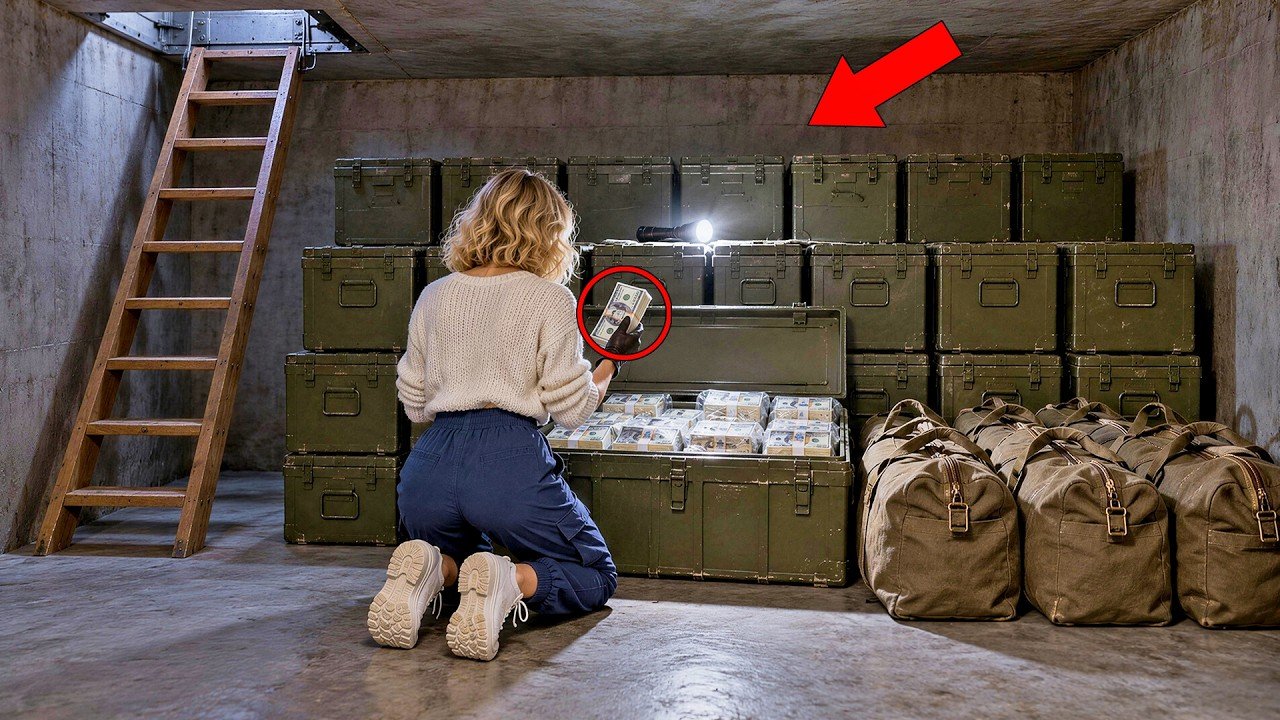
It was a concrete bunker.
The walls of the cavity were poured, reinforced concrete — smooth and dry.
The space was roughly eight feet deep and extended out beyond the boundaries of the trapdoor, forming a subterranean room right beneath the center of the house.
A heavy wooden ladder was bolted to the concrete wall, leading down to the floor of the bunker.
Nora aimed the flashlight beam at the floor of the hidden room.
Stacked against the far concrete wall, organized with terrifying meticulous precision, were dozens of heavy, olive-drab metal ammunition cans.
They were stacked three high, forming a solid wall of military-grade steel.
Next to them were five large canvas duffel bags — the kind used by banks to transport coins — zipped tight and secured with heavy brass padlocks.
Nora felt her mouth go completely dry.
Her hand was shaking so badly the flashlight beam danced erratically across the concrete.
She didn't think.
She acted on pure animal instinct.
She swung her legs over the edge of the trapdoor, found the first rung of the wooden ladder, and descended into the cold, dry dark.
The air down here was different.
It smelled of canvas, machine oil, and old paper.
Her boots hit the concrete floor with a soft thud.
She stood in the center of the small bunker, sweeping the flashlight over the metal cans.
They were completely devoid of dust.
The seal on the bunker had been perfect.
She approached the nearest stack of ammunition cans.
The heavy steel latch on the top can was locked into place.
Nora set the flashlight down on an adjacent can, angling the beam so she could see.
She gripped the metal latch, thumbed the release lever, and pulled hard.
The seal popped with a sharp hiss, the rubber gasket yielding after years of compression.
Nora pushed the heavy steel lid back on its hinge.
She looked inside.
She stopped breathing.
The can wasn't filled with bullets.
It wasn't filled with old documents or paranoid survival rations.
It was filled with money.
Stacks of it, wrapped in thick, clear, vacuum-sealed plastic bags.
Nora reached a trembling hand into the metal box and pulled out one of the heavy, plastic-wrapped bricks.
She held it up to the beam of the flashlight.
It was a solid block of hundred-dollar bills.
The bills weren't new.
They were older designs, the faces small and the paper slightly faded, but they were in pristine condition.
The brick in her hand was dense, thick, and heavy.
It had to be at least fifty thousand dollars just in this one block.
She looked back into the metal can.
There were at least twenty identical blocks packed tightly inside.
She slowly turned her head, looking at the wall of identical metal cans stretching across the concrete bunker.
Dozens of them.
And the heavy canvas bags.
Nora dropped to her knees on the cold concrete floor, the brick of money heavy in her lap.
The crushing weight of her debt, the thirty-day deadline, the ruined house above her — all of it vanished.
Replaced by a sudden, terrifying vertigo.
She wasn't standing on dirt.
She was standing on an empire.
Nora did not scream.
She did not laugh.
She did not feel the sudden, euphoric rush of a lottery winner.
What she felt was a cold, suffocating terror.
She dropped the brick of money back into the olive-drab ammunition can and pulled her hand away as if the plastic had burned her.
Her breathing echoed in the tight concrete space, harsh and frantic.
She backed away until her shoulders hit the cold, poured wall of the bunker.
She wrapped her arms around her knees, staring at the stacks of metal boxes in the beam of the flashlight.
Millions.
There had to be millions of dollars in this room.
And money like this did not exist in a vacuum.
It was not earned through overtime shifts or careful investments.
Money packed into vacuum-sealed bags and buried beneath a false concrete floor in the middle of the Texas panhandle was blood money.
It belonged to cartels.
It belonged to men who did not ask questions and did not leave witnesses.
The silence of the farm above her suddenly felt entirely different.
Yesterday, the isolation of Oak Haven had been a lonely, tragic fact.
Now, it was a tactical disadvantage.
She was miles from the nearest paved road.
She was alone.
If someone came up that driveway right now, no one would hear her scream.
Nora scrambled to her feet.
The flashlight beam swung wildly across the room.
She grabbed the heavy wooden rungs of the ladder and climbed out of the bunker, moving with a frantic, desperate energy.
She hauled herself up over the edge of the trapdoor, her boots slipping on the dusty oak floorboards.
She grabbed the heavy steel plate and dragged it back over the opening.
It slammed down into its recessed groove with a heavy metallic thud that vibrated through the floor joists.
She kicked the ragged flaps of the black tar paper over the steel, then began dragging the splintered oak floorboards back into place, arranging them like a crude puzzle over the scar in the floor.
It wasn't enough.
The broken boards were an obvious beacon.
She ran into the living room, grabbed the largest, heaviest garbage bag of rotting clothes she had packed that morning, and dragged it down the hallway.
She hauled it into the study and dumped it directly over the broken floorboards.
She went back for another. And another.
She built a foul-smelling barricade over the trapdoor until the floor was entirely obscured by Arthur's hoard.
Only then did she stop.
She leaned against the doorframe, her chest heaving, the sweat drying cold on her skin.
She needed a weapon.
She remembered a heavy, locked steel cabinet in the master bedroom upstairs.
She had ignored it the day before, assuming it was filled with more of Arthur's useless paperwork.
She ran up the narrow, groaning staircase, her boots taking the steps two at a time.
The bedroom was a sweltering oven.
The steel cabinet sat in the corner, its combination lock rusted and frozen.
Nora didn't bother trying to guess the numbers.
She went back downstairs, retrieved the heavy iron pry bar from the kitchen floor, and marched back up.
She wedged the iron claw behind the locking mechanism of the cabinet and threw her weight into it.
The cheap sheet metal buckled instantly.
The lock snapped off and hit the floor.
Nora pulled the door open.
Inside, sitting on the top shelf, was a Smith & Wesson .357 Magnum revolver.
Beside it lay two boxes of heavy-grain ammunition and a yellowed, spiral-bound notebook.
Nora picked up the gun.
It was heavy, oiled, and perfectly maintained — a stark contrast to the decaying ruin of the house around it.
She popped the cylinder.
Six brass cartridges stared back at her.
She snapped it shut, her thumb resting on the heavy hammer.
The weight of the steel in her hand anchored her.
It slowed her heart rate.
She set the gun on the mattress and reached for the spiral-bound notebook.
She carried the notebook and the revolver downstairs to the kitchen.
She sat at the sticky, vinyl-covered table — the only piece of furniture left in the room.
Outside, the sun was beginning to set, casting long, bruised shadows across the dead grass.
The wind picked up, howling through the broken slats of the barn.
Nora opened the notebook.
The pages were filled with Arthur's cramped, erratic handwriting.
But this wasn't the manic rambling of a hoarder.
It was a ledger.
And it was a confession.
Nora turned on a battery-powered camping lantern, pushing away the encroaching dark, and began to read the history of her inheritance.
The first entry was dated the 14th of October, 1998.
"Storm took down the power lines on the north ridge. Creek flooded over the banks, found the wreckage in the mud on the south edge of the property line. Small twin-engine. Pilot was dead. Passenger was dead. Cargo was intact."
Nora traced the faded ink with her fingertip.
In 1998, she was four years old.
Her mother was working three jobs just to keep the lights on in a cramped apartment in Fort Worth.
And Arthur was out here dragging bodies out of the mud.
She turned the page.
"16th of October, 1998. Buried the two men in the old limestone quarry. Covered it with the bulldozer. Hauled the cargo back to the house in the dark. Six duffels. Twelve metal cases. I counted it twice. Six million, four hundred thousand dollars. Hundred-dollar bills. Used, unmarked, cartel money. Has to be. They will come looking for it."
Nora felt a chill crawl up the back of her neck.
Six point four million.
The number was too large to process.
It was a theoretical concept — an abstract weight that suddenly sat right here in the rotting kitchen with her.
The subsequent entries chronicled Arthur's descent into a deeply rational, entirely suffocating madness.
"November 1998. Rented the concrete mixer under a fake name in Amarillo. Dug the hole by hand, working only at night. Covered the windows. If they fly over, they won't see the light. If they drive up, I hear the gravel."
"March 1999. It's safe, but I can't spend it. Not a dime. If I buy a new truck, they will know. If I pay off the mortgage entirely, the bank flags it to the IRS. If the IRS looks, the cartel looks. The cartel has eyes everywhere in the banks down here. I have to wait five years."
But Arthur didn't wait five years.
The ledger revealed a man who had become entirely paralyzed by his own fortune.
As the years ticked by, his paranoia mutated.
He stopped going into town.
He stopped buying fresh food.
He let the tractors rust because repairing them required hiring mechanics who might snoop around the house.
He began hoarding trash to make the property look utterly devoid of value.
A camouflage of poverty to hide the empire beneath his feet.
"August 2005. I took out one bill. Just one hundred dollars. Went to a gas station in Lubbock to break it. The cashier looked at it too long. He held it up to the light. I panicked. Walked out without the change. I am being watched. I know I am. The house is the only safe place."
Nora stared at the page, her eyes burning.
Arthur had let his own son — Nora's father — die of untreated kidney failure in 2011 because he refused to pay the hospital bills.
He had the money to save him buried in the dirt just fifty feet from where he slept.
He could have anonymously paid the debt.
He could have hired the best specialists in Houston.
But he was too terrified that the sudden influx of cash would alert the ghosts he believed were hunting him.
He had chosen the money over his own flesh and blood.
He had chosen the dark.
"January 2024. The roof is leaking in the study. I can't hire a roofer. I put buckets down. The money is safe. The bunker is dry. I am tired. My chest hurts. But I won't let them take it. It's mine."
That was the last entry.
He died three weeks later, collapsing in the hallway of a massive coronary, surrounded by towers of old newspapers and empty cans, starving to death on top of a mountain of cash.
Nora slammed the notebook shut.
The sound echoed in the empty kitchen.
A deep, violent hatred for the man surged in her chest.
She grabbed the notebook and threw it across the room.
It hit the peeling wallpaper and fluttered to the floor.
Arthur hadn't left her an inheritance.
He had left her a curse.
He had built a psychological prison and died inside it, and now the door was open, inviting her to step inside.
She looked at the revolver.
She understood the logic now.
She understood the fear.
If she tried to deposit a million dollars into her checking account, the federal government would freeze her assets within forty-eight hours.
The DEA would be at her door.
And if the money still belonged to the ghosts of 1998, the cartel would find her long before the trial.
She couldn't take it.
She had to walk away.
She had to let the county take the house, let the bulldozers come, and let the secret stay buried under the concrete forever.
It was the only way to survive.
Then she thought of her checking account. Eighty-four dollars.
She thought of the thirty-year mountain of student loan debt waiting for her in Dallas.
She thought of her manager at the diner, a man who docked her pay when the grill broke.
She thought of her mother, who had worked until her spine gave out, dying in a rented room that smelled of bleach and despair.
Arthur had let the money control him because he was a coward.
He lacked the imagination to use it.
He lacked the courage to launder it.
Nora was not a coward.
She reached out and placed her hand over the cold steel cylinder of the revolver.
The fear was still there — a hard knot in her stomach — but the panic was gone.
It was replaced by a cold, calculating clarity.
She was not going to die in a diner.
She was not going to let the bank win.
She was going to take it all.
The crunch of gravel broke the silence of the third night.
Nora woke instantly.
She was sleeping on the floor of the master bedroom, the revolver tucked under her makeshift pillow of folded clothes.
She didn't turn on a light.
She rolled quietly to her feet, moving to the window overlooking the long dirt driveway.
It was 2:15 a.m.
The moon was a thin, useless sliver in the sky.
A vehicle was creeping up the drive.
It wasn't the pristine white truck of the real estate agent.
It was an old, heavy-duty pickup, its headlights cut off, moving by the dim glow of its running lights.
The engine gave a low, throaty rumble that vibrated through the cracked windowpane.
Nora felt her pulse hammering a frantic rhythm in her throat.
They know. The ghosts are here.
She grabbed the revolver, checking the cylinder by touch in the dark.
Six rounds.
She thumbed the hammer back.
The sharp click sounded deafening in the quiet room.
The truck rolled to a stop near the sagging porch.
The engine died.
A heavy silence settled over the property.
Nora crept out of the bedroom, moving silently down the stairs, pressing her weight against the edges of the steps where the wood was less likely to groan.
She reached the bottom and pressed her back against the wall of the hallway, right next to the front door.
She heard a heavy pair of boots hit the dirt.
A car door shut quietly.
Then a voice. Rough, quiet, and old.
"Arthur, you miserable old bastard. I know you're dead."
It wasn't a cartel hit squad.
It was one man.
Nora peered through the side window.
The man standing on the porch was in his late sixties.
He wore a faded canvas jacket, a battered Stetson, and held a lever-action hunting rifle casually in his right hand.
He didn't look like a professional killer.
He looked like a desperate local who had run out of options.
He stepped up to the front door and tried the handle.
It was locked.
He stepped back, raised his boot, and kicked the heavy oak door right next to the lock.
The rotted wood of the door frame splintered instantly.
The door swung inward, crashing against the interior wall.
Nora stepped into the doorway, raising the heavy Smith & Wesson, leveling it directly at the man's chest.
"Drop the rifle," she said.
Her voice was steady. It surprised her.
The old man froze.
He looked at the barrel of the .357, then up at Nora.
He didn't raise his hands, but he didn't raise his rifle either.
He squinted in the dark.
"You must be the granddaughter," he rasped, his voice thick with phlegm and cigarettes. "The lawyer in town said some girl came down to clean out the trash."
"I said drop it."
Nora steadied her grip. "I'll put a hole through your lungs before you can clear that lever."
The man let out a dry, rattling chuckle.
He opened his hand and let the rifle clatter to the porch floorboards.
He kicked it away with his boot.
"Relax, girl. I ain't here to shoot nobody over a pile of dirty money."
Nora didn't lower the gun. "Who are you?"
"Name's Miller," he said, hooking his thumbs into his belt loops. "I used to run diesel with your granddaddy back before he lost his damn mind. I hunted this property for twenty years. Watched him haul cement out here in the dead of night back in '98. Watched him sit on this porch with a shotgun for twenty-five years, guarding dirt."
He took a slow step forward. Nora tightened her finger on the trigger. He stopped.
"Arthur told everybody he was broke," Miller continued, his eyes scanning the empty living room behind Nora. "But a man don't guard empty dirt. I know he found something out there in the mud when that plane went down. The whole county heard the crash, but the sheriff never found the wreck. Arthur found it, and he hid whatever it was in this house."
"He was a hoarder," Nora lied smoothly, her face a mask of cold indifference. "He hid trash. I've spent a week throwing out thirty years of old newspapers and cat food cans. The bank is seizing the property on Monday for back taxes. There's nothing here."
Miller smiled. It was an ugly, broken expression.
"Don't play me for a fool, girl. The bank don't seize property that fast. I need ten thousand dollars. I got a bad liver and a hospital bill the size of a mortgage. You give me ten grand and I walk away. I forget Oak Haven exists. You don't. And I make a phone call to some boys in Juarez who are still very interested in what happened to a certain flight in '98."
Nora's mind raced.
If she paid him, she confirmed the money was here.
He would be back in a month for twenty thousand.
He was a leak that would eventually sink her.
She needed to break his leverage.
She needed to make him believe the well was dry.
"Call them," Nora said, her voice dropping to a dangerous, flat whisper.
Miller blinked. The smile faltered. "What?"
"Call them."
Nora repeated, taking a step forward out of the shadows, letting the moonlight catch the cold steel of the revolver.
"Call the cartel. Tell them Arthur Hayes found their money twenty-five years ago. Tell them the money is gone."
She kept her eyes locked on his.
"Arthur spent his life terrified of shadows. I found his ledger. I know what he did. But you're wrong about the money, Miller. He didn't hide it here. He buried it out in the south pasture. And yesterday, the county environmental team came out with ground-penetrating radar to assess the illegal diesel dump for the soil cleanup."
Miller's face went pale.
"They found the anomaly," Nora lied, her voice dripping with absolute conviction. "The state police were out here at noon. They dug it up. All of it. Three squad cars, a federal agent, and a backhoe. They took the metal cans. They took the duffels. The FBI seized the entire property as a crime scene. That's why the door was unlocked when I got here. They're coming back at dawn with a forensic team to tear up the foundation."
Miller stared at her, his jaw slack.
"No. No, he kept it here. He never took his eyes off the house."
"He was paranoid, Miller. He guarded the house so no one would look at the pasture."
Nora lowered the gun slightly, letting a look of bitter exhaustion wash over her face.
"I'm fifty thousand in debt, standing in a condemned house that the federal government is about to seize at sunrise. I didn't get a dime. I'm just here to grab his mother's wedding ring before the feds lock the gates. So if you want to call Juarez, call them. Tell them the FBI has their cash. See how much of a reward they give you."
Miller looked at the ruined living room, the stacks of trash bags, the peeling wallpaper.
The absolute squalor of the place seemed to finally register with him.
A man sitting on millions didn't live like this.
The lie was perfect because it fit the tragedy of Arthur's life perfectly.
The old man slumped. The fight draining out of him in an instant.
He looked old, tired, and defeated.
"God damn him," Miller whispered. "God damn that miserable old freak."
He turned slowly, stepped off the porch, and walked back to his truck.
He didn't look back.
The engine coughed to life.
The headlights flicked on, and the beat-up Chevy rolled down the dirt driveway, fading into the dark Texas night.
Nora stood in the doorway for a long time, the heavy revolver hanging at her side.
The lie had worked.
But it had bought her days, not years.
She couldn't stay here.
The longer the house stood, the more vulnerable the bunker was.
She needed to act immediately.
She had the money.
Now she needed the dirt.
The next morning, Nora packed a single canvas duffel bag.
She climbed down into the bunker, unzipped the heavy canvas, and carefully transferred fifty thousand dollars in small, faded hundreds into a standard black gym bag.
She zipped it tight, hauled it up the ladder, and sealed the trapdoor.
She pulled the trash bags over the scar on the floor, locked the front door of the farmhouse, and got into her car.
She didn't drive to Dallas.
She drove north, crossing the Oklahoma border just after noon.
The casino was a massive, glittering monument to desperate hopes, rising out of the flat prairie like a neon mirage.
Nora walked through the sliding glass doors, the blast of conditioned air smelling of stale smoke and ozone.
She bypassed the table games and headed straight for the high-limit slot machines.
Over the next six hours, she played a methodical, agonizing game of financial alchemy.
She fed the old 1990s hundred-dollar bills into the machines, played a few spins to register activity, and then hit the cash-out button.
The machine spat out a bar-coded ticket.
She took the tickets to the automated kiosks and exchanged them for crisp, newly minted currency.
She washed twelve thousand dollars this way, moving from machine to machine, losing a few hundred to the house edge, but effectively scrubbing the serial numbers and the history off the cash.
It was exhausting, tedious work, but when she walked out of the casino at dusk, her purse held ten thousand dollars of untraceable, perfectly clean money.
The next morning, she sat in the polished oak office of Gregory Finch, the estate attorney.
She wore a clean blouse she'd bought at a department store on the way into Dallas.
Her hair was washed and pulled back tightly.
She sat straight in the leather chair, projecting the aura of a woman who had simply run out of patience.
"I've decided to retain the property," Nora said, sliding a thick manila envelope across the desk. "Inside is a cashier's check for forty-two thousand dollars. It covers the back taxes in full. The remaining funds are for your retainer."
Finch blinked, looking at the envelope as if it were a live grenade.
He opened it, inspected the bank check, and looked up at her in genuine shock.
"Miss Hayes, yesterday you told me you were virtually bankrupt. Where did you secure this kind of capital overnight?"
"I secured a private loan from a silent partner," Nora lied smoothly, her tone leaving no room for follow-up questions. "I'm setting up an LLC today. Oakhaven Holdings. The property deed will be transferred to the company. The tax lien is cleared. The land is mine. Proceed with the paperwork."
Finch swallowed hard, adjusting his glasses.
"Very well. But you understand the environmental liability remains. The land is virtually useless for agriculture until the diesel spill is remediated."
"I don't intend to farm it," Nora said, standing up. "I'm going to develop it."
Three days later, Nora stood at the end of the long dirt driveway on County Road 9.
The morning air was thick with diesel fumes and the roar of heavy machinery.
Two massive yellow excavators were tearing into the side of the rotting farmhouse.
The sagging porch collapsed first, groaning in a cloud of white dust and splintered wood.
The roof caved in violently, taking the second floor with it.
Nora watched with her arms crossed.
She didn't feel a shred of nostalgia.
She felt only the deep, satisfying release of a tumor being cut from bone.
The demolition crew worked fast.
By noon, the house was a flattened pile of debris.
They loaded the wreckage into a convoy of heavy dump trucks, hauling away the ghosts, the garbage, and the misery of Arthur Hayes.
When the site was cleared, leaving nothing but the original concrete slab foundation, the foreman walked over to Nora, wiping sweat from his brow.
"Slab's cracked to hell, boss," the foreman yelled over the idling engines. "You want us to rip it out?"
"No," Nora shouted back. "Leave it. I've got a concrete crew coming tomorrow morning. We're pouring a new industrial pad directly over the old slab. Ten inches thick, steel reinforced. The new warehouse goes right on top."
The foreman shrugged. "Your money, your call."
Nora smiled. It was a small, dangerous smile.
By the end of the week, a massive, unbroken sheet of pristine white concrete covered the exact footprint of the old farmhouse.
It was thick enough to withstand an earthquake.
Underneath it, securely entombed beneath layers of steel mesh, curing cement, and the old trapdoor, was the bunker.
She had built an impenetrable vault.
The money was safe from the cartels, safe from the government, and safe from trespassers.
It would sit there, quietly waiting in the dark.
Nora would build a cheap metal storage facility on top of it, creating a legitimate business front that generated a modest, clean income.
And every few months, when the facility was closed and the cameras were off, she would drill an access panel, slip down into the dark, and take exactly what she needed.
Nothing more.
She got into her ten-year-old sedan.
The air conditioning was still broken.
The seats were still torn.
But as she gripped the steering wheel, the car felt different.
The world felt different.
She put the car in drive and pulled onto the county road.
She didn't look back in the rearview mirror.
Arthur Hayes had spent his life staring at the dirt, terrified of the horizon.
Nora kept her eyes firmly on the road ahead.
She owned the dirt now.
And the horizon belonged to her.