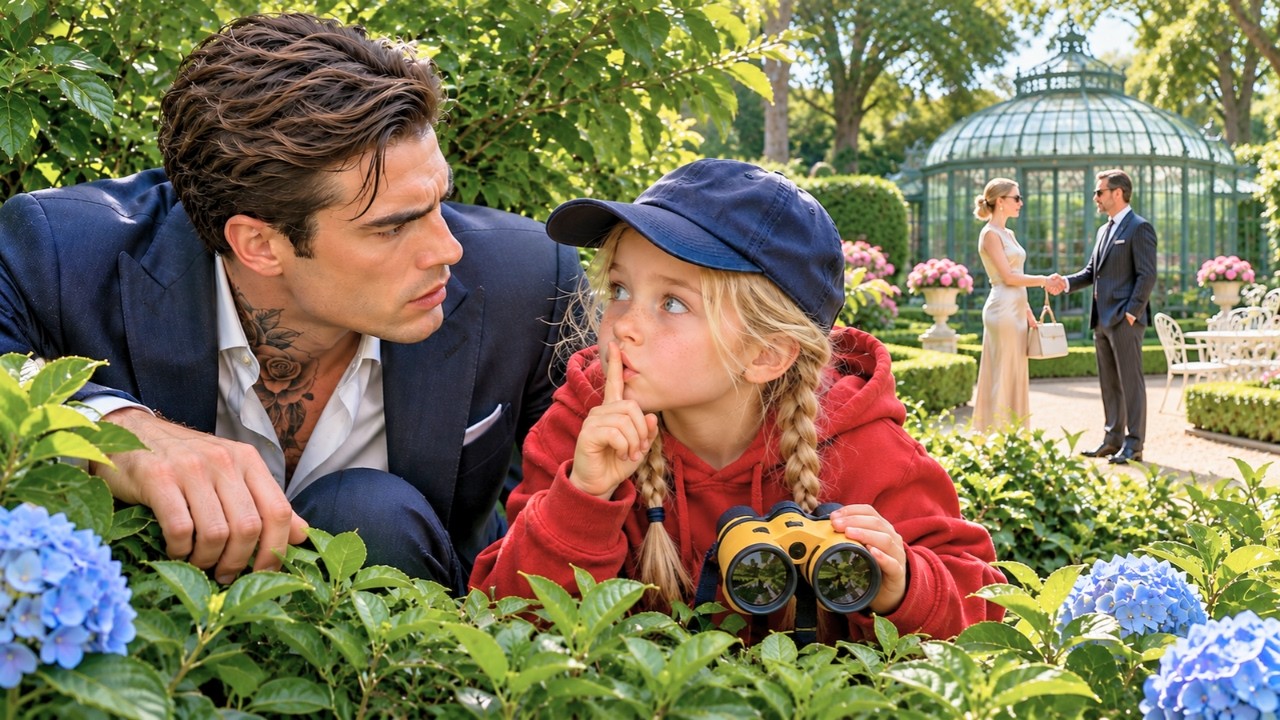
"Shh, I'm spying on your fiancé."
The whisper came from behind the tallest hedge of blue hydrangeas at the south end of the garden, and it was so small and so serious that Dante Moretti stopped walking in the middle of the gravel path.
It was four o'clock on a Thursday afternoon in late June.
The Moretti estate on the north shore of Long Island had been built by his grandfather in 1958, forty-two rooms of white limestone wrapped around a central courtyard, and the garden stretched three hundred yards from the back terrace down to the private seawall.
The hydrangeas along the south path had been planted the year Dante was born.
His mother had chosen the color herself.
Thirty-five years later, they were still the same blue, the blue of a shallow sea in early morning, and the perfume they threw off in the heat was the one smell Dante associated with being home.
He had been walking the long loop he walked every afternoon when business allowed it, hands in the pockets of a charcoal linen trouser, collar open, the jacket already folded over the back of a chair in his study.
The low gold light of the hour before dinner lay across the lawn in long warm bands.
He stopped.
He listened.
He did not call out.
The whisper came again, slightly louder, and this time it was followed by the small, careful rustle of a child trying very hard not to be heard.
Dante stepped off the gravel and came around the flank of the hedge from the kitchen garden side.
A pair of pink sneakers was all he saw at first.
Then the sneakers rose into small white socks, into denim overalls, into a yellow cotton shirt, and finally into a face he knew.
Sophie Carter was five years old.
Her hair was the color of unsalted butter, pulled into two uneven pigtails that her mother had tied for her that morning.
Her cheeks were round and warm with the afternoon.
In her right hand, she held a plastic magnifying glass, pink around the rim, the kind that came in cereal boxes.
She had the lens pressed close to one eye, and the eye behind it was enormous and very blue and very grave.
She turned her head when she sensed him.
The lens dropped.
The small round face went pale, then flushed, then composed itself with the dignity of a diplomat caught in a hallway.
Dante felt the smile arrive before he could stop it.
He had not smiled like that at anything in his own garden for a long time, and it surprised him.
He crouched down on his heels so that his eyes came level with hers.
"Detective Sophie," he said, "who are we spying on today?"
She did not laugh.
She did not blush any further.
She lifted the magnifying glass a careful inch, lowered it, and looked past his shoulder in the direction of the glasshouse that sat at the far east corner of the garden, half hidden by a stand of old lilacs.
Then she looked back at him, and her small mouth drew itself into a line that was far too old for her age.
"Three days now, Mr. Dante," she whispered. "Three days."
Dante did not stand up.
He stayed on his heels, his elbows resting lightly on his knees, so the child above him would not feel she was speaking to a tower.
"Tell me," he said.
His voice was quiet, the way a man speaks to a bird that has landed near his hand.
"Tell me about the three days."
Sophie glanced once more toward the glasshouse behind the lilacs.
She took a careful breath, the way she had seen grown-ups do when they were about to report something important.
"Monday," she said, lifting one small finger, "after lunch, the big clock in the hall said two. Miss Isabella came out through the French doors. She looked left. She looked right. She did not see me because I was behind the stone frog. She walked fast, Mr. Dante. Ladies in nice shoes don't walk fast unless they want to get somewhere nobody is watching."
A second finger rose.
"Tuesday, same time, two o'clock, same path. She had a little white bag I never saw her carry before. She went inside the glasshouse, and she did not come out for twenty-two minutes. I counted on my mother's kitchen timer. I set it before I went out."
A third finger.
"Wednesday, two o'clock again. But yesterday was different."
The small voice dropped.
"Yesterday there was a man."
Dante kept his face still.
"A man?"
"I never saw him go in. I only heard him."
Sophie leaned closer, her breath warm and smelling of apple juice.
"He was whistling, Mr. Dante, soft, like he did not want anybody outside to catch it. But I heard. The glasshouse makes everything sound bigger if you stand next to the back wall."
"Can you whistle it for me, Detective?"
Sophie pursed her lips.
The sound that came out was thin and uneven, but the notes were in the right order, and Dante knew them before she reached the fourth bar.
Low, low, high.
Low, low, high.
A slow descending line, a small lift at the end, like a question that did not expect an answer.
The Boatman's Daughter, an old lullaby from the fishing villages along the Jersey coast.
Not a famous song, not a song anyone outside two or three families would even recognize.
Dante had heard it exactly once inside this house, eighteen months ago, drifting up the back stairs on a winter evening, when he had come down for a glass of water and had paused in the hallway outside the staff quarters.
Daniel Carter had been singing it to his daughter through a closed door, low and off-key and tender, before bed.
The warmth in Dante's chest cooled by one slow degree.
His smile did not fall.
He held it exactly where it was.
"That is a very good whistle, Detective," he said. "Where did you learn that song?"
"My daddy used to sing it," Sophie said.
The grave little mouth trembled for one second, then set itself again.
"Only him. Only ever him."
From the kitchen window across the lawn came the clear, familiar sound of Elena Carter's voice.
"Sophie! Sophie, honey, snack time!"
The child turned her head at once.
"Coming, Mama!"
She looked back at Dante.
She tucked the pink magnifying glass into the front pocket of her overalls with the care of a professional stowing a service weapon.
Then she leaned one small hand against his knee for balance, pushed off, and ran across the gravel toward the house, pigtails jumping behind her.
Dante did not move for a long time.
He stayed crouched beside the hydrangeas with the hum of bees around him and the low gold light sliding down the hedges.
His eyes rested on the far corner of the garden, on the pale glass walls half hidden by the lilacs, on the green shadow inside where no silhouette moved.
Three days.
Two o'clock.
A whistled lullaby that only a dead man was supposed to know.
Dante gave himself five full minutes before he moved.
He rose from his crouch, brushed the gravel from his trouser knees, and walked the long way back to the house, through the rose beds and around the fountain, so that nothing in his pace would read as hurried to anyone watching from an upstairs window.
The kitchen door was open.
The warm yellow light of the room spilled onto the flagstones outside.
Elena Carter stood at the deep farmhouse sink with her back to the door.
She was thirty-two years old, slim at the shoulders, her dark hair twisted up and held with a pencil that had been there since morning.
A stack of blue china sat on the drying rack beside her.
She was washing a wooden salad bowl by hand, slowly, the way a person works when their hands are busy so their thoughts can be elsewhere.
Dante crossed the tiled floor without raising his voice.
"Elena."
She turned, startled, and dried her hands on the apron at her waist.
"Mr. Moretti. Did Sophie bother you in the garden? I told her not to go past the lilacs."
"She did not bother me."
He pulled out a tall stool at the counter and sat down, so his height would not loom.
"She is a very polite child."
Elena's smile was quick and thin.
The hollows under her eyes were deeper than they had been in the spring.
She had lost weight.
She had tried to hide it under a looser apron.
Dante let the quiet sit for a moment, then he said, as if he were asking after a cousin, "How are you doing, Elena? Really?"
The small smile wavered.
She looked down at the wooden bowl in her hands.
"I am fine, sir. We are fine."
"And Daniel?"
The name landed in the room the way a dropped glass lands on a tile floor.
Elena did not look up.
The bowl in her hands turned once, slowly, in the soapy water.
"Eight months tomorrow," she said.
"Eight months since he walked out of this kitchen and did not come back. The letter from the office said he had taken money. Numbers I had never seen in my life. The newspaper picked it up for one day, and then they forgot. I have been pretending we are fine since then, Mr. Moretti, because that is what Sophie needs."
"And Sophie?"
Elena finally lifted her eyes.
They were red-rimmed and very steady.
"She does not believe her father left us. She will not say it, but she does not. She still sets a third place at the table on Sundays."
Dante nodded once.
He reached for a tangerine from the fruit bowl on the counter and began to peel it, slowly, as a man peels something only to give his hands a reason to be moving.
"Elena, the lullaby Daniel used to sing her, the slow one with the long low notes. The Boatman's Daughter."
The smile that came to her mouth now was sadder and more private than any she had shown him.
"His grandfather sang it on a trawler out of Belmar sixty years ago. Daniel sang it to Sophie every night from the day she was born."
"Who else knew that song? Elena, in this house, anywhere?"
Her brow drew.
"No one, Mr. Moretti. No one outside the three of us. It is not even on any record I ever found."
Dante set the half-peeled tangerine on the counter.
He stood up.
"Thank you, Elena. Lock the kitchen door tonight."
He walked out before she could ask why.
The cream Bentley came up the curving drive at 6:23, exactly seven minutes before Isabella Russo had said she would arrive.
Dante watched it from the tall window of his study on the second floor and timed the small adjustment she always made to her hair in the side mirror before stepping out.
One minute, forty seconds.
Longer than usual.
She crossed the gravel in low ivory heels.
Her dress was pale green silk, cut simply, the kind of simplicity that cost more than most of the cars parked at his gate on business nights.
Her dark hair was loose on her shoulders.
She looked up at the window she could not quite see him through and lifted one hand in a small, affectionate wave at the house.
Dante lifted two fingers back, because that was what a man about to be married did, and watched her disappear beneath the portico.
The second car arrived four minutes later, a black sedan, polished to a wet shine, driven by a man Dante had known for twelve years.
Marcus Bellini stepped out of the driver's door himself, as he always did, because he would not let any other hand steer a vehicle that carried him to the Moretti estate.
He was forty-one, broad at the shoulder, dark-suited, his hair cropped close.
The thin white scar at the corner of his jaw caught the last of the sun.
Two years earlier, in a parking garage off Mulberry, that scar had been a bullet meant for Dante.
Marcus looked up at the same window.
He did not wave.
He nodded once, slowly, the way a soldier nods at a general.
They met at the long dining table at seven.
Isabella at Dante's right, Marcus at his left, candles between them.
The housekeeper on duty, not Elena, laid out veal and spring peas and a chilled white Burgundy.
Isabella laughed softly at something Marcus said about traffic on the Midtown Tunnel.
The scent that rose from her wrist when she lifted her glass was jasmine with a thread of wood smoke running under it.
The perfume she had worn since the first night Dante had met her.
Dante ate slowly.
He asked the ordinary questions.
Who she had seen in the city, which boutique had finally called her back about the second fitting, whether the florist had confirmed the white peonies for the engagement party on Saturday.
Isabella answered all of them in her soft, musical voice.
Her left hand rested lightly on his wrist between courses.
The diamond on her fourth finger threw small bright squares of light onto the linen cloth.
Marcus spoke only when spoken to.
He drank very little.
His eyes moved once, briefly, across Isabella's face when she laughed, and once across Dante's, and he caught Dante watching him, and he smiled the broad, warm smile of a brother.
Dessert was almond cake and black coffee.
Isabella set down her small silver spoon.
She pressed her napkin to the corner of her mouth.
She rose.
"Darling, give me twenty minutes. The white orchids in the glasshouse need water, and the gardener will not do it the way I like."
She bent, kissed the top of his head, and crossed the dining room on her low ivory heels.
Dante lifted his coffee.
He did not watch her go.
Inside the pocket over his heart, he quietly noted the time and the lie.
By eleven, the house had gone quiet.
Isabella had returned from the glasshouse at eight minutes past eight, forty-three minutes after she had left, her lipstick slightly fainter than it had been at the table and a small streak of something green in the heel of her ivory shoe.
She had kissed Dante on the cheek, pleaded a headache, and gone upstairs to the suite she had been using for the last three months.
Marcus had taken his coffee in the library with a stack of security reports, said his good nights at ten, and let his black sedan carry him down the long drive.
Dante had read in the study until the last footstep on the service stair faded.
Then he had turned off the main overhead and sat for a long time in the small pool of light from the brass desk lamp.
At midnight exactly, he reached into the lower left drawer and drew out a laptop that no member of his staff had ever touched.
It had no label, no sticker, no company serial.
It had been built for him three years ago by a boy in Astoria who was now dead of other reasons, and it answered only to his thumbprint and a fourteen-character passphrase he had never written down.
The screen woke.
He opened the private mirror of the estate security log.
The mirror pulled from a separate fiber line buried under the north wall of the garage, hidden from the main house system.
It wrote to a drive nobody but Dante knew existed.
Every camera, every motion sensor, every door contact on the property reported into it in parallel with the ordinary feed Marcus's team watched from the gatehouse.
It had been Dante's grandfather's one rule, passed down with the keys to the vault.
Never let the man you trust most be the only man who sees.
Dante scrolled to the glasshouse cluster.
Six cameras ring the structure.
Two inside the pitched glass roof, one at each of the four cardinal walls.
The feed window for all six was dark.
He clicked into the authorization log.
The entry sat at the top of the column, as neat as a signature on a check.
"19 days ago, 22:41 hours. Camera cluster 7. Offline for scheduled maintenance. Reauthorization window indefinite. Authorizing officer: M. Bellini."
Dante read it once.
He read it a second time, slowly, letter by letter.
Then he opened the adjacent clusters.
The two cameras on the lilac grove, dark.
The camera on the service path that ran behind the kitchen garden to the glasshouse door, dark.
The low motion sensor on the gravel between the hydrangea hedge and the eastern wall, dark.
All of them stamped with the same authorizing initials.
All of them set offline within the same twenty-minute window.
A ring of blindness had been drawn around the glasshouse on the night of the sixth of June.
It had not been lifted since.
Dante sat back in the chair.
He did not move for a long time.
He was not surprised, which was perhaps the coldest part of the moment.
Somewhere inside the quiet machinery of his mind, a line had been drawing itself for a long time, and tonight the pencil had finally reached the paper.
He thought of a bullet two years ago in a parking garage off Mulberry.
He thought of a white scar at the corner of a jaw.
He thought of twelve years of Thursday evenings, Marcus at his left hand at dinner, Marcus at his right hand at every door.
He closed the laptop.
He did not call his lieutenants.
He did not reach for a phone.
He did not even stand.
He only placed his two hands flat on the surface of the desk, and he decided, in the yellow light of the lamp, the one thing a man in his position had the discipline to decide first.
Silence.
Watch.
Learn the whole shape of the knife before touching it.
He turned off the lamp.
He walked up the stairs in the dark.
Outside Sophie's small window at the end of the staff hall, the hydrangeas moved once in the sea wind and then were still.
Dante slept perhaps two hours.
By seven in the morning, he was back behind his desk in a fresh shirt.
And by noon, he had made exactly one phone call.
"Marcus. Dinner tonight. Just the two of us. Eight o'clock. I had the kitchen pull out the Barolo your father used to send me."
"The '97?"
Marcus's voice warmed, the way it always warmed at the mention of his father.
"Boss, for what occasion?"
"No occasion. I have missed a quiet table with you."
The line was quiet for one small beat.
Then, "I'll be there at 7:45."
He arrived at 7:42, as Dante had known he would.
The small dining room off the library had been laid for two.
The chandelier had been dimmed.
The Barolo breathed in a crystal decanter at the center of the cloth.
Rosa, who had served the Moretti family for twenty-nine years, poured the first glass and withdrew without a sound.
They ate the first course in the low, easy quiet of two men who had broken bread together across a thousand tables.
Marcus asked after Isabella.
Dante answered that she had a headache again.
Marcus made a small, concerned face and said the wedding week was always like this, that his own sister had barely eaten in the final days before her ceremony.
Over the second course, between the veal and the small bitter salad, Dante set his glass down and let the silence stretch for one unhurried second.
"Marcus, I have been thinking about reopening the Carter file."
The fork in Marcus's hand did not stop.
The knife did not pause.
The small muscle at the corner of his jaw, the one just beneath the thin white scar, did not move.
"Daniel Carter?"
Marcus took a sip of the Barolo.
"After eight months?"
"After eight months."
Marcus set the glass down with great care.
He looked across the table with the open, patient face of a brother being asked a hard question.
"Boss, may I speak freely?"
"Always."
"Close that file. Permanently. Burn it if you want. The money is gone. The man is gone. The forensic accountants we hired said as much in their final report. All reopening it does now is drag Elena and the child through another round of newspapers, another round of federal interviews, another round of questions that have no answer."
His voice softened in exactly the right place.
"She has suffered enough, Dante. Let her have her kitchen and her little girl in peace. Do not disturb her anymore."
The sentence was perfect.
The compassion in it was perfect.
The small, precise placement of Elena's name was perfect.
Dante nodded slowly.
He said, "You are probably right."
Marcus's shoulders settled by a quarter inch.
That was when the door opened.
Isabella came in without knocking in a dove gray silk robe over a cream nightdress, her feet bare on the parquet.
"I heard voices."
She crossed the room on a soft apologetic smile.
"My headache is better. I thought I would come down for a sip of water."
She bent to kiss the top of Dante's head, the way she always did.
Then she went around the table.
She bent and kissed Marcus on the cheek.
She did not pause before it.
She did not ask with her eyes.
The kiss landed exactly on the small white scar beneath his jaw with the certainty of a woman who had placed it there a hundred times before.
"Goodnight, boys," she murmured, and padded back out through the library.
Marcus did not blush.
Marcus did not laugh it off.
Marcus did not even blink.
He lifted his glass and said warmly, "She has gotten so comfortable here. It is beautiful to see."
Dante lifted his own glass.
He smiled inside the quiet filing room behind his ribs.
He opened a drawer and set the kiss there beside the lullaby and the disabled cameras, and closed the drawer again.
Dante was in the garden again at 6:15 the next morning in a soft gray sweater and his oldest leather shoes, the ones he kept for walking the seawall before the house was awake.
The air was still cool.
The hydrangeas were still folded in on themselves against the dew.
The glasshouse at the far east corner sat quietly behind the lilacs in the pale blue light, as innocent as a greenhouse ever looks before any human has lied inside it for the day.
He walked the long gravel loop.
He paused at the stone frog Sophie had mentioned.
He crouched there for a moment and looked at the view the child had of the French doors on the back terrace.
The sightline was clean.
A five-year-old on her stomach behind the frog would have seen every step a woman in low heels took across the flagstones.
He straightened.
He turned.
She was standing at the end of the path in a pale yellow nightgown and the pink sneakers from the day before, her butter-colored hair uncombed from the pillow.
In both hands she clutched a small notebook, pink-covered, the corners already soft from use.
She crossed the gravel on tiptoe as if she still believed noise was dangerous.
"Mr. Dante."
Her whisper was no louder than yesterday's.
"I brought my notes."
He went down on one knee.
He did not reach for the notebook.
He waited for her to offer it.
She did.
With both hands.
The cover said DETECTIVE NOTES in uneven block capitals, written in red crayon.
Underneath, in smaller letters, S. Carter.
Five years old, case number one.
He opened it slowly.
The first page was a map of the garden, drawn in blue crayon.
The hydrangeas were blue circles.
The lilacs were purple scribbles.
The glasshouse was a tall triangle with a door marked by a careful black square.
Dotted lines showed Isabella's route from the terrace to the door.
Beside the door, a small stick figure stood with its arms down.
He turned the page.
Here, the drawing was more detailed.
A yellow-haired woman in a green dress held out her hand toward a taller figure in black.
In her palm, drawn in careful silver crayon, was a small flat rectangle, roughly the size and shape of a credit card.
A line of tiny dots ran along one edge, the way a child draws the chip on a bank card she has seen her mother hold.
"She gave him this," Sophie whispered. "Through the little window at the back of the glasshouse. She stood on the big flower pot to reach up."
He took it and put it inside his coat.
Dante turned the page again.
The man had been drawn more carefully than anything else in the book.
A long dark coat, drawn in heavy black crayon.
Four round silver dots down the front.
Four buttons.
Dante understood.
Large and polished.
The figure stood a full head taller than the Isabella figure beside it.
The face was blank.
Sophie had drawn no features, only a small question mark where the eyes should have been.
"I never saw his face, Mr. Dante. The glass is too foggy at the back. But he is tall. Taller than Daddy. Taller than Mr. Marcus."
He turned to the last written page.
A single word, carefully printed in black crayon.
FALCON.
Beneath it, in smaller letters, as if the child had tried a second time to get the sound right, "Falco."
"She said it twice," Sophie whispered. "She said, 'Falcon says tomorrow.' And then later she said, 'Tell Falco he is wrong.' I am not sure which one is right. I am sorry, Mr. Dante. I only had one ear against the glass."
Dante closed the small book very gently.
He slid it into the inside pocket of his sweater, over his heart, next to the lullaby and the kiss and the ring of blind cameras.
He laid one hand lightly on the top of her uncombed yellow head.
"Detective Sophie," he said, "you have done more in one week than most grown men do in a year. Go wash your hands for breakfast. Tell no one you came out here, not even your mother."
She nodded, grave as a judge.
She ran back toward the kitchen door on her small pink sneakers.
Dante stayed on one knee in the gravel for a long moment, his hand still raised in the air where her hair had just been.
Dante drove himself.
He took the old gray Volvo from the back of the fourth garage bay, the car that had been registered twelve years ago to a cousin who no longer lived in the country.
He left the estate through the service gate at 9:22 in the morning, told the gatehouse he was going to buy coffee beans in the city, and watched in the mirror until the long drive emptied behind him.
The coffee shop in Astoria was called Nona Lucia's.
It had six small round tables, a counter the color of old copper, and a proprietor who had been part of the Moretti neighborhood since 1971.
Dante parked around the corner and walked in with the collar of his sweater turned up.
Joseph Ricci was already at the back table under the pressed tin wall clock.
He was fifty-four, lean, bald at the crown, with the slow deliberate hands of a man who had spent twenty-one years inside federal server rooms before Dante had quietly cleared a very old debt for him.
He drank espresso two cups at a time and read the morning paper folded in quarters.
He did not stand.
He pushed the second cup across the table with two fingers.
"Boss, you drove yourself. That means something is wrong at home."
Dante sat.
He slid a small object across the copper tabletop under his hand so that only Joseph's hand lifted off the paper to receive it.
It was a thumb-sized memory card, matte black, wrapped once in a strip of white tape.
"Backup sensor on the north wall of my glasshouse, not on the official system. My grandfather's rule. It has been writing to its own card for nineteen days while the main cameras were off."
Joseph slid the card into his inner pocket without looking at it.
"What else?"
"Three days of a woman going in at two in the afternoon. A man I have never seen going in at some other hour. A name the woman spoke twice. Falcon. Or Falco. And an authorizing officer on the camera shutdown whose name you already know."
Joseph did not ask whose name.
He finished his first espresso.
He lifted the second.
"72 hours," Dante said. "Thermal, audio, motion. Off every book I own. Only you, only me."
"You will have it by sundown tonight."
Joseph set the small cup down.
The paper under his hand stilled.
"Dante, listen to me, because I owe you honesty before I owe you work. If Marcus Bellini is dirty, you are not losing one lieutenant. You are losing most of your captains, half your gatehouse, your security chief on the Manhattan side, and the two drivers who think the sun rises when he walks into a room. You will be alone in your own house for a week before you can rebuild. Make your short list of the people who answer to you and not to him. Make it now. Make it short."
"I have been making it for a long time."
Joseph studied him across the small round table, then he nodded once, slowly.
The way a surgeon nods before the first cut.
Dante drove home the long way, around the top of the island, and arrived at the estate at two in the afternoon.
He walked in through the kitchen door.
Elena was on her knees in the main hall.
A long bolt of ivory silk fell over her lap.
Her mouth held three pins.
She was running a measuring tape around Isabella's waist with the quiet concentration of a woman who had been asked to help with the wedding dress because the Milanese seamstress had canceled her second fitting.
Isabella stood on a low velvet stool above her in only a slip.
Her arms raised prettily.
She was humming to herself.
She saw Dante in the doorway and smiled over her shoulder.
"Darling, come tell me if the drop at the back is right."
Dante crossed the hall.
He stopped behind Elena.
He looked down at the dark head of the woman whose husband was missing, measuring the hem of the woman who had kissed Marcus on the scar.
He said, "Evenly. It is perfect."
Joseph called at 2:17 in the morning.
Dante had not been sleeping.
He answered on the first ring in the dark from the leather chair by the study window.
"I pulled the thermal from nine o'clock. Dante, there is a body in your glasshouse. Not above the ground. Below."
Dante did not speak.
"The sensor caught the heat bleed through the flagstones. Human-sized, lying along the north wall. Steady core temperature. He is alive. He has been alive down there for some time. There is a second small heat signature next to him. I think it is a lamp."
"How deep?"
"Eight feet, maybe nine. Under the planting tables."
Dante set the phone on the desk.
He opened the lower drawer.
He took out a thin pocket flashlight, a short folding knife, and the small Beretta he had not touched in two years.
He slid them into the inside pocket of a dark windbreaker.
He walked down the back stairs in his socks, carrying his shoes, and put them on at the kitchen door.
The lawn was wet with the sea mist that always rolled in off the sound around three.
The moon was a pale thumbnail behind thin cloud.
The lilacs were black against the glass walls beyond them.
He crossed the grass without using the gravel.
He kept to the hedge line.
The glasshouse door was unlocked as it always was in June, and the hinges had been oiled recently by someone who did not want them to creak.
Inside, the air was warm and heavy with the sweet funeral smell of white orchids.
Long wooden tables ran down both sides of the central aisle.
Row after row of pale blossoms turned their small faces toward him in the moonlight.
He walked the length of the aisle.
He stopped at the far end where a square of terracotta tile sat slightly lower than the rest of the floor.
The grout around three of its sides was dark.
The grout along the fourth side was a thin, pale line where it had been broken and remade so many times the sealant could no longer hold.
He knelt.
He slid the blade of the folding knife along that pale line.
The tile lifted on a hidden hinge.
Beneath it, a narrow concrete stair fell straight down into black.
The air that rose from it was ten degrees colder than the greenhouse air, and it smelled of damp cement and old sweat and something faintly metallic.
He heard, very distinctly, the sound of a human being breathing in the dark below.
He clicked on the small flashlight.
He drew the Beretta, held it low along his thigh, and started down the stairs.
The stairs were narrower than the drawings in Dante's grandfather's old estate plans had ever shown.
Fourteen steps, each one of raw poured concrete, no handrail.
The walls close enough on either side that his shoulders brushed them going down.
The air thickened with every step.
The sea mist above gave way to a stale underground cold that smelled of damp cement, electrical insulation, and the long slow sourness of a human body held too long in one place.
At the bottom was a steel door, flush with the concrete, painted the same dull gray as the wall.
Not locked.
The latch had been dropped from the inside only, which meant whoever came down last had expected to come down again.
Dante lifted it with his thumb and pushed the door open with the barrel of the Beretta.
The room beyond was perhaps twelve feet by fifteen, bare bulb overhead, hanging from a wire, turned down low.
Cinder block walls.
A folding card table pushed into one corner with two empty water bottles and a half-eaten sandwich wrapped in waxed paper.
A space heater in the far corner, hissing softly.
And in the center of the room, bolted to the floor, a single metal chair.
A man sat in it.
He was thin to the point where his shirt no longer touched his shoulders.
His hair had grown out past his collar.
His beard was eight months of neglect.
His wrists were cuffed to the chair arms with heavy chain, and the chain ran down to a steel ring sunk in the concrete between his feet.
His head hung forward against his chest.
One eye was ringed in old yellow bruise.
The other was ringed in new purple.
Dante lowered the gun.
He said very softly, "Daniel."
The head came up slowly, the way a head comes up when the neck has forgotten how to lift it quickly.
The one good eye tried to focus in the dim bulb light.
It landed on Dante's face.
It widened.
"Boss?"
The voice was a cracked whisper, dry at the edges, almost no voice at all.
"Boss, is that you? Or am I—"
"It is me."
Dante crossed the room in three strides and dropped to one knee in front of the chair.
"I am here, Daniel. I am here."
He slid a small set of bolt cutters from the inside pocket of the windbreaker.
The chains were heavy, but the links at the cuffs were ordinary.
The first fell away.
The second.
The ring between his feet took three slow squeezes of the handles.
Daniel did not move during any of it.
He only watched Dante's hands work as if he were watching a dream undo itself one careful knot at a time.
When the last chain hit the concrete, Daniel's shoulders dropped three inches.
The whole weight of eight months leaving him in a single breath.
"They told me no one was coming," he whispered. "They told me every day for eight months. They told me you had believed them."
Dante caught him under the arms as he slumped forward.
"I should have come sooner, Daniel. I should have known sooner."
Daniel's head fell against Dante's shoulder.
The breath that came out of him was almost a laugh and almost a sob.
And it carried the first words he had been saving for exactly this moment.
"It was not me, Boss. It was never me. It was Marcus and her."
Dante did not ask who her was.
He already knew.
He only closed his hand around the back of Daniel's thin neck, held him there for one steady second, and then stood with his accountant's weight across his shoulder.
The climb back up the fourteen steps was slow.
Daniel's bare feet could not take the concrete.
Dante carried him most of the way through the warm orchid air, out across the wet lawn in the thinning dark.
He did not go to the main house.
He went to the small gatekeeper's cottage at the west edge of the property, the one that had stood empty since his grandfather had died.
Inside, he laid Daniel on the narrow bed in the back room.
He locked both doors.
He drew the curtains.
He sent a single text from a phone no one at the estate had ever seen to Joseph Ricci in Queens.
"He is alive. West Cottage. Come at first light. Alone."
Then he sat down on the floor beside the bed and watched Daniel Carter breathe.
In and out.
In and out.
Like a man relearning the shape of being alive.
First light came gray and salt-washed over the sound.
Joseph Ricci let himself in through the kitchen door of the gatekeeper's cottage at 4:52 in the morning carrying a leather satchel and a thermos.
He did not say good morning.
He crossed straight to the back room, laid two fingers against Daniel's wrist, counted silently for ten seconds, and nodded once at Dante.
"He will live. He needs food before anything else. Nothing solid for the first hour."
Dante had already boiled water on the small gas ring in the cottage kitchen.
He unwrapped a packet of chicken bouillon from his own pantry and ladled the broth with slow, careful motions into a shallow blue bowl.
He carried it in.
He propped Daniel against two pillows and held the first spoonful to his cracked lips.
Daniel drank.
The broth went down.
The color came back into his face by one slow degree with every sip.
Joseph sat in the chair by the window and said nothing.
By the sixth spoonful, Daniel's one good eye was clear enough to focus.
"Can you talk, Daniel?"
"I can talk, boss. Slow. Let me talk slow."
Dante set the bowl on the nightstand.
He pulled the small chair close to the bed.
He laid his forearms across his knees.
"Start wherever it starts."
Daniel's voice came out dry and uneven, but the sentences were in order.
The sentences had been in order inside his head for eight months.
"February last year. I was running the quarterly tie-out on the Jersey holdings. I found a line that did not match. $170,000 moved out of the laundromat account on Jericho into a trust in Delaware I had never seen before. I thought it was a keystroke error. I pulled the archive. I started walking the ledger backward."
He paused.
He drew a long breath.
"Fourteen months, boss. Fourteen months of a slow, patient skim. Nothing big on any single line. Never more than $200,000 at a time. But by the end of my count, six million dollars had moved out of your working accounts through three shell companies. Every one of them routed finally into a single offshore trust registered on Grand Cayman. The signatory on that trust was a lawyer in Zurich I had never heard of. But the beneficial ownership, when I peeled the three layers, boss, was one name. Marcus Bellini."
Dante did not move.
Joseph in the chair by the window closed his notebook very softly.
"I made the mistake, boss. I made it the way an honest man makes a mistake. I went to Marcus alone. I thought I owed him the chance to explain before I came to you. I thought twelve years was worth thirty minutes. On the 18th of October, in his office at the Manhattan House, I laid the printouts in front of him. I asked him to walk me through what I was missing."
Daniel's voice steadied.
"And he looked at the pages. He looked at me. He slid the drawer of his desk open. He took out a small gold stopwatch, the one he carries at the track, and he set it on the desk between us. He said, 'Daniel, you have thirty seconds. Join, or walk out. On thirty-one, I make a different call.'"
A tremor moved through Daniel's thin shoulders.
"I walked out, boss. I walked out, and I went home, and I kissed Sophie on the top of her head, and I told Elena nothing. I was going to come to you the next morning. They took me at eleven that night from the bottom of my own driveway."
He stopped.
He breathed.
He looked at Dante.
"The ledger. The real one. Encrypted. I hid the drive before I ever went to Marcus. He has beaten me a hundred times for the location. I never gave it. It is safe, boss. It is still safe."
Daniel closed his good eye for a long moment.
When he opened it, something in his face had gone further back into itself, into the small cold room under the glasshouse where he had been forced to listen to things no man should have to carry alone.
"There is more, boss. The worst part is not the money."
Dante did not speak.
He only lifted the blue bowl and brought the spoon to Daniel's lips one more time.
Daniel drank.
His voice, when it came back, was steadier.
"He visited me down there. Not every day. Once a week, sometimes twice. He would sit on the edge of the card table, and he would eat his sandwich in front of me, and he would talk. He talked, boss, for eight months. I think he had been carrying it so long inside himself that even I was better than keeping it alone. He had no one else to tell. His only audience was a man he had decided was already dead."
Dante set the bowl down.
He said, very evenly, "What did he say?"
"He told me about the garage."
The small bare room went quiet.
Even the sea wind against the cottage window seemed to pause.
"The garage off Mulberry, two years ago, the night the shooter came for you. Marcus took a bullet in the shoulder that night, Daniel. I was standing next to him when it hit."
"The shooter was his, boss."
The sentence sat in the air the way an object sits on a surface no one is ready to lift it off of.
"He told me the man's name. A kid out of Red Hook. Twenty-four years old. $3,000 up front and seven on the back end if the show went well. The orders were specific. Two shots. The first high into the left of your head, close enough to kiss your hair. The second into the meat of Marcus's shoulder, below the collarbone, nowhere near the artery."
Daniel's lips were dry.
He wet them.
"Marcus wore three layers under his jacket that night. A soft vest, a ceramic plate at the chest, and a thin trauma pad taped over the shoulder itself, under the shirt. The bullet went where it was told to go. He bled the right amount. He fell at the right angle. He pulled you behind the concrete pillar. He bled onto your sleeve so you would carry the smell of it home with you. The kid from Red Hook was in a drainage pond off the Belt Parkway by sunrise. Marcus told me which exit."
Dante did not move.
His hands rested on his knees exactly where they had rested a minute ago.
His eyes did not leave Daniel's face.
Nothing in him so much as blinked.
"He said it like he was telling me a joke. Boss, he said, 'I bought twelve years of a man's absolute trust with one bullet I was ready for and one bullet I never had to take.' He said, 'The only expensive thing in this life is the first scar. After that, they will let you walk through the whole house.' He laughed. Boss, he laughed when he said it."
Daniel stopped.
His one eye was wet now.
He did not raise a hand to wipe it.
He waited.
Dante did not speak.
Twelve years.
Thursday chess games with Daniel's predecessor.
The drive north through a snowstorm the night Dante's mother died, Marcus at the wheel in silence, not even a radio.
The small white scar at the corner of a jaw, kissed by a woman at a candlelit table.
Every door Marcus had opened for him.
Every door Marcus had closed behind him.
Twelve years of a brother, built on two seconds in a parking garage and a bullet that had never been meant to kill.
The silence after Daniel finished was not a short silence.
It was the silence of a house that has understood what season it is standing in.
Outside the window, a single gull cried once over the sound.
Joseph Ricci, in the chair by the curtain, bowed his head.
Dante Moretti sat perfectly still, his hands open on his knees, and let the whole twelve years quietly take its true shape inside his chest.
Daniel waited for Dante's silence to settle before he spoke again.
He had been a man who worked with numbers all his life, and he knew that the second row of bad news should never be delivered until the first row has been counted.
"Boss, there is one more name I have to put on this table."
Dante did not turn his head.
His hands were still open on his knees.
"Say it."
"Isabella."
The name was quiet in the small room.
Joseph Ricci lifted his eyes from the floor and set them carefully on the window.
"Marcus brought her in. Boss, he told me so himself. In the fourth month, he said he was proud of her. He said she had never missed a mark in eighteen months."
Daniel's one good eye held on Dante's face.
"She is not from Milan. She is from Astoria. Her real name is Isabella Russo. That part is true. She was a catalog model, hand and foot work mostly, who booked two runway shows in six years and never a third. Her agent dropped her the February before you met her. She was two months behind on the rent of a studio on 28th Street. Marcus found her through a cousin who ran a nail salon on Steinway. He paid off her lease. He paid off the agent. He paid for the Italian lessons and the Milan backstory and the apartment on Fifth. He paid for eleven months of a woman learning how to be a different woman."
Daniel paused.
"The gala. The children's hospital gala at the pier, eighteen months ago. The seating chart was arranged. The dropped glove at the champagne table was rehearsed. The twenty-second conversation in which she did not know who you were was written out on index cards in Marcus's handwriting. I saw the cards, boss. He showed them to me once when he was drunk. He kept them in a leather folio in his office safe. He was proud of the second line. He said he had made her read it six hundred times until the delivery landed clean."
Dante's hands did not move.
"The plan was in three steps. Step one, the engagement. Step two, the wedding. Step three, a boating accident off Montauk six weeks after the honeymoon. A chartered forty-foot yacht. A sudden squall off the point. A widow in black at the funeral in St. Patrick's. The estate and the holdings passed to her under the prenuptial Marcus drafted himself and your lawyer never saw. Within ninety days, every asset she inherits is routed through a feeder trust in Luxembourg into the same Cayman account the six million already sits in. She keeps the house on Long Island as her settlement. He keeps everything else. They go on separately after that. He runs the Moretti name. She disappears to a villa he has already bought her outside Nice."
Daniel swallowed.
The one eye had not left Dante.
"I heard them, boss. In the glasshouse, three weeks ago. The vent above the room I was in came up directly beneath the north bench where she keeps her orchids. They stood eight feet above my head, and they walked through the whole thing one more time. She corrected him on the date of the yacht charter. He laughed. He kissed her. I heard that, too."
Dante stood.
He walked to the window of the back room.
He drew the curtain aside with one careful finger.
Outside, the first full color of dawn had reached the lawn.
The grass was wet.
The hydrangeas along the south path were just beginning to open their blue heads to the morning.
Beyond the hedges, the glasshouse sat silent in the pale pink light, as innocent as the day his grandfather had built it.
He did not speak.
He did not turn from the window.
Behind him, in the small bed, Daniel Carter closed his good eye at last and allowed himself to sleep.
Dante left the gatekeeper's cottage at 5:40.
He crossed the lawn by the same hedge line he had used coming out, let himself in through the kitchen door, and climbed the back stairs to his own suite without passing a single waking face.
He stood under the shower for seven minutes.
The water went from hot to very hot.
He let it.
When he stepped out, his hands were as steady as they had been at any dinner table in his adult life.
He shaved slowly.
He chose a crisp white shirt of Egyptian cotton and the soft gray trousers Isabella had told him twice she loved.
He knotted a navy tie with four slow motions in the mirror.
He studied his own eyes in the glass for one long moment.
Nothing in them moved.
He went down to breakfast at 7:15.
Isabella was already in the morning room.
She wore pale pink linen and had pinned her hair up loosely at the nape of her neck.
She lifted her face for his kiss, and he gave it lightly at the small warm place in front of her ear.
"You smell of jasmine today," he said, pulling out the chair opposite her. "I had almost forgotten how much I love it on you."
She laughed, delighted.
"You never notice."
"I noticed today."
Rosa poured his coffee.
Dante opened the leather folio beside his plate and glanced down at the engagement party menu Isabella had been quietly editing for a week.
"The lobster tartlets, keep them. Lose the quail eggs. Mrs. Falcone will faint and tell everyone her shellfish allergy was ignored."
"Done, darling."
Isabella drew a soft line through a word with a silver pencil.
The three diamonds on her left hand caught the light.
"You are in a good mood for a Friday."
"I slept well."
She smiled across the toast at him.
She did not notice that his eyes had not reached hers.
Marcus arrived at 7:42, a dark leather binder under his arm, exactly as he arrived every morning before an event week.
He crossed the morning room with the easy stride of a man who had never doubted a floor beneath his feet.
"Boss. Isabella. The final security sweep is on the desk by nine. Four exits covered, two layers at the gate. The drive sealed from six tomorrow onward."
Dante set his cup down.
He let the pause stretch for one small, friendly beat.
"Marcus, I want you to double the inside detail for tomorrow. Four more men on the ballroom floor itself, two more at the service entrance, one at every French door opening onto the terrace. I know it is more than we usually run. The guest list has grown. I would rather we look over-prepared than caught thin."
Marcus did not blink.
He smiled the warm, easy smile of a brother being trusted with a brother's safety.
"Of course, boss. I will pull in Enzo and little Mateo tonight. You will not even know they are there."
"Thank you."
Marcus bent, kissed Isabella's cheek with brotherly lightness, and walked out humming under his breath.
The humming carried just loud enough to catch the ear.
It was the first bar of The Boatman's Daughter.
Isabella did not look up from the menu.
Her silver pencil moved on.
A moment later, the service door opened.
Elena came in with the basket of warm bread Rosa had asked for from the oven.
She crossed the room on quiet shoes, set the basket at the center of the table, and began to withdraw.
Dante lifted his eyes.
Elena's eyes met his for one second, perhaps two.
He did not nod.
He did not speak.
He only let the look rest, steady and unmistakable, in the small, warm space between them.
He is alive. By tomorrow night, your husband comes home.
Elena's hands did not tremble.
The small color that rose into her cheeks was the only answer she dared.
She turned and went out through the service door without a sound.
Dante lifted his coffee again.
"Darling," Isabella said, laughing, "you are quiet this morning."
"I am happy," Dante said, and he smiled.
Dante gave himself three days.
Not because three days were enough, but because three days were all he had before the ballroom would fill with four hundred faces, and because a plan built in a hurry was still faster to execute than a plan Marcus Bellini would be given a fourth day to smell on him.
He kept his usual mornings.
He walked the garden at seven.
He took breakfast with Isabella.
He let Marcus brief him on the party at ten, approved every detail with warm nods, and sent him away at eleven.
He attended two meetings at the Manhattan House in the afternoon, both of them boring, both of them watched.
He came home for dinner.
He kissed Isabella on the forehead at eleven.
He went to his study and locked the door at midnight.
Then, in the pool of lamplight, every night from Monday through Thursday, the second day began.
Monday night he drove himself to a boatyard in Red Hook.
Vincent Falcone met him in the back office.
Vincent was sixty-three, gray-headed, the last capo of the old Jersey wars who still owed Dante's father a debt neither of them had ever named out loud.
He listened for twenty minutes.
He said one sentence at the end.
"Boss, you have my men and you have my name. Walk away whenever you need to."
Tuesday night was Brooklyn.
Two capos in a social club on Court Street who had hated Marcus Bellini since a wedding in 2020, where Marcus had publicly corrected one of their uncles on the pronunciation of a surname.
They had been waiting for a reason.
Dante gave them a reason.
They poured him grappa and shook his hand with both of theirs.
Wednesday afternoon, in chambers on the fourteenth floor of the Dirksen Federal Courthouse in Lower Manhattan, Dante laid a folder on the desk of Judge Elena Ramirez.
She had been his father's clean judge for sixteen years, a woman who had taken not one dollar in her whole career and had sent two of Dante's cousins to prison without flinching when the evidence demanded it.
She read for forty minutes without lifting her head.
She closed the folder.
She said, "I will have the federal task force warrants ready by Saturday morning. Do not make me regret your timing."
Wednesday night, in the gatekeeper's cottage, Daniel Carter pressed his thumb against a biometric reader Joseph Ricci had brought from Queens.
The encrypted drive, buried in a sealed PVC pipe behind a loose brick in the basement of Daniel's own house, had been recovered by Joseph that afternoon under cover of a plumber's van.
The drive opened on the first try.
Twenty-three files bloomed on the laptop screen.
The offshore ledgers, the Zurich attorney's correspondence, the Cayman trust papers, two separate audio recordings Daniel had captured on his own phone through the vent above his head of Marcus and Isabella walking through the yacht plan in the glasshouse.
Dante copied the twenty-three files onto four identical thumb drives.
On Thursday evening, Vincent Falcone received one.
One of the Brooklyn capos received the second.
Judge Ramirez received the third through a courier only Joseph Ricci knew.
The fourth Dante slid into the inside breast pocket of the tuxedo that hung ready in his dressing room, beside the small Beretta he had not worn to a party in nine years.
No one of the four knew the names of the other three.
Each of them had been told the same single sentence.
"If I do not walk out of that ballroom alive on Saturday night, open your drive by Sunday morning and burn his world to the ground."
By midnight on Thursday, the plan was complete.
Dante stood in his dressing room in his shirt sleeves.
He looked at the tuxedo on its hanger.
He looked at the small silver hydrangea pin Isabella had chosen for his lapel.
He turned out the light.
The house had gone quiet by one in the morning.
The caterers had finished setting the long buffet tables along the ballroom's north wall.
The florist had hung the last swag of white peonies above the center chandelier and gone home.
Isabella had taken a sleeping draught at eleven and had not stirred since.
Dante sat alone in the study on the second floor.
The brass lamp on the desk threw a single pool of warm light across the leather blotter.
The rest of the room sat in soft shadow.
A tumbler of water, untouched, stood at his right hand.
The tuxedo for tomorrow night hung on a mannequin by the window, the silver hydrangea pin already fixed through the lapel, waiting.
He had been looking at nothing for perhaps forty minutes when the study door, which he had left not quite shut, breathed open by two careful inches.
A small face appeared at the gap.
Butter-colored hair, uncombed again.
Pink pajamas with a cartoon rabbit on the pocket.
The pink magnifying glass clutched, as always, in one hand.
"Mr. Dante."
The whisper was no louder than it had been in the hydrangeas.
"I could not sleep."
He did not startle.
He turned slowly in the chair, and he smiled.
The small careful smile he had learned how to make for her.
"Come in, Detective. Shut the door behind you."
Sophie did.
With both hands.
She crossed the Persian rug on bare feet.
She stopped at his knee and looked up at him with the sea-blue eyes that saw everything and asked for nothing.
"Mr. Dante, I need to ask you something, and I need you to tell me the real answer, not the grown-up answer."
"Ask me."
"Is my daddy really coming home?"
Dante did not look away from her.
He did not reach for words.
He slid down from the chair and knelt on the rug so that his eyes came level with hers, as he had knelt in the garden the first afternoon.
He laid his hands lightly on her small shoulders.
"Tomorrow night, after the party is over, after all the strangers have gone away, you will see him, Sophie. I promise you."
Her small lower lip trembled once, hard, and then set itself.
"Promise with a pinky, Mr. Dante. Grown-ups keep those ones."
She held up her right hand, the little finger extended.
Dante hooked his own around it.
He held it there for one long, steady second.
"Pinky promise, Detective."
Her eyes filled.
She did not let the tears fall.
Dante lifted his left hand to the cuff of his shirt.
One of the small silver buttons there, round and polished and no larger than the nail of her little finger, came away in his fingers with a quiet twist.
"Hold out your pajamas."
She did.
He threaded the small button through the cotton over her heart and fastened it there, the way a sheriff pins a star.
"Detective badge," he said. "Official. Only one in the world."
Sophie looked down at the button.
She touched it with the tip of one careful finger.
The tears finally spilled, two of them, down each round cheek.
She did not wipe them away.
She leaned forward and pressed her small forehead once against his, hard.
And then she turned and ran out of the study on bare feet, the pink magnifying glass flashing once in the lamplight before she disappeared down the hall toward her mother.
Dante remained on his knees on the rug for a long time.
The pool of lamplight did not move.
Outside the window, the sea wind pushed once against the glass and was still.
Saturday evening came in slow and warm, the sound beyond the lawn turning rose gold under a sky without a single cloud.
By seven the drive was already thick with cars.
By 7:30 the ballroom had begun to fill.
By eight it was a river of silk and black wool and old perfume, four hundred faces that between them held most of the quiet money of three states.
The chandeliers above the parquet had been lowered to full and lit all at once.
The light they threw was the color of warm honey.
A string quartet in the alcove played a soft Vivaldi that nobody listened to and everybody felt.
White peonies climbed the carved stone of every pillar.
The long buffet along the north wall held oysters on crushed ice, filet medallions, three kinds of risotto, and a tower of profiteroles glazed in dark chocolate.
The guest list read like the index of a careful decade.
Two United States senators, a deputy mayor, the acting commissioner of the port authority, the patriarchs of the Falcone, Castellani, and Vecchio families with their wives and their eldest sons, three bishops, four federal judges, though only one of them, in the back near the terrace, knew what the night was really for.
Two columnists from the Post and a photographer from Vanity Fair, both admitted with warm smiles and a quiet word that nothing above the shoulder went to print without approval.
Isabella Russo stood at Dante's right hand in the center of the room.
She wore ivory silk, cut low at the back and high at the throat, a long single strand of pearls that had belonged to Dante's mother, and the three-carat diamond.
Her dark hair was pinned up with a small white orchid above her left ear.
She was radiant.
Every head she turned toward turned toward her first.
Marcus Bellini stood at Dante's left, black wool hand-stitched in Rome, a single white boutonniere in his lapel.
He did not leave Dante's elbow for an hour.
He laughed warmly at the senator's jokes.
He kissed the hand of each matriarch.
He placed himself between Dante and every unfamiliar guest with the easy watchfulness of twelve years.
On a small side table near the orchestra, placed there at seven by Isabella's own hand, lay a slim navy folio.
Inside it, Dante knew without opening it, were the papers of a thirty-million-dollar investment partnership between Moretti Holdings and a Swiss consortium whose beneficial ownership, if traced three layers deep, would resolve to a single Zurich attorney.
The signing was scheduled for ten, between the toasts and the cutting of the cake.
Isabella had called it, laughing, "My little gift to you tonight."
Dante lifted a flute of champagne from a passing silver tray.
He touched it to Isabella's.
He touched it to Marcus's.
He drank one measured sip.
He laughed at something the Falcone patriarch said about horses.
He let his hand rest at the small of Isabella's back and felt her lean her weight gently against it, the way she always did at crowded tables.
9:50.
9:52.
9:55.
Dante set his half-finished glass of champagne on the mantel of the great fireplace.
He placed one hand briefly on Marcus's shoulder, the way a brother touches a brother before a toast.
He stepped away from the small circle at the hearth, took a fresh flute from a passing tray, and walked out into the open center of the ballroom.
The quartet in the alcove let the Vivaldi fall into a soft chord and lifted their bows.
Four hundred faces turned toward him.
Dante lifted the fresh flute in his right hand.
He let the small silver sound of the crystal against his wedding ring carry across the parquet.
Three light taps, the way his grandfather had always called a room to attention.
The quartet in the alcove went still with its bows raised.
The last laugh at the far end of the ballroom died away.
Four hundred faces turned toward him and held.
Isabella, at the fireplace, lifted her chin and smiled her prepared smile.
Marcus, beside her, folded his hands at his waist and composed his face into the warm, proud expression a brother wears at a brother's engagement.
Dante did not look at either of them.
"Thank you all for being here tonight," he said.
His voice carried easily, trained by twenty years of rooms.
"This is a house my grandfather built. He had one rule for it. He said no one lies under this roof twice."
A small ripple of polite laughter moved through the senators and the matriarchs.
The old men who had known his grandfather smiled, remembering.
"So, before we sign the papers Miss Russo has so kindly prepared for us at ten," Dante said, "I would like to show you a short film."
His right hand slid into the inside pocket of the tuxedo and drew out a small black remote, no larger than a cigarette case.
He raised it almost casually and pressed a single key.
Above the long buffet on the north wall, the velvet drape that had hung there all evening parted on silent tracks.
Behind it, a wide display screen woke to a soft white square.
The ballroom lights dimmed by half.
For one breath, the four hundred faces understood only that there would be a slideshow, a charming toast with pictures.
Then the audio came out of the ceiling speakers, a woman's voice, soft and musical.
"The yacht leaves Montauk Sunday the 18th. He will drink two glasses of the Barolo before we are past the point. I have the second bottle on the mezzanine already. The squall forecast is clean through the week."
A man's voice, warm, familiar, almost affectionate.
"Keep him on the aft deck, not the galley. The galley tears up on insurance review. Marcus, do stop fussing. I know my part. Eighteen months, darling. Do not get tender on me in the last six weeks."
Soft laughter.
The small, familiar laugh Isabella used at breakfast when Dante made a joke about the headlines.
The ballroom did not move.
Four hundred faces froze in exactly the position they had held when the first sentence began.
A woman near the terrace let a single oyster shell slip from her fingers.
It struck the parquet with a tiny bright sound no one turned toward.
Dante pressed the remote a second time.
The audio faded.
An image bloomed on the white screen.
A photograph taken an hour before dawn by Joseph Ricci on a camera lowered through the glasshouse vent on a cable.
Daniel Carter in the metal chair, chained at the wrists and ankles.
His beard eight months long.
His one open eye fixed in the lens.
A collective sound, half gasp and half low moan, moved through the room.
The image changed.
Pages of the offshore ledger.
The Zurich correspondence.
The Cayman trust papers with the beneficial owner line circled in red.
Marcus Angelo Bellini.
Isabella's hand went to her throat.
The three diamonds on her fingers shook once in the honey light.
At the fireplace, Marcus Bellini's left hand began to move slowly up the lapel of his tuxedo jacket.
He never reached the holster beneath.
Three men who had been standing against the wall for the last forty minutes in the uniforms of the catering staff converged on him in a single quiet rush.
The first took his elbow.
The second took the back of his neck.
The third slid one hand inside the jacket and lifted the small Walther out before Marcus's fingers closed around the grip.
The ballroom did not scream.
It did something stranger.
It held its breath.
The three men took Marcus Bellini to the parquet in one practiced motion.
The first swept the right leg.
The second drove the shoulder.
The third already had the Walther in his hand before Marcus's knee struck the floor.
A fourth man, who had been pouring champagne at the service table all evening, stepped out from behind the ice stand with a pair of black zip restraints and bound Marcus's wrists behind his back in three fast pulls.
The whole thing lasted perhaps four seconds.
It made less noise than a dropped tray.
At the fireplace, Isabella's crystal flute slid from her fingers.
It struck the marble hearth and broke in two clean pieces.
The champagne spread in a dark fan across the pale stone around her ivory heels, soaking the hem of the silk dress she had chosen for the photographers.
She did not scream.
She did not weep.
She looked at the screen above the north wall, where her own voice had just finished betraying her, and then she looked at the parquet in the center of the ballroom, where the man who had trained her lay with his cheek pressed into the varnish, and then she looked at Dante.
What she saw in Dante's face sent her sideways across the room on her ivory heels toward the double doors that opened onto the great entrance hall.
The two Brooklyn capos who had come dressed as guests in dark suits and white boutonnieres stepped away from the far wall and set themselves in the open doorway with their hands folded neatly in front of them.
They did not speak.
They did not reach for her.
They only stood shoulder to shoulder and let the sight of them stop her at six feet.
Isabella turned.
The other door.
The men already there.
She turned a third time.
The terrace.
Already blocked.
From the back of the ballroom, near the terrace doors, a slim woman in a plain black suit stepped forward out of the crowd.
She drew a thin leather case from the inside pocket of her jacket and let it fall open in her hand.
The gold shield of the United States District Court caught the chandelier light and threw a bright square across the parquet.
"Federal task force," said Judge Elena Ramirez in a voice that did not need volume to carry. "Nobody leaves this room through any door that is not mine."
The four hundred guests had already begun to move.
Not panicked, not screaming, but the way crowds move when they understand they have become witnesses rather than company.
They flowed back along the walls away from the center of the floor, parting around the fallen man and the standing woman like water around two stones.
A hundred phones were already out.
A hundred small bright screens recorded.
On the parquet, Marcus turned his cheek enough to find Dante's shoes two paces away.
His mouth was pressed thin.
The thin white scar on his jaw stood out against the sudden gray of his face.
"You wouldn't dare," he rasped through his teeth.
Dante looked down at him.
He did not raise his voice.
He did not harden it.
"I already did."
A sound at the service door at the far end of the ballroom made the crowd turn one more time.
Joseph Ricci was there in a dark windbreaker, his arm wrapped under the arm of a thin man in a borrowed jacket.
Daniel Carter stood on his own feet, barely.
His beard trimmed in the cottage that morning.
His one good eye bright and open.
He walked three slow steps into the room on Joseph's arm.
And then he stood on his own.
And he looked up at the screen that still held his own photograph.
And then he looked at the woman in the ruined ivory dress by the fireplace.
And he said nothing.
At the very back of the ballroom, half hidden behind the kitchen pass, a small round shape in a gray housekeeper's dress pressed both hands flat against her mouth.
The sound that came out of Elena Carter then was not a word in any language.
It was a long, low, breaking note.
The sound a woman makes when a thing she has been holding on to for eight months lets go of her all at once.
Daniel's one good eye lifted and found her.
By midnight the ballroom was empty.
The federal task force had taken Marcus Bellini out through the service drive in an unmarked gray sedan at 11:12.
Isabella Russo had been led out through the same door nine minutes later in handcuffs, the ivory silk still champagne-dark at the hem.
Judge Ramirez had kept the four hundred guests seated along the walls for an hour of statements, had collected 220 phones for forensic imaging, and had released the room one small group at a time with a quiet word about discretion.
The reporter from the Post had agreed to a single front-page column written by Dante's own press office in exchange for an exclusive sit-down the following Tuesday.
The photographer from Vanity Fair had surrendered her memory cards without argument.
The chandeliers had been lowered.
The white peonies on the pillars had begun to droop in the warm air.
The parquet, where a man had lain face down four hours earlier, had been quietly polished clean.
Dante walked the long hallway toward the back of the house in his shirt sleeves.
His tuxedo jacket hung over his arm.
His tie was loose.
He had not spoken to anyone for forty minutes.
He stopped at the kitchen doorway.
Inside, in the warm yellow light that had refused to go cold for eight months, Daniel Carter sat at the scarred wooden table with Elena across from him.
Her hands held both of his across the wood.
Neither of them was speaking.
Neither of them was crying any longer.
They were only looking at each other, the way two people look when the thing they had both stopped allowing themselves to hope for is finally sitting in front of them, breathing.
From the service corridor behind them came the sudden light drum of small bare feet on tile.
Sophie came around the corner at a full run, her yellow hair flying, the small silver button still pinned to the pocket of her pink pajamas.
She saw her father.
She stopped dead for one breath, then she moved.
Daniel was out of his chair and down on both knees before she reached him, his thin arms already open.
The small body hit his chest with a soft, hard sound.
"Daddy."
The word broke in the middle.
Everything after it was not words.
It was the long, unselfconscious weeping of a five-year-old who has been pretending for eight months that she was not afraid, finally allowed to stop pretending.
Daniel's arms closed around her.
His cheek pressed down into her uncombed hair.
Elena came out of her chair and knelt down beside them, and her arms went around them both.
Dante stood at the kitchen doorway.
He did not step inside.
The thing in his chest that had sat frozen for a long count of years, through a parking garage, through a wedding dress fitting, through twelve years of Thursday chess games, finally quietly let go.
He felt it leave.
He did not try to name it.
He turned and walked back up the long hallway alone.
Three days later, Sophie found him in the garden.
He was sitting on the low stone bench by the fountain in the late afternoon light.
The hydrangeas along the south path were in full open bloom.
The glasshouse at the far east corner stood with its door propped wide for the first time in eight months, a pair of workmen inside quietly carrying out the metal chair.
Sophie came up the gravel on her pink sneakers, the plastic magnifying glass swinging from one hand.
She stopped two feet from him and tilted her small head.
"Mr. Dante."
The grave little voice was the same it had been the first afternoon.
"Can I still be your detective?"
Dante looked at her.
The laugh that came out of him then was not the small, careful smile he had been making for her all week.
It was a real laugh, warm and whole, from somewhere low in his chest.
The first full laugh that had moved through this garden in more years than he could count.
He stood up.
He bent.
He lifted her high onto his shoulder in one easy motion.
She squealed, delighted, and locked her small hands under his chin.
"Detective Sophie Carter," he said, loud enough for her mother and father, standing together under the kitchen arch, to hear across the lawn, "you are the finest detective I have ever met. The position is yours for life."
He turned with the small warm weight on his shoulder, and he walked across the gravel toward the house where Elena and Daniel waited, hand in hand, in the open kitchen door.
The three of them disappeared inside together.
The sun went down over the sound.