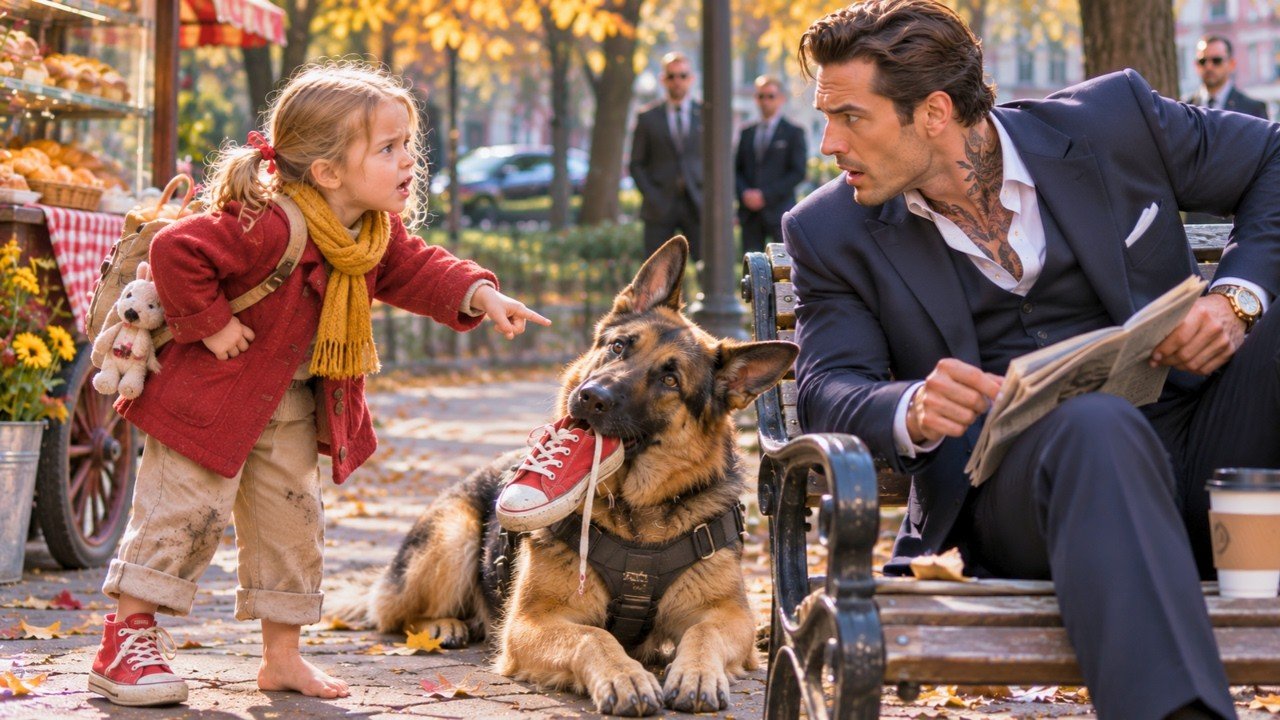
"Mister, your dog stole my shoe. Give it back."
The voice cut across the Brooklyn sidewalk at 7:42 on a cold October morning, with the kind of fury only a five-year-old can produce when something sacred has been violated.
Damian Falcone, thirty-five years old, stopped mid-step.
His coffee rose halfway to his mouth and stayed there.
Three feet in front of him stood a girl no taller than his thigh — one red sneaker on her left foot, one white sock dirty along the heel.
On her right, a smear of bread crumbs across her chin, a small fist planted against her hip.
Her curly blonde hair caught the thin morning sun and threw it back brighter than the coat she wore, which was two sizes too big and the color of a daffodil.
Behind Damian, ten paces back on the pavement, his two bodyguards slowed and exchanged a look.
Neither man moved.
Neither man had a protocol for this.
Max sat four feet away on the opposite curb beside a small sandwich cart.
The red sneaker balanced delicately between his teeth.
The canine shepherd did not look guilty.
He looked satisfied, the way he looked after a successful retrieval exercise.
Damian lowered the coffee.
He had been walking the old block out of some impulse he had not examined — the kind of impulse that visits a man on the morning of his second engagement and reminds him he once ran these streets with holes in his shoes.
He had expected ghosts.
He had not expected an interrogator in a yellow coat.
"My dog stole your shoe," he said.
"Yes."
She did not blink.
"He took it from the ground where I put it."
"Why was it on the ground?"
"Because there was a rock inside it."
She paused, as though offended by the need to explain.
"Then he committed the crime."
Damian laughed.
It came out before he could stop it — short and startled and almost foreign, the first real laugh his throat had produced in six months.
One bodyguard behind him coughed into his fist to hide his own.
The girl was not amused.
She waited.
"All right," Damian said.
He raised his hand toward Max.
"Give."
Max rose, crossed the quiet street with the calm authority of a dog who understood traffic better than most pedestrians, and set the red sneaker gently on the pavement in front of Damian's polished shoes.
Then he sat and looked up at his handler with an expression that said, I brought her to you. The rest is yours.
Damian bent at the knee.
His black overcoat opened. The Patek Philippe on his wrist caught the light.
He picked up the sneaker.
It was warm from the dog's mouth, light as a bird.
A faded cartoon strawberry grinned on the heel.
Inside, true to the girl's testimony, was a small gray pebble.
He turned the shoe once in his palm, then he lifted his head to hand it back to her — and the morning stopped moving.
Damian lowered himself onto one knee.
The pavement was cold through the fabric of his trousers, and he did not notice.
He held the red sneaker out between them, cradled in both hands the way a man might offer back a wounded animal.
The girl took it without ceremony, inspected it for damage, pulled out the gray pebble, examined that too, then set the pebble on the curb with the care of someone preserving evidence.
She sat down on the pavement in her yellow coat, pulled on the sneaker, and tightened the Velcro strap with a short, dry rip.
Damian meant to say something — something mild and adult and ready to be forgotten.
He meant to stand up, apologize to whichever grandparent was watching, drop a hundred-dollar bill into the sandwich cart's tip jar, and keep walking into the rest of his engagement morning.
Then she looked up.
Her eyes were gray. Not blue-gray. Not green-gray.
The exact cold slate gray he had seen every morning of his life in the bathroom mirror — the gray his mother had once called wolf eyes before she died, the gray no one else in his bloodline carried except him.
She frowned at him, perhaps because he had not yet moved.
When she frowned, two small dimples appeared, one on each side of her mouth, placed with the symmetry of a signature.
He knew that signature.
Rachel Brooks had those dimples.
Rachel Brooks, who had sat on the windowsill of an apartment on Clinton Street six Octobers ago, barefoot, a chipped mug of tea in her hands, laughing at something he had said about his father.
Rachel Brooks, whose blonde hair had curled exactly like this child's hair when it dried after rain.
Rachel Brooks, who had vanished from his life on a Tuesday in April without a note, without a trace, without a reason that any of his men had ever been able to find.
Damian's chest went tight in a way that had nothing to do with the cold.
"What's your name?" he asked. His voice came out quieter than he meant.
"Emily," she said. She was still fussing with the Velcro.
"Emily Brooks."
The last name landed like a fist.
He did not move for several seconds.
Behind him, one of his bodyguards shifted his weight on the pavement — a small sound of leather and asphalt.
The man had worked for Damian for seven years and had never seen his employer's face go that particular shade of pale.
He did not understand what was happening. Neither did his partner. Neither did anyone on the street.
Max did.
The K9 shepherd remained seated beside Damian's left knee, dark eyes fixed on his handler's face, utterly still — waiting, as though the dog had already finished solving something the human had only just begun to see.
Emily finished with her shoe.
She stood up, dusted her palms on the hem of her yellow coat, and lifted her chin at Damian with the same small defiant tilt he had seen in a thousand photographs of himself as a boy on his mother's dresser.
"Your dog," she said solemnly, "should apologize."
Damian could not speak.
Emily turned on her heel and marched across the street, red sneakers slapping against the pavement, the pebble she had rescued now clutched in her small fist.
She did not look back.
She had delivered her verdict, and the matter, as far as she was concerned, was closed.
Damian rose slowly from the curb.
His knees did not feel like his own.
The sandwich cart stood tucked against the brick storefront of a narrow deli — the kind of place that had survived three waves of Brooklyn and did not advertise.
A hand-painted sign above the window read HELEN'S in faded red letters.
Behind the cart, a woman in her early sixties bent to catch Emily by the shoulders, her graying hair pulled back in a loose braid, her apron dusted with flour.
She lifted her eyes to see what her granddaughter had been shouting at.
The color left her face.
Damian saw it happen.
He saw her recognize him in a single breath, saw the small flinch of her mouth, saw her fingers tighten on Emily's shoulders hard enough that the girl made a short, confused sound.
Then Helen Brooks turned, drew Emily into the deli behind her, and shut the glass door with the quiet precision of a woman closing a vault.
The deadbolt turned.
Damian crossed the street.
Max followed at his left heel without being called, then stopped twenty feet short of the door and sat on the sidewalk — out of range, out of pressure.
The dog had read the woman's shoulders the way he read everything.
Helen reappeared on the inside of the glass.
She did not open the door.
She stepped out through the side entrance by the sandwich cart, closed it behind her, and planted her small body between Damian and the deli as though her sixty-two years weighed three hundred pounds.
Her voice came out low and shaking with something older than fear.
"Don't you dare come near her."
Damian stopped on the pavement.
His bodyguards drifted closer, instinct taking over, and he lifted one gloved hand without looking back.
They stopped where they were.
"Mrs. Brooks—"
"Don't." Her eyes were wet and furious at the same time. "Don't say my name like you have the right."
He studied her face.
The resemblance was there too, under the lines.
Rachel had her mother's mouth.
"Who was her father?"
Helen's jaw moved once, as though she were chewing on a word she refused to spit out.
She said nothing.
Behind her, through the glass, Emily was climbing onto a stool to watch, red sneakers swinging.
Damian lowered his voice until it was barely above the hum of the street.
"Please. I'm not here to hurt anyone. I need to talk to you. Not on the sidewalk. Not in front of her. Whatever you want to tell me, I'll listen."
Helen looked at him for a long moment.
Her eyes went past him to Max, who had not moved, then back to his face.
"Nine o'clock," she said finally. "Not here. Upstairs."
The door beside the deli rang twice.
She turned and went back inside.
The deadbolt turned a second time.
At nine that night, Damian climbed three flights of narrow stairs in a stairwell that smelled of oregano and old paint.
He had come alone.
The bodyguards waited on the corner.
He had left his overcoat in the car and brought only his phone and a flat manila envelope he did not yet know he would need.
Helen opened the door on the second ring.
She did not greet him.
She stepped aside, locked the door behind him, and pointed to a worn blue armchair in a living room the size of his bathroom.
Emily was already asleep behind a cracked bedroom door at the end of the hall, a nightlight spilling pink across the floorboards.
Helen sat across from him on a kitchen chair she had dragged in.
She did not offer coffee.
"Six years ago," she began, and her voice was flat — the way people spoke when they had rehearsed the words too many times to still feel them. "Rachel came to me in the middle of the night. She was three months pregnant. She was shaking so hard she couldn't hold a glass."
Damian did not interrupt.
"Someone had sent her a recording. Audio only. Your voice, giving an order to a man named Carlo to have her killed before the baby showed. She played it for me. It was you, Damian. It was your voice saying her name."
The room narrowed around him.
"She ran that night. I drove her to the bus station myself. She went to Pittsburgh. She had Emily alone in a county hospital under a different last name. She worked three jobs. She came back here three years ago so I could help with the child. But she doesn't live here. She moves between cities. She has been chasing something for six years. I don't ask her what anymore."
Helen reached into the pocket of her apron and set a small black USB drive on the coffee table between them.
Her hand was trembling.
She pulled it back before he could reach for it.
"She sent me this three weeks ago by mail, from a city I'm not going to tell you. There was a note with it. One line."
Her eyes locked onto his.
"The recording was faked. Find out who. If anything happens to me, give this to someone who loved me once."
She pushed the drive across the wood.
Damian stared at it.
He did not pick it up for a long time.
When he finally did, his fingers closed around the plastic too tightly, and he felt — for the first time in his adult life — something inside his chest crack along a seam he had not known was there.
Six years of a story he had never been told had just reached up through a USB drive and taken him by the throat.
"Mrs. Brooks," he said, and his voice was not steady, "I never gave that order."
Helen looked at him for a long time.
Then: "Prove it."
The penthouse was quiet in the way only money could buy.
Damian stepped out of the private elevator at 12:41 in the morning and found the lamps dimmed to amber, the fireplace running low, and Cassandra Vale on the leather sofa with her legs folded beneath her and a crystal tumbler of whiskey waiting on the glass table.
She was twenty-eight.
She had the kind of beauty that photographers framed in black and white because color felt redundant.
Her dark hair was pinned up with the deliberate carelessness of someone who had spent an hour making it look careless.
She had chosen a cream silk robe she knew he liked.
The wedding was in two months.
"You're late," she said, smiling. "I almost gave up on you."
Damian hung his coat on the hook by the door.
The USB drive sat in his inside pocket like a coin of lead.
He had kept his left hand away from it the whole ride home.
"Harbor meeting ran long. At midnight, the Greeks never sleep."
He crossed to the sofa, took the whiskey she offered, and kissed the top of her head because that was what she expected.
The scent she wore was something French and expensive, and he had bought it for her himself.
For a moment, he could not remember why.
"How was your day?" she asked.
"Quiet. Walked the old block this morning. Nothing changes down there."
The lie came out of him smoothly — the way lies had always come out of him when the person asking already believed what they wanted to hear.
He watched her face.
She tilted her head and smiled at him with the practiced warmth of a woman who had never had to work for anyone's attention and did not intend to start.
The elevator chimed.
Thomas Grayson stepped out of it the way he always did — a leather folio under one arm, suit still crisp at an hour when most men would have abandoned the tie.
Ten years as Damian's right hand had taught him to arrive without being called.
He gave Cassandra a courteous nod and crossed to the sideboard for his own glass.
"The Port Authority revisions," he said, laying the folio open on the table. "They want three signatures by Friday. I flagged the clauses that moved."
"Walk me through them."
They talked for twenty minutes. Containers, insurance ceilings, union schedules.
Damian signed where Thomas's pen tapped.
Cassandra drifted to the window, looking out over the East River as though the lights were a show put on for her.
Near the end, Damian turned a page and said almost absently, "Took Max down to the old block this morning. Walked past Helen's deli. Place still looks the same."
Thomas's hand paused on the corner of the folio for half a second.
The thumb lifted, hesitated, then settled.
Damian did not look up.
"Nostalgia," Thomas said after a beat. Voice easy. "Dangerous habit, so I'm told."
Thomas left ten minutes later.
Cassandra kissed Damian good night and drifted toward the bedroom.
He said he would be a few minutes.
He locked the study door, slid the USB into his laptop, and pressed play.
His own voice. His own cadence. Giving an order he had never given.
Damian sat in the dark and listened to himself condemn the mother of a child he had met that morning.
Damian did not sleep.
He sat in the study until the first gray wash of dawn crept across the East River, the recording looping in his earphones, each pass peeling back another layer of something he did not yet have a name for.
The voice was his. The rhythm was his. Even the small breath he always took before saying someone's full name — Rachel Brooks — was his.
And none of the sentences had ever left his mouth.
At 6:15 he changed into a plain black turtleneck and jeans, left a note on the kitchen counter saying he had an early meeting at the port, and took the service elevator down to the garage.
He drove himself.
He did not call his bodyguards.
He did not take Max, who watched him from the kitchen doorway with the quiet reproach of a dog who understood when he was being left behind.
The address was in a tired block of Bay Ridge, where the shop signs still carried names from forty years ago.
Vincent Rosa Studio sat behind a boarded-up record store down an alley Damian had not walked since he was sixteen.
The buzzer did not work.
He knocked three times, waited, knocked twice.
The door opened on a man in his late seventies with ink-dark eyes and hands that had not yet learned to shake.
Rosa had worked sound for Damian's father since before Damian was born.
He had wired rooms, cleaned tapes, buried evidence, resurrected ghosts.
He had retired the year the old man died.
He looked at Damian without surprise.
"Your father used to come to me at six in the morning too," he said. "Never good news at that hour. Come in."
The studio smelled of solder and coffee.
Rosa plugged the USB into a battered console older than most of Damian's cars and said nothing for two hours.
Damian sat on a stool in the corner and watched waveforms crawl across three monitors.
He drank the coffee that was set in front of him without tasting it.
At 8:42, Rosa took off his headphones.
"Three sources," he said. "Spliced. Clean work, but not perfect. Whoever did it took your voice from three separate conversations — different rooms, different years. You can hear the ambient fingerprint shift if you know where to listen. Phone call, maybe '17 or '18. Boardroom, acoustically dry, probably '19. Car interior, highway noise bled through. They layered the audio, matched the room tone, flattened the edges."
He turned the monitor toward Damian and pointed at a faint ladder of markers along one track.
"This signature — that's a software stamp. Proprietary. Your father bought three licenses six years ago and locked them. One for him. One for you. And one for the man he trusted to clean problems off tape."
Damian did not have to ask the name.
He said it anyway, quietly, because he needed to hear himself say it.
"Thomas."
Rosa met his eyes.
"Whoever did this," the old man said, "knew you intimately."
Damian sat in his car in the alley for fifteen minutes before he turned the key.
He came back to the deli at four in the afternoon with Max on a short lead and nothing else.
Helen was wiping down the sandwich cart when his shadow fell across the counter.
She did not look up for a long moment.
When she did, her eyes went first to the dog, then to the empty space on the sidewalk where the two bodyguards usually stood.
He had left them a block away.
"One hour," he said. "The park. I will not take her out of sight. You can watch from the bench."
Helen pressed her lips together.
Behind her, through the glass, Emily was perched on a stool coloring in a notebook with a stub of blue crayon.
The yellow coat was draped on the chair beside her like a small flag of office.
"One hour," Helen said finally. "You bring her back dry. You bring her back warm. You bring her back before dark."
"I promise."
Emily came out at the mention of Max's name.
She did not greet Damian.
She greeted the dog.
She crouched down, took Max's furry face in both hands, and informed him seriously that she had forgiven him for the shoe but not forgotten.
The park was two blocks away — a square of yellowing grass and a chain-link fence around a splintered climbing frame.
Helen followed at a distance and sat on a bench near the gate with her coat buttoned up to her throat.
Damian took a bench on the far side.
Emily did not sit.
Emily had work to do.
She led Max to the edge of the grass where a thin line of pebbles ran along the base of the fence.
From the pocket of her yellow coat, she produced a small plastic sandwich bag heavy with stones.
"These are my friends," she said.
She laid them out on the bench between them, one at a time, naming each as she placed it.
"This is Walter. He is quiet. This is Margaret. She bosses the other rocks. This is Captain. He is a soldier."
Max lay down at her feet and placed his muzzle in her lap, the canine's eyes half-closed.
He had never, in six years of working beside Damian, laid his head in anyone's lap.
Damian watched the dog's ribs rise and fall and could not swallow.
"That one," Emily said, pointing at Max without looking up, "is a very good boy, even if he is a criminal."
Damian laughed.
The laugh came out broken.
She kept arranging stones.
"Do you have a dad?" he asked before he could stop himself.
She did not look at the question.
She picked up a small flat stone and turned it in her fingers.
"My dad is in the stars," she said. "Mom told me he had to go there a long time ago, but he can still see me."
Damian looked down at his hands.
He kept looking at his hands.
When Helen stood from the far bench, Emily gathered her stones.
She chose one — small, gray, smooth as a river bead — and placed it carefully into Damian's palm.
She folded his fingers over it.
"That one," she said, "is for finding things that are lost."
Damian carried the gray pebble in his pocket for the rest of the week.
He touched it the way a man touches a scar — absent, constant, confirming that the thing had happened.
The night he left Emily at the deli, he drove to Luca Falcone's apartment in Carroll Gardens and did not call ahead.
Luca was twenty-eight — a cousin's son, two years out of Columbia Law with a graduate certificate in forensic accounting and a quiet apartment full of ferns.
He opened the door in sweatpants and a hoodie, took one look at his uncle's face, and poured two glasses of bourbon, neither of them touched.
"I need you to look at someone," Damian said. "Six years of financials. Everything you can pull. No one else sees this. Not Marco, not the lawyers, not the family."
"Who?"
"Thomas Grayson."
Luca did not blink.
He had been raised in the house.
He understood what the sentence cost to say.
"Give me two days."
Luca worked out of a borrowed office above a dry cleaner in Red Hook on a laptop that did not touch the Falcone network.
He slept in six-hour pieces.
He ran shell traces through three jurisdictions.
He pulled wire records from a cooperating banker who owed Damian's late father a kindness.
Forty-eight hours later, he laid three folders on Damian's desk and tapped the top one.
"Three shell companies," he said, "all registered within an eleven-month window starting six years ago this summer. One in Delaware, one in Nevis, one in Luxembourg. All with directors who do not exist except on paper. All routed through a correspondent bank in Nassau."
He opened the second folder.
"Over the last six years, two million one hundred thousand dollars have moved through those three shells. Not in one lump. In pieces. Pieces small enough that nobody would flag them if nobody was looking."
He opened the third.
"The pieces all originated from one source. Harbor Freight Logistics. Your family's legal shipping arm."
Damian stared at the pages.
The numbers blurred, then sharpened.
Harbor Freight Logistics.
Six years ago, Rachel Brooks had been the junior bookkeeper on that account.
The memory came back whole — the way memories came back when a man had been running from them.
A Tuesday night in the old apartment on Clinton Street.
Rachel in one of his shirts at the kitchen table, barefoot, hair pulled back, the harbor ledgers spread in front of her, the small line between her eyebrows that only appeared when numbers disagreed with her.
She had looked up and said, almost to herself, "Something's off in the harbor account."
He had been pouring wine.
He had kissed the top of her head and told her to leave it until Monday.
He had told her the men who ran the account were his father's friends, and that friends of his father did not steal from his father.
He had told her she was tired.
He had told her to let it go.
Damian closed the folder.
His hands were steady on the leather.
She had not let it go.
She had kept looking.
And somewhere between her ledger and his kiss, Thomas Grayson had understood exactly what she was about to see.
Six years ago, Rachel had not run from Damian.
She had run from the man who would have had her killed to protect two million dollars and a secret she had almost finished counting.
Cassandra Vale noticed before anyone else did.
She had always noticed first.
It was how she had survived being orphaned at nineteen, how she had learned to read a room before she entered it, how she had learned to read Damian Falcone across the length of a crowded gallery two years ago and decide in six seconds that he would be hers.
For four days now, he had been elsewhere.
Not physically. Physically, he came home.
He sat at the long walnut table at eight in the evening, cut his steak, poured her wine, asked about her day.
He kissed her forehead when he passed behind her chair.
He laughed in the right places.
But his eyes had gone somewhere she could not follow.
At dinner on the fourth night, she set her glass down and let her brush his wrist.
"You've been quiet, darling. Long week? Thomas looked worried this afternoon. He said the harbor contracts shifted again."
"They did."
"Anything I should know about?"
He smiled at her the way he had smiled at her the day he proposed — which was to say, warmly, and told her nothing.
She returned the smile.
She did not press.
Pressing was for women who did not understand men like Damian Falcone.
She refilled his wine.
She laughed at a story he told about Max chasing a seagull on the pier.
She waited.
He went to bed at half past eleven.
She waited another forty minutes, until the breathing beside her slowed and deepened.
Then she rose, slipped into the silk robe she kept on the chair, and padded barefoot across the cold marble to the private study at the far end of the penthouse — the one with the second desk, the one Damian never entered.
She closed the door, locked it, and opened the lower drawer.
The encrypted phone was black and matte and unmarked.
She dialed one number from memory.
Thomas answered on the second ring.
"He is suspicious," she said.
The gentle voice she used at dinner was gone.
In its place was something quieter, cooler, closer to the bone.
"He has been meeting Luca off the books. He walked the old block three times this week. The child is his, Thomas. I am sure of it."
A pause on the other end. Then Thomas, equally stripped down:
"The girl too?"
"Both."
"And the mother?"
"If she surfaces, she will surface. She always comes back for what she started."
"The grandmother?"
"If she gets in the way."
She listened to him breathe for a moment, and the sound was familiar — familiar the way a thing from before her other life was familiar.
Eight years ago, in a different borough, under a different name, she had been a twenty-year-old assistant at a brokerage the Falcones had quietly swallowed.
Her father had been one of the men who did not survive the swallowing.
He had taken the pills himself two weeks after the acquisition closed.
Thomas had found her at the funeral.
Thomas had told her over cold coffee in a diner on Flatbush that patience was a weapon the Falcones had never learned to respect.
Eight years of patience.
She hung up the phone and smiled at her own reflection in the dark window.
The next morning, Damian walked into the Harbor Freight boardroom at nine sharp with Thomas on his right and three senior partners around the walnut table.
He wore the gray suit — the one Thomas had once said made him look like a prosecutor.
He wanted Thomas to notice the suit.
They moved through the agenda. Container quotas, union renegotiation, a small insurance adjustment on the Fulton Street warehouse.
Damian signed where he was supposed to sign.
Near the end, as the partners gathered their folders, he leaned back in his chair and said, almost in passing:
"One more thing. I'm authorizing a personal transfer out of the Nassau channel this week. Five hundred thousand, routing through the Cayman intermediary we used for the Delgado estate. Account ending 4721. Flag it as discretionary. No family note."
Thomas, who had been closing his folio, slowed.
Only Damian saw it.
The thumb paused on the leather clasp.
"Family matter?" Thomas asked, voice easy.
"Old friend's widow. Carlo's wife. She's been struggling. He would have wanted it."
"Of course."
Damian held his eyes for one half-beat longer than necessary.
"Handle it quietly, would you?"
"Always."
The partners filed out.
Damian stayed in the chair after Thomas left and let the room settle.
The Delgado estate did not exist.
The Cayman intermediary did not exist.
The account ending 4721 had been opened by Luca sixteen hours earlier under a shell no one in the organization had ever heard of.
Its only purpose was to be looked at.
Twenty-four hours later, Luca called from the Red Hook office.
"He bit."
"When?"
"Nine twenty last night. He accessed the account record from a terminal registered to his home address. Full read. Stayed in the file for seven minutes. Took screenshots. The audit trail is clean, Uncle. We have him."
Damian closed his eyes for a moment.
The gray pebble was warm in his palm.
"Keep the file open. Do not close the account. Do not touch anything. Understood?"
He hung up and sat alone in the car.
The evidence was in hand.
In a different life — in his father's life — the next step would have been simple: a quiet drive, a quieter room, and a problem that stopped being a problem by sunrise.
He was not his father.
And more urgently, Thomas was not stupid.
A man who had just confirmed his employer suspected him would not wait for the knock.
Thomas would move first.
Whatever Thomas moved against would be the thing that could end him.
There were only three such things left in the world.
Rachel. Helen. Emily.
Damian started the car and drove to the deli.
He did not explain.
He told Helen only that Max would be staying with her from tonight onward — that the dog needed quiet, that the dog was trained and would hurt no one in the apartment and would hurt anyone who was not supposed to be in the apartment.
He asked her to let the dog sleep in the hallway outside Emily's door.
Helen looked at him for a long moment, then she nodded.
Emily, when she heard, dropped her crayons and ran.
Rachel Brooks stepped off a Greyhound bus at Port Authority at 4:12 on a Thursday afternoon with a canvas duffel on her shoulder, a baseball cap pulled low over her blonde hair, and a one-terabyte external drive wrapped in two layers of waterproof plastic at the bottom of her bag.
She was thirty-one.
She had learned in six years of running to walk with her chin level and her eyes moving, to pay cash for coffee, to never sit facing a window she had not first checked for a reflection.
She did not take the subway.
She took a cab three blocks, then walked seven, then took another cab in the opposite direction, then walked the last mile to the pay phone outside a bodega on Court Street.
She fed the slot four quarters and dialed the deli from memory.
Helen answered on the second ring.
The small sound Helen made when she recognized her daughter's voice was the only crack Rachel allowed herself to hear.
"I'm home."
"Come now. The back stairs. Don't ring."
Rachel climbed the back stairs twenty minutes later, duffel over one shoulder, her hand on the railing because her legs had decided somewhere on the third landing that they were done.
The apartment door opened before she reached it.
Helen pulled her inside without a word, locked the three deadbolts, and held her face in both hands for a long moment, looking at the bruise of exhaustion under her eyes.
Then a sound from the hallway — a small gasp — and Emily was there in her nightgown with her hair wild from sleep and her red sneakers on the wrong feet, running the length of the apartment at full speed.
Rachel dropped to her knees in time.
Three weeks. The longest they had ever been apart.
Emily clung to her mother's neck with the full weight of a five-year-old who had been counting days on a calendar, and Rachel buried her face in her daughter's hair and did not breathe for ten seconds.
A low shape moved in the hallway behind Emily.
A dog. Dark, lean, sitting very still, watching Rachel with calm, intelligent eyes.
Rachel's hand tightened on her child.
"That's Max," Helen said quietly. "He is a guest. He belongs to someone."
Rachel's eyes went up slowly.
"Someone?"
Helen said nothing.
They put Emily back to bed at nine.
Rachel sat at the kitchen table, ate half a bowl of soup, and told her mother in a flat, tired voice where she had been.
Zurich. Lisbon. Nassau. A bank clerk in Antigua who liked bourbon. A disgruntled compliance officer in Luxembourg who liked Rachel's smile.
Six years of pulling one invisible thread until the thread had become a rope.
She set the external drive on the table between them. Bank records. Email archives. Wire copies.
Enough to end him.
Helen folded her hands on the wood.
"Damian came last Tuesday. He has been here three times."
Rachel went very still.
The soup grew cold between her hands.
She did not look up for a long time.
Then she said, almost to herself:
"Then it's starting."
The man in the gray sedan at the corner of Court and President had been there since Tuesday evening.
He was on his third driver, his fourth coffee of the shift, and his twelfth cigarette.
He did not know why he was watching the deli.
He knew only that Thomas Grayson paid him in cash and that the standing order was to log every person who entered through the deli door or the side stairwell and to photograph their face.
At 4:47 on Thursday afternoon, a woman in a baseball cap climbed the back stairs with a canvas duffel.
He raised the long lens, waited for the half turn at the landing, and caught her face in profile for one clean frame.
He did not recognize her.
The man he reported to did.
Thomas Grayson was in his car on the FDR when the photo arrived on his secure phone.
He pulled onto the shoulder, enlarged the image, and stared at it for eleven seconds.
Then he dialed one number.
Cassandra answered on the first ring.
"She's here."
A beat of silence on her end. Then, soft and perfectly level:
"Are you certain?"
"The hair is dyed darker. The face is thinner. It's her."
"Who else is in the apartment?"
"The grandmother. The child. The dog."
"The dog?"
"Damian put a canine inside two days ago. He hasn't told me why. I think he knows."
Cassandra was quiet for perhaps three seconds.
In those three seconds, she walked herself through eight years of patience and decided that patience had reached its natural end.
"Tonight," she said. "The mother. In the records. Not the child in front of her unless there is no choice. Clean, no signatures."
"And the grandmother?"
"If she is in the way."
"And the dog?"
"Shoot it."
She hung up.
She stood for a moment in the window of the private study, looking out at the East River, and she let herself remember a thing she almost never allowed herself to remember.
She had been twenty years old.
She had been an assistant on the thirty-seventh floor of a brokerage in Midtown called Vale and Hartman.
The Vale had been her father.
The Hartman had been the only partner who refused to sell when the Falcone group began buying up Vale and Hartman's clients one by one.
Her father had held out for sixteen months.
On the sixteenth month, the SEC letter had arrived.
On the seventeenth month, her father had taken a bottle of lorazepam with half a glass of Scotch and had not woken up.
She had been the one who found him.
Thomas Grayson had come to the funeral.
He had not introduced himself as a Falcone man.
He had said only that the acquisition had been handled badly by people above him, and that she deserved to know her father had not been crazy.
Over coffee two weeks later, he had told her that the Falcones punished patience as weakness, and that this was the flaw a patient woman could use.
Eight years. One charity gala. One perfect introduction. One engagement ring.
And tonight, finally, the last loose thread.
Damian did not know Rachel had come home.
Helen had chosen not to tell him. Not yet.
She had sat with Rachel until two in the morning, trying to decide how much of her daughter's life she had the right to hand back to a man she had spent six years teaching Emily to call a stranger in the stars.
In the end, Rachel had asked for one more day.
One day to breathe. One day to decide for herself.
Helen had agreed.
So when Damian arrived at the deli at eleven on Friday morning, he found only Helen behind the counter — pale, tired, oddly watchful.
He did not read her face correctly.
He read her as a woman who had slept badly because her granddaughter had a strange dog on the hallway rug.
He did not ask the question that would have changed the day.
"May I take Emily to the park? Prospect Park. An hour. Just the three of us."
Helen hesitated.
Rachel was upstairs asleep on the pullout.
Behind her, Emily was already pulling on her yellow coat because she had heard Max's name through the glass.
Helen nodded once.
Damian drove them himself.
No guards. No chase car.
Max rode in the backseat with his head across Emily's lap.
The pebble that Emily had given him sat on the dashboard where Damian had placed it that morning.
Prospect Park was almost empty at that hour.
A thin November sun came through the bare branches in long gold strips.
Emily walked in the middle, red sneakers scuffing leaves, one small hand in Damian's and the other on Max's collar.
She was explaining the official hierarchy of her pebble collection and had reached a dispute between Walter and the Captain when Damian found the words.
"Emily. Um. I knew your mother a long time ago. Before you were born."
She stopped walking.
She tilted her head up at him the way she had tilted it up at him on the sidewalk that first morning.
"You knew her?"
"Yes."
"Were you friends?"
He had to be brief for a moment before he answered.
"Yes. We were."
"Why did you stop being friends?"
"Something happened that she didn't do, and something happened that I didn't do, and we both believed the wrong thing about each other for a very long time."
She considered this with the gravity of a small judge.
"That's sad."
"Yes."
"Are you going to find her?"
"I'm going to try."
Emily thought about this.
Then she reached up and patted the back of his hand twice — the way adults pat children when the child has made a reasonable request.
"Good."
They walked on.
Max pattered in front, then dropped back, then pattered in front again.
At the small bridge over the frozen stream, Max stopped, turned around, and placed his muzzle on top of Damian's left shoe.
He did not move for a full minute.
Emily watched the dog, then looked up at Damian.
"He pretends not to care," she said quietly, "but he really does."
Damian could not answer her.
By the time they drove back to Court Street, the November dark had already come down over Brooklyn.
He walked Emily to the door and crouched to say good night.
Max did not follow him back to the car.
Max sat in the hallway outside Emily's bedroom door, as Damian had quietly ordered that morning, and watched the stairwell with the patience of a soldier who understood exactly what he had been left to do.
At 10:51 on Friday night, Rachel Brooks had been home for less than thirty hours.
She was sitting at the kitchen table in her mother's old gray cardigan, drinking tea that had gone cold, scrolling through the last of the files on the external drive by the light of a desk lamp.
Emily was asleep in the back bedroom.
Helen had just gone to lie down.
Max, curled in the hallway outside Emily's door, lifted his head.
The fire escape window in the kitchen had been painted shut for twenty years.
It opened anyway — not with a shove, with the slow, controlled pressure of a crowbar wrapped in cloth.
Rachel was on her feet before the first man cleared the sill.
She did not scream.
Screaming was a thing she had trained out of herself in cheap motels in six cities.
She grabbed the external drive, bolted down the hallway, and shoved it into Emily's small hands as she dragged the child from the bed.
"The cabinet. The one under the sink. Climb in. Lock it from inside. Do not open it. Do not open it for anyone except Max."
Emily's eyes were huge in the dark.
She did not ask.
She ran.
Helen came out of the back room already shouting, saw the first man in the kitchen, and swung the only thing she could reach — a ceramic lamp.
It shattered on his shoulder.
The second man was already behind her.
The butt of a pistol cracked against her temple, and she went down hard against the door frame and did not move.
Rachel reached the kitchen as the small sound of the sink cabinet closing behind Emily reached her.
She put her body between the men and the cabinet.
The first man came at her.
Max came at him first.
The dog cleared the hallway in two bounds — silent — and took the man at the forearm with the full working weight of a trained canine.
The man's wrist broke before his scream finished starting.
The pistol spun across the linoleum.
The second man fired.
The shot went wide, punched a hole in the refrigerator door.
He was already backing toward Rachel.
He got an arm around her throat before she could turn.
She drove an elbow back, caught him in the ribs, nearly broke free — but he was bigger and he had leverage.
And in three seconds she was dragged backward toward the kitchen window, half-conscious, her feet skidding on the broken ceramic.
The third man, who had never made it past the hallway, heard a siren two blocks away and ran.
Max released the first man and turned toward the second.
Too late.
The second man was already on the fire escape with Rachel over his shoulder.
He fired once more down into the kitchen to buy himself the stairs.
Max flinched, did not pursue.
The dog stood for a half second in the ruined kitchen, listening.
Helen groaned.
The siren was still blocks off.
Upstairs doors were opening.
Max turned.
He went to the sink cabinet.
He lay down against the closed door, body pressed flat along the wood, muzzle on his paws, and did not move.
Inside, in the dark, Emily held the external drive against her chest and listened to the dog breathing on the other side of the panel.
Damian was on the Brooklyn Bridge when his phone made a sound he had never heard it make before — a short, cold triple pulse.
He had installed the alert himself two days earlier, on a channel only one address could trigger: the fire escape window of apartment three above Helen Brooks's deli.
He did not call anyone.
He drove.
He took the car across the bridge at ninety, cut east through the Heights with one hand flat on the horn, and was outside the deli in eleven minutes.
The front door of the stairwell stood open.
A dark liquid smear on the second landing made him miss a step.
He did not stop.
The apartment door was ajar.
The kitchen was a wreck.
The sink cabinet door hung undisturbed in the middle of a floor strewn with broken ceramic, blood, a toppled chair.
Helen lay crumpled against the hallway door frame, breathing, a dark bloom of blood under her gray hair.
He crossed to her in three strides, pressed two fingers to her throat, found a pulse, called her name, got nothing.
A single low sound from the dark hallway — a dog's exhale.
Max was lying against the sink cabinet exactly as he had been for thirteen minutes.
His flank rose, fell, rose.
His dark eyes caught the hall light and did not blink.
Damian understood everything in one breath.
He crossed the kitchen floor on one knee, careful of the glass, and crouched beside the cabinet.
He placed one palm flat on the wood.
"Emily. It's Damian. The dog's handler. I'm here. Max is here. Open the door, baby."
A pause.
Then, small and perfectly steady from inside the cabinet:
"Max is here. He bit the bad man."
Damian closed his eyes.
"Yes, he did. Good girl. You can come out now."
The latch turned from the inside.
The door opened an inch.
A small hand came out first, with the external drive clutched in it. Then a tangle of blonde curls.
Then Emily, in the long pink nightgown she had been sleeping in, her yellow coat still hanging on the hook by the front door, one bare foot and one in a red sneaker she had grabbed from under the bed.
She did not cry.
She climbed out, sat down on the kitchen floor beside Max, and put her small arm around the dog's neck as if she had been waiting for the right moment to thank him.
Damian lifted her into his lap in the middle of the ruined kitchen and held her for the first time in his life.
She did not resist.
She leaned her head against his chest, listened to his heart beating too fast, and said nothing.
Behind them, Helen made a small sound and tried to sit up.
Damian turned, held her shoulder down with one hand.
She fixed her eyes on his face and whispered the sentence he had already known since he saw the window.
"They took Rachel."
Damian reached for his phone and dialed Detective Marla Reyes.
The all-night diner on Atlantic Avenue was almost empty at two in the morning.
A cook flipped eggs for a cab driver at the far end of the counter.
A single fluorescent tube at the back of the room buzzed in a key that did not quite match the refrigerator.
Damian chose the booth in the corner because he could see the door and the kitchen pass at the same time.
Helen was at Methodist Hospital with a mild concussion and seventeen stitches.
Emily was in a locked suite at the Pierre under the care of Luca and two of Damian's oldest and most trusted men, with Max on the rug beside her bed and strict instructions not to leave her sight.
Damian had kissed the top of her head twice before leaving.
She had not let go of his sleeve for a full minute.
Detective Marla Reyes slid into the booth across from him at 2:11, still in the clothes she had been sleeping in, hair pulled back with a rubber band, a thin case file already under her arm.
She was forty-three.
She had worked organized crime out of the 76th Precinct for eleven years.
Three years ago, Damian had passed her a sealed envelope containing the home address of a man who had killed a nine-year-old witness in a case she could not close.
She had never asked how he had found it.
She had never forgotten.
She did not order coffee.
She looked at his face across the Formica and said, "Talk."
Damian laid four things on the table between them.
A black USB drive — the forged recording, Vincent Rosa's full analysis signed and dated.
A manila folder — Luca's two days of forensic work: three shell companies, $2,100,000, Harbor Freight Logistics, the clean traced line back to Thomas Grayson's desk.
A thumb drive — Thomas's seven-minute visit to a shell account that did not exist, timestamped and chain-of-custody logged by Luca's clean laptop.
And a one-terabyte external hard drive — blood smeared in one corner where Emily's small hand had held it against her chest in the dark.
Reyes did not touch any of it for a long time.
She looked at them in order, slowly, with the care of a surgeon reading an x-ray.
When she looked back up, her face had gone very still.
"You understand what you are handing me, Falcone?"
"I do."
"Three of these open federal doors. Two of them open doors that walk straight back into your own house."
"I know."
"The Harbor Freight accounts aren't just Thomas. Those are family books. Once I pull on this, the whole weave comes apart. Your father's name. Your name on half those filings. The port contracts. The waste contracts. The union locals. You know this ends your empire, too."
"It should have ended years ago."
She looked at him for a long moment, and something behind her eyes moved and then settled.
"All right."
She slid the drives into her jacket, opened her notebook.
"Where is she?"
"Rachel's phone pinged once at 11:07, three blocks inland from the Red Hook container yards. Then dead. Thomas owns paper on two warehouses out there through a shell. One was condemned nine months ago. Cold storage. No power on the city grid. That's where he'd put her."
"Dog?"
"Max will find her. Helen kept the scarf Rachel was wearing yesterday. It still has her scent on it."
Reyes nodded once, already dialing.
"Five o'clock, Red Hook. Don't be late."
Damian was already moving.
Red Hook at 4:40 in the morning smelled of salt, diesel, and the kind of cold rain that did not fall so much as hang in the air.
The container yard stretched out under sodium lights in long, dim corridors of steel.
Somewhere beyond the breakwater, a tugboat sounded its horn, and the note hung over the water for a long moment before it died.
Damian stood at the edge of the staging area beside Reyes's sedan and waited for Max to come to him.
The dog had traveled in Reyes's cruiser, which Damian had insisted on because he did not want his own vehicles anywhere near the perimeter until it was over.
Six tactical officers in dark gear moved in disciplined half steps across the wet concrete behind them, taking positions along two sight lines Reyes had sketched out on the hood of the car ten minutes earlier.
A paramedic unit idled with its lights off two blocks back, out of sound.
Reyes walked over with the dog on a short lead and handed the lead to Damian.
"He's your animal. You run him."
Damian crouched.
He pulled Rachel's scarf from inside his jacket.
It had been folded once, carefully, by Helen inside a clean paper bag.
The wool was dark gray and still carried the faint scent of the drugstore shampoo she had used in whatever rented room she had slept in two nights ago.
He held it to Max's muzzle.
Max inhaled once. Long. Measured.
Then his whole body changed.
His tail dropped level.
His ears came forward.
His shoulders lowered.
The affectionate dog who had been sleeping beside a five-year-old in a hotel bed six hours earlier was gone.
In his place stood the animal the United States Army had trained for four years before Damian had bought his retirement.
Damian unclipped the lead.
"Find her."
Max did not run.
Max walked — head low, nose working the wet pavement in short, systematic sweeps, moving in a tightening arc out from the car.
In twenty seconds he had the line.
He turned left down the first corridor between container stacks and did not look back.
Damian and the tactical team followed in a staggered line.
Reyes stayed one step off Damian's shoulder, pistol low.
The rain had thickened into a cold mist that caught in their eyelashes.
Three warehouses in a row.
Max passed the first without slowing.
He passed the second.
At the third — a long, low cold-storage building with faded blue paint peeling off corrugated steel and a condemnation notice from the Department of Buildings nailed to the loading door — he stopped.
He sniffed along the base of the door.
He walked the length of the wall.
He came back to the loading door and sat down.
He looked at Damian.
Confirmed.
Reyes raised two fingers.
The team split silently into breach positions — two to the east door, two to the roof hatch, two to the main loading bay.
She looked at Damian.
"Stay back."
"I'm going in with the first stack."
"Falcone—"
"I'm going in with the first stack."
She held his eyes for a half second, then shook her head once and let it go.
Inside the warehouse, in a cold concrete office at the back, Rachel Brooks sat tied to a steel chair under a single hanging bulb.
Her lip was split.
Her left eye was swelling shut.
Her hands were zip-tied behind the chair back, and she had not spoken in two hours.
Thomas Grayson paced in front of her in a cashmere coat ruined by rain.
His voice had gone hoarse.
"Who else did you send the files to? Who, Rachel? Who?"
She lifted her chin and looked at him with the one eye she still had open.
She said nothing.
Reyes raised her hand.
Three fingers. Two. One.
The loading door went in with a short, dry crack of hydraulics and a splintering of rusted hinges.
The two officers at the east door were through a half second behind.
The team on the roof dropped into the main floor through the hatch in a controlled coil of rope and dark gear.
The two men guarding the office hallway did not have time to understand what was happening.
The first one saw a shape — low and dark — break out of the dark aisle to his left, and raised his pistol a quarter of the way before Max hit him in the thigh and took him off his feet.
The dog did not release.
The man's gun clattered across the concrete.
A tactical officer stepped on his wrist and put a knee between his shoulder blades, and the fight ended in four seconds.
The second one made it two steps toward the office before Reyes put the laser dot of her service weapon in the center of his chest and said one word, quiet and very clear:
"Down."
He went down.
Damian did not stop for either of them.
He crossed the warehouse floor in the wake of the first stack — pistol low, eyes on the thin yellow bar of light under the office door at the back.
Thomas Grayson came through that door first.
He had heard the breach four seconds before it happened.
He came out with his own weapon already drawn and his cashmere coat flaring behind him, and he stopped dead when he saw Damian ten feet away with a Glock centered on his sternum.
The two of them stood that way for perhaps three seconds.
The warehouse behind Damian echoed with the controlled calls of Reyes's team securing the floor.
In the office behind Thomas, Rachel sat tied to the chair, her head lifted at the sound, her one open eye finding Damian through the doorway.
Thomas's throat moved.
"Damian. Put it down. She was going to take everything from you. The accounts. The ports. The name. All of it. Cassandra and I were saving the house."
"Put it down, Thomas."
"Cassandra loves you." The voice cracked at the edge. It was closer to a plea than Damian had ever heard from the man. "She has loved you from the first night. Everything we did was to keep her beside you."
"Rachel carried my daughter alone for six years. Because of you."
Thomas's eyes flickered.
The pistol trembled a quarter of an inch.
Half a second too late, Damian said, almost gently:
"Put it down."
The pistol started to come down.
Damian did not shoot him.
He covered the ten feet in four long strides, inside the arc of Thomas's lowering arm, swept the barrel aside with his left hand, and drove the butt of his own Glock up under Thomas's jaw in one clean, short motion.
The sound was a dull, wet crack of bone.
Thomas went down sideways against the office door frame and stayed down.
Reyes was already there, cuffs out, dropping to one knee.
Damian stepped over the body into the office.
He crossed to Rachel and crouched in front of her chair.
He drew the small folding knife from his pocket and cut the zip ties from her wrists — one at a time, slowly, the way a man cuts something precious free.
Her hands came forward into her lap.
The left one was shaking.
He did not touch her yet.
He lifted his eyes to her face.
For the first time in six years, Rachel Brooks looked straight into the eyes of Damian Falcone.
Neither of them spoke.
The private elevator opened onto the penthouse at 6:14 in the morning.
First light was just beginning to lift off the East River — a cold pink wash on the kitchen marble.
Damian stepped out alone.
His coat was dark along one sleeve where he had knelt beside Rachel in the office.
He had not changed.
He had come straight from the hospital where he had seen Rachel admitted under a name that was not her own, and had kissed Emily's sleeping forehead at the Pierre on the way across the bridge.
Cassandra Vale was already up.
She stood at the far end of the kitchen island in the cream silk robe, a small cup of espresso in one hand, the morning paper folded unread on the counter beside her.
Her dark hair was loose.
She looked like a photograph of a woman waiting for her husband to come home from a long trip.
Her eyes went to his face.
Two seconds.
That was all she needed.
She set the cup down with the tiny click of porcelain on stone.
"You've been out all night," she said.
The smile she offered was the one from the sofa, the one from a hundred galas, the one she had been practicing in mirrors since she was nineteen.
"Come. Sit. I'll make you something warm."
"Thomas is in custody."
The smile held for a breath.
Then it adjusted — softer, more concerned.
"Thomas? What happened? Is he all right?"
"He will live."
She crossed to him with her bare feet soundless on the marble, laid a hand on his lapel, looked up at him with her lovely eyes.
"Damian, darling. Whatever he told you in there, you know Thomas. He will say anything to protect himself. Let me help you sort it."
"Vale and Hartman. The thirty-seventh floor. Your father."
Her hand did not move from his lapel.
Her face did not move.
But something behind her eyes stepped back one small, polite pace and sat down.
"That is not fair."
"I have the recording Rachel kept. I have the account trail Luca pulled. I have Thomas's statement, which he began giving to Detective Reyes forty minutes ago in a hospital bed. I have the file Rachel put in my daughter's hands under the sink last night. I have all of it."
Her hand came down slowly.
The grace left her face in stages — first the smile, then the softness, then the lovely, tired tilt of her eyes.
What remained was a thing he had never seen before and had always, somewhere beneath knowing, known was there.
She tried charm one more time. Found it would not take.
She tried anger. Her voice went low and sharp, and she told him he was a fool, that Rachel had never loved him, that she had carried a bastard away from him out of pride, that he had been alone until Cassandra had made him whole.
She tried tears.
He waited her out.
When she had nothing left, she lifted her chin and said, almost quietly:
"I loved you, Damian."
He looked at her for a long moment.
"You loved what I could become for you."
The elevator chimed.
Detective Reyes stepped out with two uniformed officers and a folded warrant in her left hand.
She read Cassandra her rights at the kitchen island in a voice without anger.
Cassandra did not resist.
She lifted her wrists for the cuffs with the same grace she had once lifted a champagne flute.
She was led out of the foyer she had chosen the chandelier for.
Damian did not follow.
He walked to the window.
The sun had cleared the Queensboro Bridge now, and the water was turning gold.
He took the gray pebble out of his pocket and held it in his palm.
"That one is for finding things that are lost."
Two days later, in a quiet corner room on the seventh floor of Methodist Hospital, the afternoon sun came through the blinds in long, warm stripes across the linoleum.
Rachel Brooks lay propped against two white pillows, a gauze bandage angled across her left temple, her lip healing in a thin pink line.
Her hair had been washed.
The hospital gown had been swapped for a soft gray cardigan Helen had brought from home.
She looked, for the first time in six years, like a woman who was no longer running.
Helen sat in the plastic chair beside the bed, her right wrist in a light cast, her left hand resting on Rachel's blanket.
Mother and daughter had barely stopped touching since Rachel had woken up.
On the floor by the window, Emily was conducting a very serious negotiation with Max over the last piece of a shortbread cookie.
The dog was pretending to consider the terms.
The red sneakers were back on both feet, Velcro straps tight, a small gray pebble tucked into the pocket of the yellow coat draped over the chair arm.
On the small bedside table lay a plain white envelope.
The lab had sent it by courier that morning.
Damian stood by the window for a long moment, watching his hand not shake before he picked it up.
He opened it with his thumb.
He read the one line that mattered on the second page.
Probability of paternity: 99.99%.
He read it twice.
He folded the paper slowly, set it back on the table, and sat down on the edge of the mattress.
Rachel's eyes were already on him.
She did not say anything.
She just nodded once, as if to tell him it was all right, that she had always known he could do the next part.
Damian slid off the mattress onto one knee on the hospital floor.
"Emily."
She looked up from Max.
"Honey, come here a second."
She came.
She stood in front of him with the gravity of a very small ambassador.
"Emily," he said, and his voice was not quite steady. "Will you let me be your dad?"
She looked at him for a long time.
She looked at her mother on the pillows, who was crying without making a sound.
She looked at Max, who placed his muzzle very gently against Damian's knee.
Then she looked back at Damian and lifted one small finger and pointed at the dog.
"Only," she said, "if you promise your dog won't steal my shoes again."
Damian laughed.
The laugh came out broken and wet and real.
And he pulled her into his chest and held her the way a man holds the thing he has spent six years not knowing he had lost.
And Max put his head down across Damian's foot.
And Rachel pressed her hand against her mouth and let the tears come.
And Helen reached across the blanket to squeeze her daughter's wrist.
And nobody in that room said another word for a long time.
Somewhere down on a Brooklyn sidewalk, a red sneaker had once sat in the mouth of a working dog.
It had carried a man back to a woman he had loved and lost, to a child he had never known, and to a family he was never again going to let slip through his hands.
Sometimes the smallest things carry us home.